
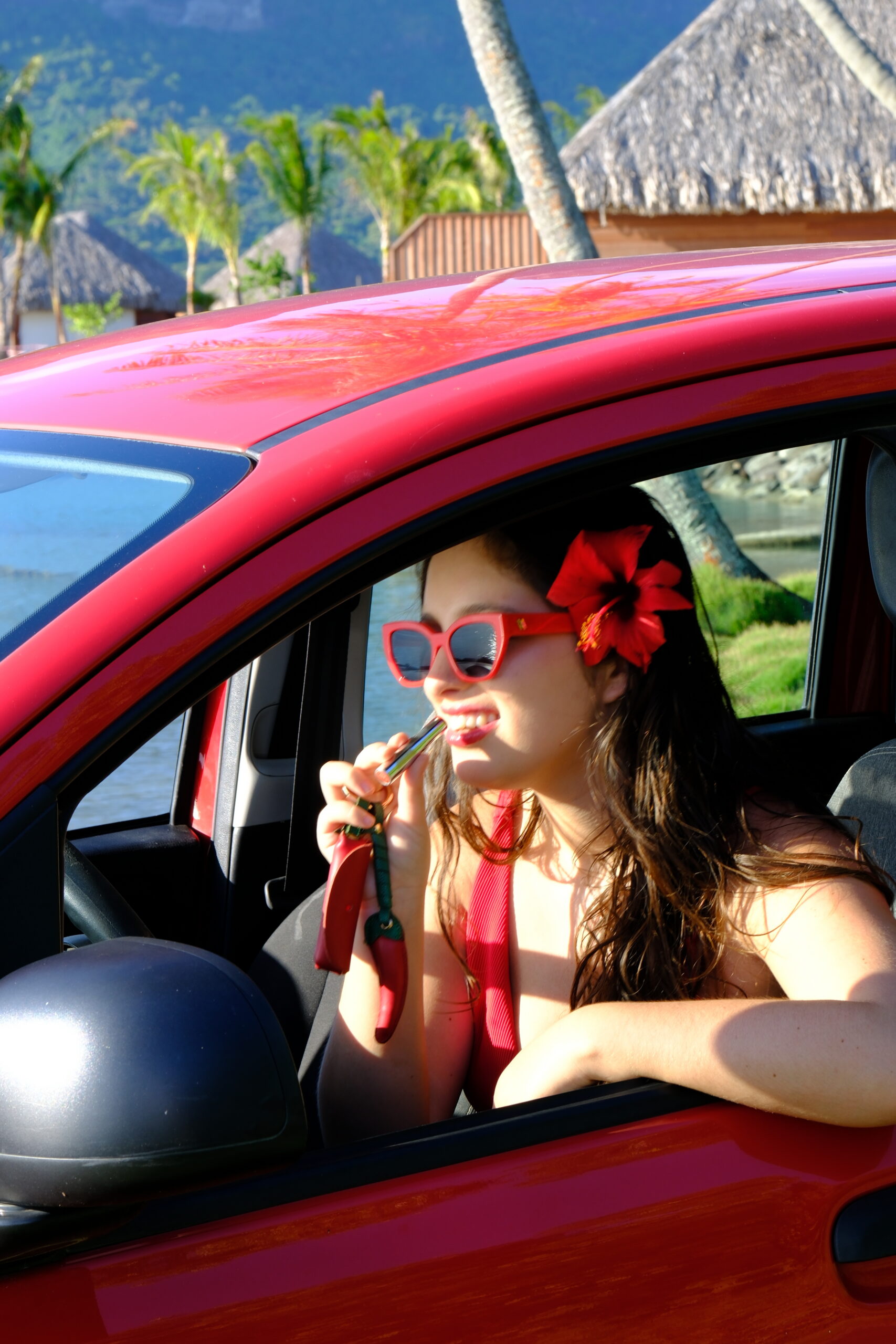
Avis Bora Bora: Our 60 Day Rental Experience and Review


The Edit: Avis Bora Bora rents cars, scooters, electric Fun Cars, and bikes from two offices on the island, one in Vaitape near the ferry dock and one near Matira Beach. We rented from the Vaitape office for 60 days using our own funds, starting with a one-day Dacia Duster SUV and switching to a manual Fiat Panda for the rest of our stay. This review covers what it actually costs, how the booking and insurance work, what the roads are like, and whether you should rent a car, a scooter, or skip it entirely.
At a Glance
| Detail | Information |
|---|---|
| Company | Avis Bora Bora (Bora Bora Rent A Car) |
| Offices | Vaitape (near the ferry dock) and Matira |
| Vehicles We Used | Dacia Duster SUV (1 day), Fiat Panda Economique (~50 days) |
| Booking Method | Phone reservation, then in-person walk-up extensions |
| Office Hours | Roughly 8 AM to 5 PM (call ahead to confirm lunch closures) |
| Insurance | Declined SCDW, used Chase Sapphire Reserve rental coverage |
| Fuel Policy | Full-to-full, attendant-pumped |
| Speed Limit | 60 km/h around the loop, lower in populated areas |
| Best For | Travelers staying 5+ days, families, multi-resort itineraries |

How We Ended Up With a 60-Day Avis Rental
Our Avis Bora Bora story does not start at a rental counter. It starts on a cargo pier north of Vaitape at six in the morning after a 13-hour overnight ferry from Tahiti, with a pile of luggage and a taxi that never showed up.
We had called for a pickup, but the dispatcher could not tell the difference between the cargo pier and the main passenger pier, so the driver waited at the wrong dock. After 15 minutes we gave up.
Alex walked the 1.9 miles into Vaitape to the Avis office while the rest of us stayed with the bags. He came back with a Dacia Duster SUV, and that turned into the beginning of a 60-day relationship with the only rental company we used on the island.
There are smaller mom-and-pop rental operators on Bora Bora too, and we noticed them as we drove around. After years of full-time travel, we have learned that smaller independent rental shops can get risky in ways the bigger names do not. Insurance disputes, vehicle condition, billing surprises, and the lack of a backup if something goes wrong. We stuck with Avis for our 60 days, and it was the right call.
That walk also told us something useful. The Avis Vaitape office sits in town, easy to reach from the ferry pier on foot if you arrive by water. For anyone considering the ferry route instead of flying, the rental car logistics are simpler than they sound.
The Avis Bora Bora Office in Vaitape
There are two Avis offices on Bora Bora, one in Vaitape near the ferry dock and one on the south end of the island near Matira Beach. We used the Vaitape office for every contract. The Matira office is convenient for travelers staying at south-end accommodations or arriving by airport shuttle on that side of the island.
The same staff rotate between both locations, so the woman who helped us in Vaitape works at Matira half the week. Whichever office you choose, you are dealing with the same company and the same fleet.
What the Vaitape Office Is Like
The office is clean and organized with a small Bora Bora-themed interior. The staff speaks Tahitian, French, and English. The woman who handled our contracts had excellent English with a French accent. We arrived during Chinese New Year and the place was decorated for it, which says something about the small-island mix of cultures you run into in French Polynesia.
The vibe is welcoming, which is worth mentioning because it stands in contrast to other tourist destinations we have visited where the locals are tired of the visitors. The staff here likes tourists.
They gave us restaurant recommendations, asked where we were staying, and turned out to know our Airbnb host. Bora Bora is small enough that everyone in the local rental, hospitality, and food industries knows everyone else.
Office Hours and Wait Times
Hours are roughly 8 AM to 5 PM. There may be a lunch closure, so call ahead if you are arriving in the middle of the day. The phone number is +689 40 67 70 15.
Wait times were not bad in our experience, but the office gets busy when cruise ships are in port or when ferries arrive. If you are walking off a ship or a ferry and heading straight to Avis, expect a line. We had no wait because we timed our visits around those windows.
The Cars We Rented
We rented two different vehicles across three contracts. The first was a Dacia Duster SUV for 24 hours. The next two contracts were back-to-back Economique rentals, both the same Fiat Panda, totaling roughly 50 days.

Day One: The Dacia Duster SUV
The SUV was not what we planned to rent. It was what Avis had available the day we arrived, and we had a pile of luggage from a long international transit. The Dacia Duster fit everything we needed to move from the ferry pier to our Airbnb on the main island, and that was the entire point.
Driving it was fine. It is a five-seat SUV with three suitcases of trunk space, a 5-speed manual transmission, and the kind of road presence that feels a little oversized for an island where every road is two lanes and every speed limit caps at 60 kilometers per hour.
We knew within a few hours that we did not need it for our actual stay. We brought it back at the 24-hour mark.
The Next 50 Days: A Manual Fiat Panda
We swapped down to the Economique class. The car we were assigned was a Fiat Panda with manual transmission. We drove it for about 50 days across two back-to-back contracts and had zero issues. No breakdowns, no service problems, no flat tires. Decent trunk space for a small compact. The air conditioning worked. It was easy to park, easy to maneuver, and small enough that the narrower side roads and tight gas station pumps were never a problem.
Bora Bora is roughly 20 miles around the entire loop. You do not need a big car. You need something that holds groceries from the Chin Lee in Vaitape, fits snorkel gear and beach bags, and gets you to a hike trailhead, a restaurant, or a resort dock. The Panda did all of that.
The Manual Transmission Money Saver
The Economique class at Avis Bora Bora is manual transmission only. The next tier up, the Auto class (currently a Renault Clio Hybride), is automatic and costs more per day at every duration tier. If you can drive a manual transmission, you keep the cheapest car class on the table.
This is true in most of the world outside the United States. Manual is the standard, automatic is the upgrade. Travelers who can only drive automatic get bumped up a class everywhere they go, in French Polynesia, Europe, Asia, Australia, and Latin America. Learning to drive a stick is a legitimate long-term travel money saver, not just a personal preference.
What Avis Bora Bora Costs
Avis publishes their full tariff card on their website. Rates are in XPF (French Polynesian francs). Roughly speaking, 100 XPF is just under one US dollar.
Here is the complete fleet and the short-term rates as of our trip:
| Class | Sample Car | Transmission | Seats | 4h | 8h | 24h |
|---|---|---|---|---|---|---|
| Economique | Fiat Panda | Manual | 4-5 | 9,500 | 10,800 | 11,900 |
| SUV | Dacia Duster | Manual | 5 | 11,500 | 12,800 | 13,900 |
| Auto | Renault Clio Hybride | Automatic | 5 | 11,500 | 12,800 | 13,900 |
| Familiale | Dacia Lodgy | Manual | 7 | 13,800 | 15,500 | 16,900 |
| SUV Premium | Toyota RAV4 Hybride | Automatic | 5 | 17,900 | 18,900 | 19,900 |
| SUV Cabriolet | Jeep Wrangler | Automatic | 4 | 21,900 | 22,900 | 24,900 |
| Scooter | Peugeot Tweet 50cc | Automatic | 2 | 5,500 | 6,200 | 6,800 |
| Fun Car (electric) | Tazzari Zero ELI | Automatic | 2 | 8,900 | 10,900 | 12,900 |
| Mini-moke (electric) | Kate E-Moke | Automatic | 4 | 12,900 | 14,900 | 15,900 |
| Bike | Standard vélo | n/a | 1 | 1,700 | 1,900 | 2,100 |
| E-bike | Vélo électrique | n/a | 1 | 3,400 | 4,000 | 4,200 |
All rates in XPF.

Long-Stay Rates
This is where it gets useful. Avis publishes long-stay tiers on each vehicle’s dedicated page, and the daily rate drops at every tier. For the Economique class, that looks like this:
| Duration | Rate per Day (XPF) |
|---|---|
| 2-3 days | 10,000 |
| 4-6 days | 8,500 |
| 7-10 days | 7,000 |
| 11-21 days | 5,500 |
| 22+ days | 4,500 |
If you are renting for a week or longer, ask in person about current rates for multi-week rentals. The website tiers are the published baseline, and the deal you can get for a long stay may be better.
What Is and Is Not Included
The base rate covers the car. Insurance, fuel package, second driver, and child seat are all optional add-ons. Avis offers a daily gas package called the essence forfait, an SCDW zero-deductible insurance, a Pack Liberté bundle, and child seats at roughly 1,500 XPF per day for the first two days.
Insurance, Franchise, and Why We Did Two Back-to-Back Contracts
We declined the SCDW zero-deductible insurance on every contract. Our Chase Sapphire Reserve credit card covers primary rental car insurance on international rentals, so adding the SCDW would have been paying twice for the same coverage.
If your credit card does not cover rental insurance abroad, the SCDW at Avis Bora Bora is 1,500 XPF per day for long-duration rentals on the Economique and Scooter classes, and 2,000 XPF per day on the E-Moke. Without it, the franchise (the deductible if you damage the car) is 200,000 XPF on the Economique and 250,000 XPF on the SUV and Auto classes.


Why We Did Two Contracts Instead of One Continuous Rental
This is the part most reviews skip. Premium travel credit cards like the Chase Sapphire Reserve cap their rental car coverage at 30 or 31 consecutive days. After that, you are uninsured even if the card normally covers you.
To stay covered for our full 60-day stay, we split the rental into two back-to-back contracts. We returned the Panda at the end of the first 30 days, signed a new contract on the same day, and drove off into the sunset in the same car. The credit card coverage resets, the rental is treated as a fresh agreement, and you stay protected the whole time.
This is the move for anyone doing a long-stay rental anywhere in the world. Check your card’s coverage cap, then plan your contracts around it. It does not cost more, it just requires showing up at the office at the right time.
Card Hold
Avis put a hold on our card at the start of the rental for the franchise amount. We believe the hold was for the full 30-day contract period, but we have not verified the exact amount or release timing. Plan for a meaningful authorization to sit on your card until the rental ends.
Fuel: What to Expect at the Pump
The fuel policy is full-to-full. The car comes with a full tank and you return it the same way. Easy. We never used the daily gas package because we were not putting on enough miles to make it worthwhile.
Pumping Gas in French Polynesia
Gas stations on Bora Bora are attendant-pumped. You do not get out and fill the car yourself. You pull up, tell the attendant either “full” or a specific amount in XPF, and they handle it. This is a small thing to know in advance because the default American instinct is to grab the pump handle and start.
There are three gas stations on the island. The one we used most often is the Mobil station in Vaitape, across from Chin Lee. It is in town, convenient to most accommodations, and easy to find.
What Fuel Costs
Fuel prices in French Polynesia are government-regulated. All stations charge the same legal rate, so there is no point shopping around. As of our stay, that was roughly 181 XPF per liter for unleaded, which works out to about $1.60 USD per liter or roughly $6 per US gallon.
That sounds expensive, but the math comes out fine in a small economy car. We drove the Panda daily for groceries, beach runs, hike trailheads, and restaurant visits, and a single tank lasted us two and a half to three weeks. Fuel was a meaningful but not painful line item across the full 60 days.
This is the trade-off across rental car destinations. In places like Mexico, the car is cheap and the gas is expensive. In Bora Bora, the car is more expensive and the gas is fixed at a regulated rate, but a small car burns so little that the math works out.
Driving Bora Bora: What the Roads Are Actually Like
There is one main road around Bora Bora. It loops the island, runs roughly 20 miles end to end, and connects every village, beach, dock, and trailhead worth visiting. That is the road you will drive.

The Main Loop
The main road is fully paved, two lanes wide the entire way around. It is not perfect. There are puddles after heavy rain and the occasional pothole, but the local crews fix things quickly and the surface is generally good.
There are no guardrails, which sounds alarming but is fine because there is also no real danger. The road hugs the lagoon side of the island and runs near sea level for most of its length.
Speed Limits and What to Watch For
The legal speed limit caps at 60 km/h around the loop, but it drops in populated areas. Around Matira, near schools, and in town it can be 30 or 40 km/h. You do not want to drive faster than the limits anyway.
The road is shared with foot traffic, scooters, bicycles, skateboards, and dogs, because there are no sidewalks. Walkers walk in the lane with you. Cyclists weave. Kids hang out on side roads, but you will see them step into the main road too.
The things to actively watch for are debris on the road, dogs on the road, and the unpredictable movement of pedestrians and cyclists. Drive calm, drive aware, and you will be fine.
Cruise Ship Days
This is real. When a large cruise ship anchors in the lagoon, the entire island fills up. Cars, scooters, bicycles, and electric Fun Cars are all on the road simultaneously. Traffic jams form. Matira Beach fills up. The Vaitape parking situation gets dire.
The Avis fleet itself is around 40 to 50 cars total. On a big cruise ship day, the line at the office can get long and availability can tighten. If you are planning a visit that overlaps with a cruise ship in port, book your rental ahead.
Side Roads and Tsunami Evacuation Routes
Off the main loop, conditions vary. Some side roads are paved concrete, others are not paved at all. The pattern we noticed is that tsunami evacuation routes are paved (the island uses them to move people uphill to safety), while regular neighborhood and access roads sometimes are not. Our Airbnb sat on a paved tsunami route, which made driving in and out easy. Trailhead access roads varied.
Night Driving
We did it. It is dark. Outside of Vaitape there are no streetlights, so the only light comes from your headlights. It is not unsafe, it is just darker than most American drivers are used to. Take it slower at night, especially in areas with foot traffic.

Parking Around the Island
Parking is where the small-car advantage shows up most. Across 60 days we parked at almost every spot worth visiting on the island, and the experience varied by location.
Vaitape
The town itself gets congested. Trying to park near Chin Lee during morning or afternoon rush is close to impossible. Our solution: park at the large sandlot near the ferry dock and walk into town. It is a short walk, almost always has space, and it skips the frustration entirely. This is the move locals and long-stay visitors use.
Matira Beach
Matira is the main public beach on the island, and on cruise ship days it is the place everyone wants to be. Get there early in the morning or arrive later in the afternoon to find parking. The middle of the day is the worst time.
Resort Docks
We parked overnight at several resort docks during day passes and overnight stays, including Le Moana for the IHG Thalasso shuttle, the Westin mainland dock, and the St. Regis base in Anau.
Each dock has a security or attendant gate. You tell them you are catching the shuttle for your stay or day pass, they direct you to a spot, and they handle the rest. At the St. Regis dock the attendant moved his own vehicle to make space for our rental. That was a small thing that we appreciated.
Hike Trailheads
We did several hikes on the island including Mount Mataihua, Mount Mata Pupu, Arete de Matira, and the Free Cannon Hike. Trailhead parking was easy at every one of them. The trick is to start early. If you are at the trailhead by 9 AM, you have the parking and most of the trail to yourself.
Restaurants
Parking varies. The Bora Bora Yacht Club has dedicated parking. La Villa Mahana does not have its own lot, so we parked across the street at a neighboring restaurant and walked over. The ferry pier lot was always packed on ferry days.
Should You Rent a Car, a Scooter, or Skip It Entirely?
This is the real question for most readers, and our answer depends on who you are and how long you are staying.

For Solo Travelers and Couples Traveling Light
Rent a scooter. The Peugeot Tweet 50cc costs roughly half of what a car costs at every duration tier, parking is never an issue, and Bora Bora’s 60 km/h max speed limit means you are not losing any practical travel time. A scooter handles two people, a backpack, snorkel gear, and a beach day with no problem. The trade-offs are real.
You will be exposed when it rains, and tropical rain in Bora Bora hits hard and fast. You will not be able to haul groceries for a family. But for a five to seven day stay where you are mostly traveling between your accommodation, the beach, restaurants, and a couple of hike trailheads, the scooter is the smarter math.
For Families, Multi-Person Groups, and Anyone With Real Luggage
Rent a car. The Economique class is plenty of vehicle for a small island. If you are traveling with kids, beach gear, snorkel equipment, and groceries, the Fiat Panda will fit it all. The Familiale (Dacia Lodgy) seats seven if you are with extended family.
For Travelers Staying 5-7 Days With Resort Day Passes Planned
Rent the car for your whole stay. The math is simple. A taxi from Vaitape to the St. Regis mainland dock at Anau typically runs around $40 USD round trip when you pre-arrange a driver who waits for the return pickup, or closer to $80 USD round trip if you take two separate taxis.
Two day passes at different resort docks and you have already covered the cost of a rental car for several days. You also gain the flexibility to drive to dinner, drive to a hike, and stop at the grocery store between, which is hard to coordinate on taxi time.
Our Recommended Bora Bora Taxi Driver: If you do end up needing a taxi for an airport run, a resort dock transfer, or a one-off ride, our personal recommendation is Danny. He is a reliable, English-speaking taxi driver based in Vaitape, and he is the driver we used for Addison’s St. Regis day pass pickup and return.
He showed up on time both ways and the $40 USD round trip rate held when we arranged the return pickup in advance. His phone number is +689 87 71 79 11, and he told us directly we could share his number with our readers. Pre-arranging the round trip is how you lock in the lower rate instead of paying for two separate one-way cabs.
In a single day with a rental car you can do the Bora Bora manta ray cleaning station, hang out at Matira Beach, hike one of the shorter trails, and have dinner at the Bora Bora Yacht Club or another sit-down restaurant. That kind of itinerary density only works with your own transportation.
For Travelers on a Resort-Only Stay
You can probably skip the rental. If you flew in, taxied to your boat transfer, and plan to stay inside the resort for your whole trip with maybe one structured excursion, you do not need a car. The resort shuttles, lagoon tours, and pre-arranged transport handle everything.
Booking Your Avis Bora Bora Rental
Avis Bora Bora takes phone reservations, walk-up rentals, and online inquiries. The website is avis-borabora.com. The Vaitape office phone is +689 40 67 70 15. Email is contact@avis-borabora.com.
Our experience: we called from the ferry to make our initial reservation, walked into the office to handle the contract and the car keys, and arranged our long-term extensions in person. The whole process is easy. They take cash CFP, US dollars, Euros, Visa, Mastercard, and Amex.
For peak season visits, cruise ship days, and any rental during major French Polynesian holidays, book ahead. The fleet is finite and demand spikes are real.

FAQ
There are two locations. The Vaitape office is in town near the ferry dock, and the Matira office is on the south end of the island near Matira Beach. Both offices share the same fleet and the same staff rotates between them through the week.
It depends on what language your driver’s license is issued in. Avis Bora Bora accepts a valid driver’s license from your home country if it is issued in English or French, or if you are a French Polynesian local.
If your license is issued in any other language, you will need an International Driver’s Permit (IDP) to rent a car on the island. American and Canadian licenses are in English, so most travelers from those countries are covered. If you are coming from a country where your license is in any other language, we walk through exactly how to get your International Driver’s Permit through AAA in our step-by-step guide to getting an AAA International Driver’s License.
Avis accepts cash CFP, US dollars, Euros, and major credit cards including Visa, Mastercard, and Amex. A credit card is the easiest path because of the franchise hold, but other payment methods are available.
The roads are safe. The speed limit caps at 60 km/h, the main road is paved and two lanes the whole way around the island, and traffic is slow by Western standards. The things to watch for are pedestrians and cyclists sharing the road, dogs, and debris.
If your credit card covers international rental insurance, you can decline SCDW and save the daily cost. Premium travel credit cards like the Chase Sapphire Reserve cover rental insurance abroad, but they cap the coverage at around 30 to 31 consecutive days. For longer rentals, split into back-to-back contracts to keep coverage active.
The franchise (deductible) is 200,000 XPF on Economique class, 250,000 XPF on SUV and Auto class, and 350,000 XPF on the SUV Cabriolet. SCDW reduces the franchise to zero. Avis puts a hold on your credit card for the franchise amount at the start of the rental.
Fuel is government-regulated in French Polynesia. Expect to pay around 181 XPF per liter (roughly $1.60 USD per liter, or about $6 per US gallon) for unleaded. All stations charge the same rate.
For solo travelers and couples without much gear, yes. Scooters cost roughly half what cars cost at every tier, parking is easier, and the island’s 60 km/h max speed limit means you do not lose any time. For families, anyone with real luggage, or travelers planning resort day passes, a car makes more sense.
The airport sits on its own motu (Motu Mute) and is only accessible by boat. You cannot drive there. Avis Bora Bora rentals are for use on the main island only.
Yes. We left our car at several resort docks during overnight stays and day passes. Tell the dock attendant or security what you are doing, and they will direct you to parking.
Is Renting From Avis Bora Bora Worth It?
For us, yes. We rented for 60 days, drove an SUV and a Fiat Panda, never had a mechanical issue, used the car at every resort dock and hike trailhead on the island, and never felt overcharged for what we got. The staff was friendly, the office is well-run, and the long-stay tiered pricing made an extended rental work for our budget.
Would we book Avis Bora Bora again? Yes, same office, same vehicle class. The only thing we would change is trying a different vehicle for fun on a short window. Something open-air like the Kate E-Moke or the Fun Car ELI would have been a nice “vacation car” experience for a day or two on top of the practical economy car for the long haul.
For a one-time visitor staying five to seven days, our recommendation is to rent for the whole stay. The math on taxis adds up faster than people expect, and the flexibility of having your own car to drive to hikes, restaurants, and resort docks is the difference between seeing Bora Bora and actually experiencing it.


Curated by us, for you. We may earn a commission on pieces you shop through our links


The Vanity Case
Shop the edit
Just Landed
Shop the edit
Finishing Touches
Shop the edit
Leave a Reply


style
Farm Rio Souvenir Scarves Dress Review: Midsize Sizing, Fit & Vacation Styling testing
style
Vacation Look No. 3 | Farm Rio Golden Nature Maxi Dress Outfit


Have a brand story to tell? We'd love to hear what you have in mind.
And everywhere in between
Bora Bora to Baja


Be the first to comment