
Snorkel Gear That’s Actually Worth Buying (From 6 Years of Full Time Travel)


The Edit: After six years of full-time travel and snorkeling across ten ocean ecosystems on three continents, here is the gear our family actually owns, has replaced (and what we replaced), and would buy again. Four adult tiers from honeymoon casual to freediving serious, plus a fully aesthetic monochrome tier. Three kids’ tiers organized by age. Plus the honest case for why you should buy your own snorkel gear before you fly (hygiene, money, time, and the kids), and why we no longer use full-face snorkel masks. Every recommendation in Tiers 1 through 3 is gear we own. Tier 4 is curated research for the all-black or all-white aesthetic build. Skip to the bundle that matches how you snorkel.
Snorkel Gear at a Glance
| Category | Details |
|---|---|
| Best Mask + Snorkel for Casual / Aesthetic Snorkelers | TUSA Freedom Tri-Quest + TUSA Platina II Hyperdry (Flash Yellow or pastels) |
| Best Mask + Snorkel for Serious Snorkelers / Freedivers | Cressi Z2 with UV420 + XS Scuba J-tube |
| Best Fins for Travel | Rob Allen Scorpia Evo (closed-heel) or TUSA Sport adjustable (open-heel) |
| Best Kid’s Starter Kit (Ages 4-7) | Sunnylife pastel kit (mask + snorkel + fins, ~$30) |
| Best Kid’s Mid-Tier Kit (Ages 7-10) | U.S. Divers (Costco, Target, REI) or TUSA Sport kid sizes |
| Best Kid’s Performance Kit (Ages 10+) | Aqua Lung purple and white (legacy dive brand quality) |
| Best Aesthetic All-Black Build | TUSA Zensee or Sport UM-29 + TUSA Sport Freediving snorkel + TUSA Xentra fins |
| Best Aesthetic All-White Build | TUSA Zensee QW or Sport Lapis + TUSA Lapis snorkel + TUSA Sport Freediving modular |
| Carry-On Friendly | Yes — mask, snorkel, booties, band cover all fit. Travel fins fit. Long freedive fins go in checked. |
| Markup at Destination | 35-45% in remote islands (French Polynesia, much of the Caribbean). Mexico depends on where you buy — tourist beach shops mark up, but Walmart and Soriana are close to US prices |
| Avoid | Full-face snorkel masks (linked to multiple Hawaii fatalities since 2018) |
| Where This Gear Has Been Tested | French Polynesia, Okinawa, Australia, Hawaii, Southern California, Mexico/Baja, the Bahamas, Honduras, Belize, Brazil, Fiji, New Caledonia, American Samoa |

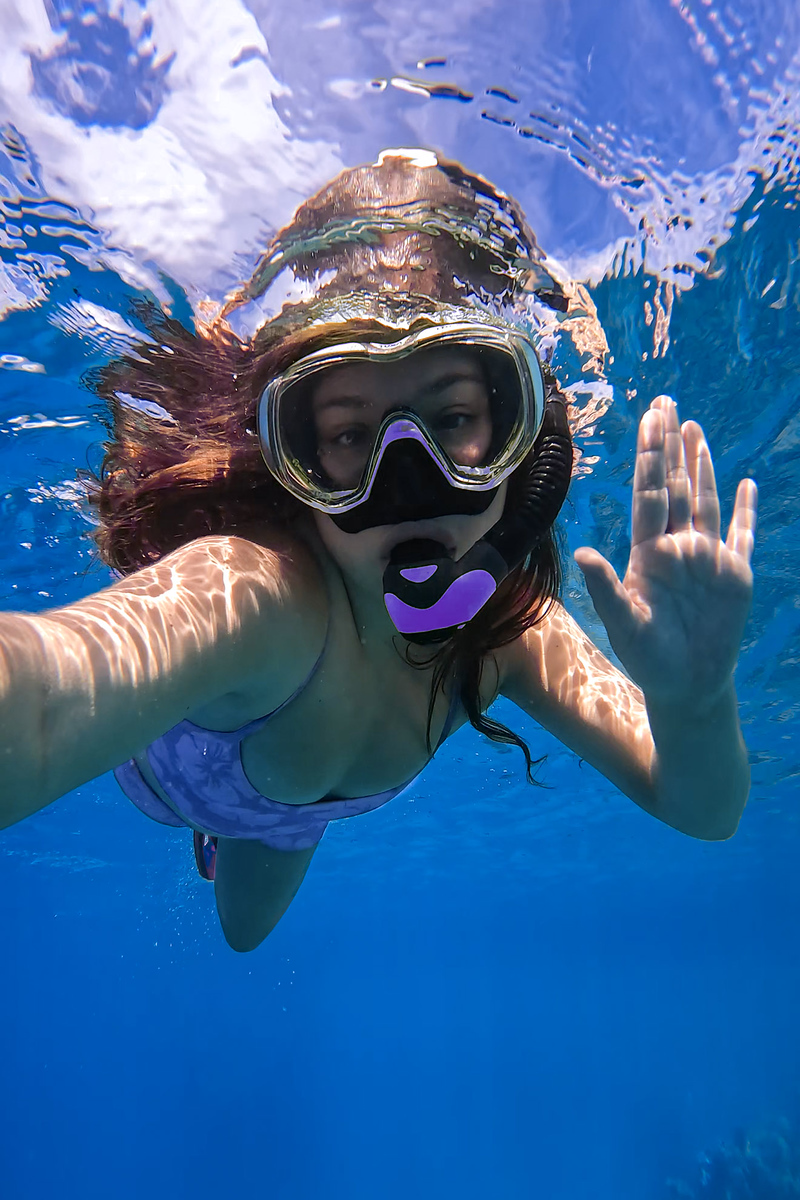
Photo by @Zoeeetai during Ocean Spirit Sail to Michaelmas Cay Tour
I have been traveling with snorkel gear since 2020. Pacific Northwest, Catalina Island and the Santa Barbara kelp forests off the California coast, the Sea of Cortez and Baja California where our sailboat lives, Okinawa Japan, the Great Barrier Reef in Australia, Fiji, New Caledonia, Hawaii, and two trips through French Polynesia.
I am writing this from Pāʻea, a quiet town on the west coast of Tahiti, with a brand new mask on the drying rack and the same fins I have been using for six years in the bag next to it. Yesterday I had an eagle ray pass within arm’s reach of me on a reef swim. This morning we snorkeled a pearl farm on Tahiti Iti with the exact gear in this post.
That is the trip we’re on right now. While we’re here in French Polynesia, I’m in the water about six to ten hours a week with my gear on, actively looking for creatures. We spent an entire week in Bora Bora at a secret manta ray cleaning station most tourists drive right past, watching the rays loop the reef wall. We’ve found big spider conch shells you can hold in two hands.
Black tip reef sharks. More hawksbill turtles than I can count. None of that happens on a one-hour tour with rented gear. It happens because we own our setup, we know how to use it, and we get in the water as often as we can.
What I’ve learned in all that time is pretty simple. Most snorkel gear is not built for travel. It is built for pool afternoons and one-week beach vacations. When you actually live out of a bag and snorkel three or four days a week for months at a time, a lot of the gear that looks great on the shelf falls apart fast.
What I am going to do in this post is tell you exactly what gear has worked for our family of four for six years, which brands are worth the money, which ones will get you cute photos but die in a year, and what to actually buy based on how you snorkel.
Every single piece of gear in this post is something we own. Most of it came from Blue Water Hunter, a real dive shop in Santa Barbara that has been outfitting divers since 1964 and where I will always send people who want expert help in person. Nothing here is sponsored. The links are affiliate links, which means if you buy through them we make a small commission at no extra cost to you. That is how we keep writing posts like this one for free.
Let’s get into it.


Where This Gear Has Actually Been Tested
Before we get into the kits, here’s the part that matters. The gear in this post has been used by our family across ten distinct ocean ecosystems on three continents. That’s not a brag. That’s the reason this post exists.
Most snorkel gear advice on the internet is written by people who have snorkeled in two places. The recommendations here come from a family that has actually put this kit through six years of saltwater, sand, sun, and travel.
French Polynesia. Bora Bora, Moorea, Tahiti, and Tahiti Iti. We’ve spent months here across two trips. Detailed snorkel-spot guides for each: Best Snorkeling Spots in Bora Bora, Best Snorkeling Spots on Moorea for Families, and Best Tahiti Snorkeling Spots for Families. One of our most memorable days was the Keishi Lagoon Tour in Bora Bora, where we snorkeled with blacktip reef sharks and rays on a private boat tour run by a local family.
Okinawa, Japan. We lived in Okinawa for three months and snorkeled almost weekly. The full breakdown of everything we did is in our Best Things to Do in Okinawa With Your Family guide. Two of our favorite snorkel spots specifically: Minna Island, the small crescent-shaped island a short ferry from Toguchi Port with some of the clearest water we’ve ever been in, and Yoron Island, a tiny gem in Kagoshima Prefecture where we swam with sea turtles on a half-day snorkel tour and found star-shaped sand at Yurigahama Beach.
Australia. The Great Barrier Reef. Cairns. Coral that’s bigger than your car, fish in colors that don’t look real on land, and water clarity that gets called overrated until you’re in it.
Hawaii. Multiple islands across multiple visits, with Oahu being our most recurring stop. Hanauma Bay’s protected marine preserve, Shark’s Cove on the North Shore in summer when the tide pools turn into a snorkel paradise, and Laniakea Beach where Hawaiian green sea turtles haul out onto the sand are all in our Best Things to Do in Oahu Hawaii guide. We’re heading back to Oahu in a few weeks for a one-year base.
Southern California. Catalina Island during our sail trip down the Pacific coast of America, plus the kelp forests off Santa Barbara at One Thousand Steps Beach just west of the harbor. The same Santa Barbara waters where we picked up most of our gear from Blue Water Hunter in the first place. Cold water, thick kelp, completely different fish than the tropics, and one of the most underrated snorkel zones in the country.
Mexico and Baja California. Our sailboat is stored in Baja and we’ve snorkeled the Sea of Cortez extensively. La Paz, Cabo, Todos Santos, and across to the Pacific side. We’ve covered our favorite snorkel-friendly Baja spots including Playa El Saltito’s sunken boat reef and Playa El Tesoro’s sea turtles in our 13 Best Beaches in La Paz Mexico guide, and the Whale Sharks in La Paz experience is its own post if you’re booking that bucket-list snorkel. The Yucatán too — the Mesoamerican Barrier Reef sits unusually close to shore in Puerto Morelos, Cozumel for the famous “El Cielo” starfish snorkel, plus the cenotes for something completely different.
The Bahamas, Honduras, Belize, Brazil, Fiji, New Caledonia, American Samoa. Reef and lagoon snorkels across all of them on various trips, including a full transpacific Disney Cruise that hit several of those.
This is the gear that survived all of it. The same TUSA mask, the same Sunnylife fins on Audrey, the same mesh-bottomed bag, the same band cover. Six years. Ten ecosystems. Three continents. From California kelp forests to Tahitian lagoons. And a lot of it is what we’re still using right now in Tahiti.

Build Your Adult Snorkel Setup
Here’s the thing nobody tells you when you go to buy snorkel gear. The right setup for you depends entirely on how you plan to use it. A kit that’s perfect for an overwater bungalow honeymoon in Bora Bora is the wrong kit for someone who wants to spearfish off a boat in Hawaii. And both of those are different from what you’d pack for a one-week cruise where you’ll snorkel twice.
So instead of giving you one “best of” list, I’m breaking adult gear into four setups. Three I actually use day to day. One is a curated aesthetic tier I built for readers who want the monochrome look, because nobody else writing about snorkel gear is helping people find it. Pick the one that matches how you snorkel, click the bundle, and you’re done.


Tier 1: If You Want Gear That Looks Great in Photos and Does the Job (Amanda’s Setup)
This is the tier for honeymooners, overwater bungalow bookers, casual lagoon snorkelers, content creators, and anyone who cares how their gear looks in the vacation photos. That is a legitimate thing to care about. Most snorkel gear is designed for dive shops, not for the camera roll from your Bora Bora trip, and there is no reason to swim around in neon yellow plastic if you don’t have to.
The Mask: TUSA Freedom Tri-Quest
Amanda has been using a TUSA Freedom Tri-Quest mask since 2020. Six years. Same mask. It is the kit she had on at Rohotu Public Beach the day we found a massive Spider Conch shell moving along the coral right offshore (that whole afternoon and a stack of other family-friendly Tahiti spots are in our Top Family Favorite Things to Do in Tahiti guide).
It’s technically a scuba-grade mask with a single large front lens plus two domed windows on the sides, which gives you 1.6 times the field of view of a standard mask. What that actually means in the water is you stop feeling like you’re looking through a porthole. Your peripheral vision is just there. When a stingray glides past your hip, you see it without turning your head. The glass is TUSA’s CrystalView, which transmits more light than standard glass, so colors look richer underwater.
The Snorkel: TUSA Platina II Hyperdry
She pairs it with the TUSA Platina II Hyperdry snorkel, which is TUSA’s premier semi-dry snorkel. The Hyperdry System uses three current rectifying plates to deflect splashes out through a separate escape pipe before they ever hit your mouth, so you get most of the benefit of a dry-top snorkel without the bulky mechanism.
Amanda runs the Flash Yellow version of both pieces so her mask and snorkel match. That is the kind of detail she notices, and honestly so do I now. Both the Tri-Quest and the Platina II also come in soft pastels including pink, translucent, and light blue if that is more your palette.

The Fins Question & Why Amanda Skips Them
Here is the part that surprised me about her setup. She does not use fins. For most lagoon snorkeling, calm reef swims, and the kind of shallow-water content people actually do in French Polynesia and the Caribbean, she goes in with just the mask and snorkel. When we do deeper water, she borrows a pair from the rest of us.
That is a real choice a lot of Tier 1 snorkelers will relate to. If you are floating over a house reef in two meters of water taking photos of the coral, you genuinely do not need fins, and skipping them means less gear to pack and less gear to rinse at the end of the day.
If you do want fins for when you go deeper, the TUSA Sport adult travel kit bundles fins together with a mask and snorkel for under $100, which is honestly a smart buy if you don’t already own the rest. The fins fit most adult sizes, the kit comes with a mesh-bottomed bag, and the whole thing packs flat in a carry-on.
Get Amanda’s setup: Tier 1 Mask + Snorkel


Tier 2: If You Want Gear That’ll Last 5+ Years of Real Travel
This is the tier for the person who snorkels more than once a year. Cruise regulars, dive-curious travelers, families who vacation in coastal places, anyone who doesn’t want to buy new gear every time they lose a fin strap on a beach. The priorities here are durability, travel packability, and enough performance that a longer or deeper snorkel doesn’t leave you gassed.
Amanda’s mask and snorkel from Tier 1 both work for this tier too. The TUSA Tri-Quest mask has survived six years of full-time travel, which is more than most people will ever put a mask through, and the Platina II Hyperdry snorkel is genuinely a serious piece of gear.
What changes at this tier is that you probably want your own fins instead of borrowing, plus a real mesh-bottomed bag to carry it all. Here’s how to think about it. If you’re buying a complete set, the TUSA Sport adult travel kit bundles a mask, snorkel, fins, and a mesh-bottomed gear bag together for under $100, and it’s the cleanest one-stop option at this tier.
If you’ve already bought Amanda’s Tier 1 mask and snorkel separately and just need the bag (which is genuinely the most underrated piece of gear we own), pick up a standalone TUSA mesh gear backpack or a Cressi mesh bag. Both drain water and sand straight through the bottom as you walk back to the car. No more soggy suitcases, no more sandy backseat, no more gear that smells like low tide by day three. If your current bag doesn’t have a mesh bottom, replace it.
For fins specifically, if you want a step up beyond what comes in the TUSA Sport kit (more propulsion for longer snorkels), look at mid-range open-heel travel fins from a serious dive brand. They’ll cost more standalone, but they’ll move you faster and last for years.
Get the Tier 2 full kit: Tier 2 Snorkel Bundle

Tier 3: If You’re Getting Serious About Snorkeling or Freediving (My Setup)
This is the tier for the person who has done enough snorkeling to know they want more out of it. You’re spending an hour or two in the water per session. You’re starting to dive down to look at things. Maybe you’re thinking about freediving classes or spearfishing. The gear at this tier is built for performance, which means lower-volume masks, simpler snorkels that don’t drag, and fins that actually move you through water.
The Mask: Cressi Z2 with UV420 Lenses
I currently dive with a Cressi Z2 mask with UV420 lenses, which I picked up here in Tahiti after my previous mask cracked mid-trip. Frameless, low-volume, mono lens, designed for freediving and spearfishing. The UV lens is the part most people don’t know they need. In bright tropical water the sun coming off white sand is punishing, and a UV420 lens blocks about 95 percent of it without making things dark underwater.
Colors actually look warmer and more saturated, which is what those lagoons look like to the naked eye anyway. I paid 9,620 CFP (about $94 USD) for it here in Tahiti but it runs closer to $60 in the US, so buy it before you fly out if you can. This is the mask I had on for the eagle ray sighting yesterday and the pearl farm snorkel this morning, and it’s the same one I’ve been using for the long sessions in spots covered in our Tahiti snorkeling guide and the Moorea snorkeling guide.

The Snorkel: XS Scuba J-Tube
For a snorkel I use a XS Scuba Flo Snorkel. Old-school J-shape, no purge valve, no dry top. Dry tops have their place, but for freediving and long snorkels a basic J-tube packs flatter, drains faster, and has no plastic parts to break in a carry-on.
The Fins: Rob Allen Scorpia Evo + 3mm Dive Socks
For snorkel fins I use Rob Allen Scorpia Evo plastic fins. Rob Allen is a South African freediving and spearfishing brand. The Scorpia fins are shorter than full carbon freediving fins, so they actually fit in the duffel bag we travel with, but they still move water like a serious fin.
They’re closed-heel fins, which means you slide your whole foot into a molded pocket like a moccasin. Non-adjustable, sized to your feet. I wear 3mm Argos dive socks under them, which protect my feet from the fin pocket, keep me warm on longer sessions, and let me walk across coral rubble at the entry point without shredding my soles.
Argos is a freediving and spearfishing brand that pairs well with the Rob Allen fins, but if you want easier-to-find alternates, both TUSA dive socks and Cressi dive socks do the exact same job. Pick whichever runs your size.
The Underrated Comfort Add-On: Neoprene Mask Band Cover
One more thing I recommend for anyone at this tier, regardless of hair length. A neoprene mask band cover. It slides over your mask strap and makes the whole thing more comfortable, especially when you’re spending multiple hours or multiple days in the water. Mine is a SEAC, which I picked up at a dive shop years ago. I had long hair when I first bought it and it saved me from getting my hair yanked out every time I pulled the mask up.
I have short hair now and it still lives on my mask, because the comfort of not having a bare rubber strap pressing into the back of your head session after session is worth the $10 price tag on its own. It’s one of those pieces of gear that solves a problem nobody’s dive shop ad ever mentions. SEAC versions are tougher to find online, so the two I’d send you to instead are the TUSA mask band cover or the Cressi mask band cover. Both do the exact same job, both are from the same legacy dive brands as the rest of the gear in this post, and both run around the same price.
Where This Kit Has Earned Its Keep
This is also the gear that’s earned its keep on this trip. Six to ten hours a week in the water, week after week. The eagle ray yesterday was on a long sunset reef swim where I was already an hour deep when it appeared.
The pearl farm snorkel this morning on Tahiti Iti was the kind of session you can only do if you have your own gear ready to go and the freedom to drive to a remote spot. The manta ray cleaning station on the north end of Bora Bora where we spent a week swimming with rays at the reef wall. Black tip reef sharks. Hawksbill turtles by the dozen. This is the kit that’s seen all of it.
Get my full kit: Tier 3 Snorkel Bundle
Cressi Z2 mask with UV420 lenses
XS Scuba Flo Snorkel
Rob Allen Scorpia Eco plastic fins
3mm Argos dive socks
Cressi mask band cover

Tier 4: If You Want the Coordinated, Monochrome Aesthetic
This is the tier for readers who want their snorkel gear to actually match in photos. Clean. Minimal. Monochrome. All white or all black. The look you see in editorial travel content and high-end overwater bungalow Reels. It is a new tier, honestly. Five years ago you could not really build this look without mismatched gear from three brands. Now you can.
Quick note before we get into the picks. Everything I’m recommending in this tier is curated based on brand research and what I would buy myself if I were building the monochrome look from scratch today. Unlike Tiers 1 through 3, this is not all gear my family has personally owned for years.
I am telling you that up front because you deserve to know which recommendations come from lived experience and which come from careful research. The product pairings here are solid, the brands are legitimate, and the aesthetic logic holds up. Just know the difference.
The Three Brands Worth Knowing
Three brands are doing the aesthetic snorkel game well. TUSA (Japanese, founded 1952) and Cressi (Italian, founded 1946) both come from serious diving heritage and offer premium masks, snorkels, and fins in clean monochrome options. An Australian brand called DiveR rounds out the lineup with handmade carbon fiber fins for readers who want the premium build.
What separates TUSA is the breadth of monochrome options for masks and fins, in either black or white. The cleanest hero kits combine TUSA’s mask and fins with a Cressi Corsica snorkel, since the Corsica comes in matching black or white and slots in seamlessly with the rest.
Cressi makes beautiful masks and snorkels in the aesthetic range, especially the Z2 and Corsica lines. Their Gara Modular fins ship with white blades and a black or grey foot pocket, a deliberate two-tone palette that actually pairs cleanly with a white face piece for a coordinated build (more on that in the Alternate Kit below). DiveR sits at the premium end with the only true all-white fins on the market.
Worth noting on warranty: TUSA covers their gear for three years, Cressi for two. Both are solid, and the extra year on TUSA is something to factor into a full-kit buying decision.


The Hero Kit: All-Black or All-White (around $300-400)
This is the core monochrome kit, and the good news is every piece comes in both colors so you can build it whichever direction matches your aesthetic. The links below are the same listings for both colors, so just pick black or white when you add to your cart.
For the mask, start with either the TUSA Zensee mask (premium scuba-grade frameless mask with CrystalView tempered glass) or the TUSA Sport UM-29 freediving mask if you want a purpose-built freediving mask at an accessible price. Pair either mask with the Cressi Corsica snorkel, a low-profile J-tube style snorkel that holds the monochrome aesthetic clean.
For fins, you have two options depending on how serious you plan to get. The TUSA Sport Freediving modular system gives you adjustable foot pockets and long blades, which is the beginner-friendly on-ramp to real freediving gear. Or the TUSA SF-0111 Hyflex Zoom Scuba Diving Fins, which is the more affordable all-in-one option.
All-black is the spearfishing and serious freediving aesthetic. All-white is the editorial honeymoon and overwater bungalow look, with the bonus that it’s something almost nobody else in the lagoon will be wearing. Either way, you end up with a clean monochrome setup with a TUSA mask and fins (covered by their three-year warranty) and a Cressi Corsica snorkel rounding out the kit.
Alternate Kit: The Premium Mixed-Brand Build (around $400-500)
If you want to mix brands either for the face piece or the fins, this is the kit. The face piece I’d recommend is the TUSA Paragon mask in white, which is TUSA’s premium scuba-grade mask with their CrystalView Optical UV-filtering lens. It’s beautifully made, photographs cleanly, and I’ve actually used the Paragon myself, so this isn’t research-only. It also comes in black if you’d rather build a darker version.
Pair it with the Cressi Corsica snorkel (in white or black). For fins, you have two paths.
The accessible Cressi path: the Cressi Gara Modular fins come with white blades and a black or grey foot pocket as the only color combination. That mixed palette is intentional from Cressi, and it actually pairs cleanly with the white Paragon and white Corsica for a coordinated build that doesn’t push you into the premium tier.
The premium DiveR path: their white foot pockets paired with Clear blades or Stealth Black blades give you a fully custom freediving setup with real handmade Australian carbon fiber. This is the high-end pick, and the price reflects it, but it’s a legitimate carbon fiber fin setup that will outlast almost any other gear choice in this post.
The Middle Path: White Face, Black Fins (around $300-400)
If committing to one color feels too precious, pair the Cressi Z2S in white plus the Cressi Corsica snorkel in white with the TUSA Xentra full-foot fins in black. You get the photogenic face piece without the premium price of a full all-white setup. Probably the smart pick for most people who want the aesthetic look without the full committal.
Shop the aesthetic tier: Tier 4 Bundle


Why It’s Worth Buying Your Own Snorkel Gear (Even For a Cruise or One-Week Trip)
Amanda is jumping in here because this part needs to come from her. After six years of full-time travel and snorkel tours in Brazil, Belize, Honduras, the Bahamas, Mexico, Moorea, and now Tahiti for the second time, she has a perspective on borrowed and rented snorkel gear that nobody on a cruise dock or tour boat is going to share with you. So here it is, from her.

The Hygiene Reality No One Talks About
Let’s start with the part most travel content politely skips. When you rent or borrow snorkel gear from a tour company, a cruise line, or a hotel water sports desk, that mask and snorkel have been in dozens of mouths and on dozens of faces before yours.
The mouthpiece. The mask skirt. The strap. Yes, most companies rinse the gear between uses. Some spray it with a sanitizer. Some don’t really do anything more than dunk it back in a bucket of seawater because, hey, it was just in the ocean, right?
That is honestly gross. The tube alone gets me grossed out, but the mask is worse, because the silicone skirt sits against your face and is collecting other people’s snot, sweat, sunscreen, makeup, and skin oils. The mouthpiece is biting into a piece of silicone that’s been in someone else’s mouth a couple of hours ago. The fins, you can pick up athlete’s foot from.
So when you weigh that against a $25 to $50 mask and snorkel set you bring with you in your carry-on, the math is honestly pretty simple. You can pay for the $25 mask and not have to deal with the gift that keeps on giving (aka the herps, in case anyone is unclear). Or you can hope the tour company actually sanitized properly. Your call.

The Flexibility Argument
Owning your gear is what unlocks the trip you actually want. The first time we came to French Polynesia in 2023, I packed our entire family’s snorkel gear into my carry-on. Mask, snorkel, fins for the kids, the whole deal. It freed us up completely.
A vacation rental started to make more sense than a resort with a water sports desk. Renting a car meant we could chase whatever beach looked good that day instead of booking tour after tour just to get in the water.
If a quiet beach looked good on the drive, we just stopped, parked, walked down with our gear, and got in. Try doing that with rental gear that has to come back to the marina by 4pm.
The other piece of this is destination markup. If you wait to buy snorkel gear once you’re in Bora Bora or Tahiti, you’re going to pay 35 to 45 percent more than you would in the US. The exact same Cressi mask that’s $60 on Amazon is around $90 here in Tahiti. That number tracks across most remote island destinations including a lot of the Caribbean.
Mexico is the exception worth knowing about. If you grab snorkel gear at a beach shop in Cabo or Cancun you’ll see 20 to 30 percent over US prices, but if you go to a Walmart, Soriana, or Mega in any decent-sized Mexican city, gear is close to US Amazon prices. Multiply the remote-island number by a family of four though and the trip math gets ugly fast.
The Time-Saver Argument
This one is huge if you’ve never thought about it. Your own gear is already adjusted to your face. The mask strap is set. The fins are sized to your feet. The snorkel is defogged the way you like it. When the boat anchors at the snorkel spot, you put your gear on and you are in the water in 30 seconds.
Meanwhile, the rest of the tour group is 20 to 30 minutes into a fitting and adjusting circus, leaks and complaints and “these fins don’t fit,” and by the time they’re in the water you’ve already seen the eagle ray, the reef shark, and the school of trumpetfish that came through. On a one or two-hour snorkel tour, that 20 to 30 minutes is real water time. Don’t waste it on logistics.

The Mom-Specific Argument
This one is for the moms reading this. Tour companies and cruise water sports desks often don’t carry kid-sized masks or fins. An adult mask doesn’t seal on a small face. A kid in a leaky mask is a kid who’s not snorkeling.
And here’s the part nobody writes about: a kid who can’t snorkel is a mom who doesn’t get to snorkel either. Most of the time the dad is off doing his own thing, and the mom is the one onshore with the kid who got left out.
So if you bring your own kid kit, your kid joins, you join, and the whole family is actually in the water together. Audrey’s first kit was a Sunnylife pastel set we bought when she was five. It was 25 dollars.
The snorkel kit came with a mask, snorkel, and adjustable fins. It traveled with us for years. The fins and the mesh-bottomed bag from that original kit are STILL in rotation six years later (the plastic mask lenses fail eventually, but that’s a separate story).
Quick Mom Hack: You can practice with your kid in the bathtub before you fly. Fill the tub, have them put their face in the water and breathe through the snorkel. If they figure it out at home, you don’t lose the first hour of your Bora Bora trip teaching them how to snorkel.
The Comfort Argument
Rental fins cause blisters. Ill-fitting masks leak salt water into your eyes the entire session. Both of those things will end your snorkel time fast and ruin a good chunk of the trip you paid thousands of dollars for. Your own gear fits you. That alone is worth the cost.
Even On a Tour, Your Own Gear Is Better
Let’s say you’ve already booked a snorkel tour and the gear is included. You should still bring your own. You’ll be safer hygiene-wise, more comfortable, in the water faster, in the water longer, and able to stay focused on what you actually came to see. The tour company isn’t going to refund you because you brought your own gear. They’ll just be relieved they have one fewer mask to fit.

The Bare Minimum Path
If you’re convinced but tight on luggage space, here’s the smallest version of this advice. You don’t even need fins. Just bring your own mask and snorkel and borrow the fins from the boat. The mask and snorkel are the gross hygiene risk.
The mask and snorkel are also the part that has to fit your face. The fins are the part that’s most universal across humans and the part you can usually tolerate borrowing for an hour. So if you can only fit two pieces of gear in your bag, make it the mask and snorkel.
A budget Cressi or U.S. Divers mask-and-snorkel set runs about $25 to $50 on Amazon (or you can grab U.S. Divers in person at Costco, Target, or Walmart in the U.S.), packs flat in a carry-on, and pays for itself the first time you don’t have to share a mouthpiece with a stranger. For kids, the Sunnylife pastel kit at around $30 includes a mask, snorkel, and adjustable fins all in one and is what we still recommend for ages 4 to 7.
One More Thing on Hygiene
If the rented-mask thing in the section above stuck with you, it should. Hygiene is genuinely the single best argument for owning your own snorkel gear, especially for moms, solo female travelers, and anyone with sensitive skin. The good news is that a $25 mask and snorkel from Amazon solves the entire problem in one purchase. Bring your own. Your face will thank you.
And one last thing, from me. While we’ve been here in French Polynesia, I’ve been spending six to ten hours a week in the water actively looking for creatures. Spider conch shells the size of two hands. Black tip reef sharks. Manta rays. Hawksbill turtles. The eagle ray yesterday. The pearl farm this morning on Tahiti Iti. The Keishi Lagoon Tour in Bora Bora where we swam with blacktip reef sharks and stingrays.
The half-day snorkel tour we did off Yoron Island in Japan where we got within arm’s reach of sea turtles. The crystal-clear water off Minna Island in Okinawa. None of that happens on a rented mask off a tour boat. It happens because we own our gear, the gear is already adjusted, and we can get in the water whenever a window opens. If you don’t have your own gear, you will never see any of this stuff. That is the honest version. Buy your gear.
Build Your Kid’s Snorkel Setup
Kids’ snorkel gear is trickier than adult gear for one reason. Kids grow. The mask that fit your five year old will not fit your seven year old. The fins you bought last summer might still fit next year, or they might not.
So instead of telling you to buy the “best” kids’ kit once, I’m going to tell you what we’ve actually bought for our two daughters across six years of full-time travel, because the truth is you’re probably going to buy more than one kit before they’re done growing.

Tier 1: The First Kit for a Younger Kid (Age 4-7)
This is the cute starter kit phase. Your kid just needs to be excited to put a mask on her face, and the Instagram-worthy pastel set from Sunnylife is genuinely the right tool for this job. We bought Audrey her first Sunnylife snorkel set when she was around five years old and it did exactly what it needed to do. She loved it, we loved how it looked in photos, and it got her into the water.
Here’s the honest part. The Sunnylife masks have plastic lenses, not tempered glass, which means the mask itself is not going to last the way a real dive brand mask will. Ours eventually leaked and the snorkel started cracking at the mouthpiece. Expect one to two years of mask life and plan your upgrade accordingly.
But here’s the part that surprised us. The fins and the mesh-bottomed bag from that original Sunnylife kit are still in rotation six years later. Audrey still uses them. The fins happen to fit her foot size as she grew, and the bag is honestly the best snorkel bag we own because the mesh bottom drains water and sand as you walk.
So buy the Sunnylife kit. Just know the mask is the short-term piece and the fins and bag are the long game.
Get Audrey’s first kit: Sunnylife Kids Bundle
Tier 2: The Functional Upgrade (Age 7-10)
Once the starter mask fails, and it will, this is the tier you move your kid into. The priorities shift from “is it cute” to “does it actually work” without spending a fortune on a brand they’ll grow out of in two years. Widely available brands like U.S. Divers and the TUSA Sport kit in kid sizes both live in this tier. We’ve owned kits from both.
Quick honest sidebar on U.S. Divers since you’ll see them everywhere. If you grew up snorkeling at all in the United States, you probably owned a U.S. Divers kit at some point. I did when I was a kid. Amanda did too. They’re stocked at Costco, Target, Walmart, REI, every major sporting goods store, and they’ve been making affordable kid and family snorkel gear for decades.
There’s a reason. The gear works, it’s priced right, and it’s the closest thing to a rite of passage in American snorkeling. Their kits aren’t going to perform like a TUSA Sport or a Cressi, but they don’t need to at this age and price point.
Audrey spent her middle years in a U.S. Divers mask and snorkel kit. It was affordable, widely available, and honestly just worked. When she eventually outgrew that mask on our current trip to French Polynesia, we left it in Bora Bora with our Airbnb host’s kids as a gift.
Those kits are built for this exact use case. Solid performance at a price that doesn’t hurt when your kid grows out of them. The TUSA Sport kit in a kid size is a similar story, and it comes in a wider range of colors if your kid cares about that. This is also the tier that fits the Rainbow Reef snorkel lagoon at Disney’s Aulani Resort on Oahu, which has an 8+ age requirement and is one of the kids’ favorite stops we’ve ever done (covered in Top 10 Must Dos at Disney Aulani).
If you’re buying right now and your kid is in that 7-10 zone, either brand will serve you well. U.S. Divers is the slightly better value and easier to find in person at Costco or Target. TUSA Sport is slightly better built. Both have mesh-bottomed bags included.
Tier 3: The Growing-Up Kit (Age 10+)
Once your kid has outgrown the functional upgrade and is actually snorkeling for the sport of it, they’re ready for gear that’s closer to adult quality. This is the tier both our daughters are in now. Addy recently bought an Aqua Lung purple and white kit here in Tahiti.
Aqua Lung is a legacy dive brand with real pedigree, and the adult-adjacent kits they make for older kids and teens are noticeably better built than anything in Tier 2. The mask seals better, the snorkel has more thoughtful features, the fins have more propulsion. Audrey has moved into the adjustable fins from the pink TUSA Sport kit that was originally Addy’s, and she’s ready for her own Tier 3 setup in the next year or so.
The price jump from Tier 2 to Tier 3 is real, but if your kid is going to keep snorkeling into their teens, this is the kit that will actually last.

Quick Questions Everyone Asks About Snorkel Gear
Yes, and the good news is masks, snorkels, booties, and band covers are all small enough to easily carry on. We’ve flown with snorkel gear all over the world in six years of full-time travel. Space-A military flights, commercial airlines, and Disney Cruise connections. None of those small pieces have ever been flagged, confiscated, or even questioned at security.
It depends on the size of the fins and the type of flight. Smaller travel fins like the ones that come with most adult and kid snorkel kits fit in a carry-on with no issue. Longer freediving or spearfishing fins are a different story.
On Space-A military flights I’ve flown with my full-size Rob Allen fins clipped to the outside of a backpack and nobody blinked, but Space-A is its own world and the flexibility you get on a military flight is not the flexibility you get at a commercial airline check-in counter. I’ve never tested bringing the big fins through commercial TSA and I would not risk it. If you’re flying commercial with longer fins, check them with the rest of your gear.
Put your mask in a hard case or wedge it tightly between clothes if you’re packing it in luggage. Masks can crack if a bag gets thrown around, and a cracked mask mid-trip means you’re stuck either snorkeling with a leaky mask or paying 35 to 45 percent more to buy a replacement at your destination.
The hard plastic case that comes with most dive-brand masks is enough protection for normal travel, and if you don’t have one, a thick layer of folded clothes or a packing cube with a rigid bottom works fine.
Rinse with fresh water after every use, let it air dry completely before packing, and use a mesh-bottomed snorkel bag. That bag is the single biggest reason our gear has lasted six years. Sand and saltwater are what kill snorkel gear over time, and a mesh-bottomed bag drains both as you walk back to the car.
Once a month or so, or any time the gear starts to smell, do a deeper clean. Warm water, a drop of regular dish soap, a soft brush for the mouthpiece and the mask skirt, and a full rinse. No special products needed. The silicone and neoprene dive brands use hold up fine to normal cleaning, and all the fancy snorkel-specific sprays are mostly marketing.
A mask, a snorkel, fins, and a mesh-bottomed bag. That’s it. Everything else is an upgrade or a specialty piece.
If you’re brand new and not sure how much you’ll snorkel, a full TUSA Sport travel kit gets you all four of those in one purchase for well under $100 and will last a casual snorkeler for years. If you can only fit two pieces in your bag, make it the mask and snorkel, and borrow the fins from the boat at your destination.
We don’t use them and we don’t recommend them. Alex tried one years ago and honestly thought the panoramic view was incredible, almost like you weren’t wearing a mask at all. Addy and Audrey used one too. But after that one trip, we stopped using them as a family.
Full-face snorkel masks have been linked to a troubling spike in snorkeling fatalities in Hawaii, particularly between 2014 and 2019 when the masks first hit the consumer market. The Hawaii Department of Health investigated the trend through a multi-year Snorkel Safety Study, and what they found was more complicated than simple CO2 buildup. The leading mechanism researchers identified is something called Snorkel-Induced Rapid Onset Pulmonary Edema (SIROPE), where the combination of breathing resistance through the mask, water pressure on the chest, and CO2 retention causes fluid to flood the lungs. Victims often pass out face-down in calm water with no warning signs of distress.
The risk is highest for older swimmers, kids, and even experienced freedivers and spearfishers (about 25 percent of the snorkeling deaths in the study involved experienced divers, which surprised the researchers themselves).
We’re not doctors and this isn’t medical advice. We’re just two parents who care about our family’s safety. Once we read the science and the case reports, both of us decided we wouldn’t put one back on our faces or our kids’ faces. The classic mask-and-snorkel setup has decades of safety data behind it. Full-face masks don’t.
If you want to read the science yourself, the original Hawaii Department of Health study is published on the NIH website here, and Honolulu Civil Beat covered the findings in plain language here. Both are worth your time before you put a full-face mask on yourself or someone you love.

The Short Answer: Just Tell Me What to Buy
If you scrolled straight to the bottom, here are the four bundles that cover most people.
For the honeymoon, overwater bungalow, vacation snorkeler: Amanda’s Tier 1 Bundle. Functional, 6 years of proof it lasts.
For the person who snorkels more than once a year: Tier 2 Bundle. Durable, travel-ready, mesh-bottomed bag included.
For the person getting serious or adding freediving to the mix: My Tier 3 Bundle. Performance gear that packs in a duffel.
For the person who wants a color-coordinated monochrome kit: Tier 4 Aesthetic Bundle. Clean all-black TUSA or mixed-brand all-white.
For kids: Match their age. Ages 4-7, ages 7-10, ages 10+.
Everything in Tiers 1 through 3 and in the kids section is gear our family has personally owned and used. We’ve flown with most of it, rinsed most of it in hotel sinks, packed most of it wet more than once, and have replaced exactly three things in six years. Tier 4 is a curated pick based on research into the brands building clean monochrome gear right now, because that look has been hard to find and I wanted to save you the hunt.
If this post saved you from buying the wrong gear, the best thanks you can give is to use our links when you buy. It’s how we keep writing posts like this one. Grab your kit, get in the water, and send us a photo from wherever you end up. Yesterday I had an eagle ray cross right in front of me. This morning we snorkeled a pearl farm on Tahiti Iti. We’ll be in Tahiti another few weeks, then heading to Hawaii.


Curated by us, for you. We may earn a commission on pieces you shop through our links


The Vanity Case
Shop the edit
Just Landed
Shop the edit
Finishing Touches
Shop the edit
Leave a Reply


style
Farm Rio Souvenir Scarves Dress Review: Midsize Sizing, Fit & Vacation Styling testing
style
Vacation Look No. 3 | Farm Rio Golden Nature Maxi Dress Outfit


Have a brand story to tell? We'd love to hear what you have in mind.
And everywhere in between
Bora Bora to Baja


Be the first to comment