
Snorkeling in Bora Bora: Don’t Book a Lagoon Tour Until You Read This


The Edit: Snorkeling in Bora Bora is one of the most popular activities on the island, with the lagoon offering sharks, stingrays, eagle rays, manta rays, and coral gardens accessible by both guided tour and independent exploration. This guide breaks down what every lagoon tour includes, how to choose the right boat for the photos you actually want, where you can snorkel straight from shore, and which resort has the best lagoonarium. Whether you’re planning your first lagoon tour or want to know which spots you can reach on your own, this post covers everything you need before you get in the water.

Quick Facts: Snorkeling in Bora Bora
| Detail | Info |
|---|---|
| Best time to snorkel | Morning, before wind and boat traffic pick up |
| Tour length | Half-day (~3-4 hours) or full-day (~6-7 hours) |
| What every tour includes | Sharks, stingrays, coral garden, motu stop, gear |
| Full-day tours include | Lunch on a private motu |
| Gear | Provided on all tours; bring your own for best fit |
| Shore snorkeling | Yes — Matira Beach, Te Faie Aro Ocean Park, and our secret manta ray spot |
| Manta ray snorkeling | Yes — on guided tours and independently at a free DIY spot on the north end |
| Book in advance | Yes — popular boats fill up fast |
| Best for families | Yes — all experience levels welcome on guided tours |
| Resort snorkeling | Better in lagoonariums than the open motu lagoon |

Here Is the Thing Nobody Tells You About Snorkeling in Bora Bora
We spent two months on this island. We drove the perimeter road more times than we can count, we were in the lagoon constantly, and we watched every boat operating out there from both the water and the shore. So when we tell you that all the guided lagoon tours go to essentially the same spots, that is not a knock on any of them. It is just the reality of how the lagoon is laid out.
Every tour hits the shark and stingray sandbank, the coral garden, and a motu for a picnic stop. Every single one. The snorkeling is incredible at all of them because the lagoon is incredible. The lunch is fresh and Polynesian and eaten with your feet in the sand. The ride through the lagoon gives you views of Mount Otemanu from every angle. These things are constants.
What is not constant is the boat.
And if you are the kind of person who cares about photos, which we are going to go ahead and assume you are because you are going to Bora Bora, the boat matters more than anything else about your tour selection.
The boat is the backdrop for some of the most iconic images you will take on this entire trip. The traditional Polynesian outrigger canoe with the tattooed hull. The sleek catamaran. The open deck with a hammock strung over turquoise water. These are the photos. So that is what you are actually choosing when you book a tour.
DIY Tip: If you have a rental car and want to see Manta Rays without the tour price tag, there is one specific roadside pull-off on the north end where you can swim out to a cleaning station for free. Read our full guide to the Bora Bora Manta Ray spot here →

What Every Lagoon Tour Includes
Before we get into the boats, here is what you can count on regardless of who you book with.
Every standard group lagoon tour includes three snorkel stops. The first is typically the shark and stingray sandbank in the shallow center of the lagoon, where blacktip reef sharks cruise the sandy bottom and stingrays glide past your legs.
It sounds more dramatic than it is. The sharks are small, calm, and completely unbothered by people. The stingrays are the ones that come right up to you. Both are extraordinary.
The second stop is a coral garden, usually somewhere near the southern motus where the water is clear and the coral is healthy. This is where you will see the most fish, the most color, and if you are lucky, spotted eagle rays sweeping through beneath you.
The third stop varies by operator but is often another snorkel site or the open lagoon pass area, followed by a motu lunch stop on full-day tours. Lunch is a traditional Polynesian spread, usually fish, poisson cru, rice, fresh fruit, and coconut bread. You eat it on a sandbar with nothing but lagoon in every direction.
Half-day tours skip the full lunch and replace the motu stop with a fruit and coconut bread tasting on a sandbar instead.
A Note On Gear: Every tour provides masks, snorkels, and fins. If you have your own gear and it fits well, bring it. A mask that seals to your face is worth more than anything a boat can hand you.
Alex always travels with his freedive mask and long fins, and having our own gear allowed us to skip the tours some days and head to the roadside Manta Ray spot on the north end, which is much easier to navigate when you aren’t relying on rental fins. For the kids, we bring their own fins too; it just makes the whole experience easier.
Reef-Safe Sunscreen: Every operator will ask you to use reef-safe mineral sunscreen. Some provide it. Bring your own to be sure, and skip the body lotion and perfume on tour day. We tested a lot of options across two months in the water, here are the best reef-safe sunscreens we actually recommend.
Book Direct, Book Early, Lock In Your Boat
Here is the booking mistake we see people make constantly: they arrive on Bora Bora, ask their resort concierge to arrange a lagoon tour, and end up on whatever boat had availability that day. The concierge is not going to tell you which boat has the best deck for photos or which one has the most aesthetic hull. They are going to tell you which one has open spots.
If you have a specific boat in mind, book directly with that operator before you arrive, or at minimum within the first day or two on the island. The most popular tours, especially on weekends and during peak season, do fill up. Some of the smaller operators only run one boat. If someone books it before you, that is it.
If you are staying at the Westin, St. Regis, or InterContinental Thalasso, your concierge can arrange a tour booking on your behalf. That is genuinely convenient and there is nothing wrong with it. Just know which boat you want before you make that call so you can ask for it by name.

The Boats: How to Choose the Right One for You
These are the operators we saw consistently on the water during our two months on the island. They are ordered by overall ratings and aesthetic, with the honest acknowledgment that the snorkeling experience is essentially equal across all of them.
Bora Bora Lagoon Tour Operators at a Glance
If you want the quick version before reading each operator section in detail, here is how the seven boats compare on what they are best for and what their boat looks like on the water.
| Operator | Best For | Boat Vibe |
|---|---|---|
| Keishi | Full private day experience | Traditional Polynesian, family-run |
| Maohi Nui | Photos and cultural authenticity | Iconic yellow tattooed outrigger with palm canopy |
| Bora Bora Manu | Classic group experience | Navy blue open boat, polished operation |
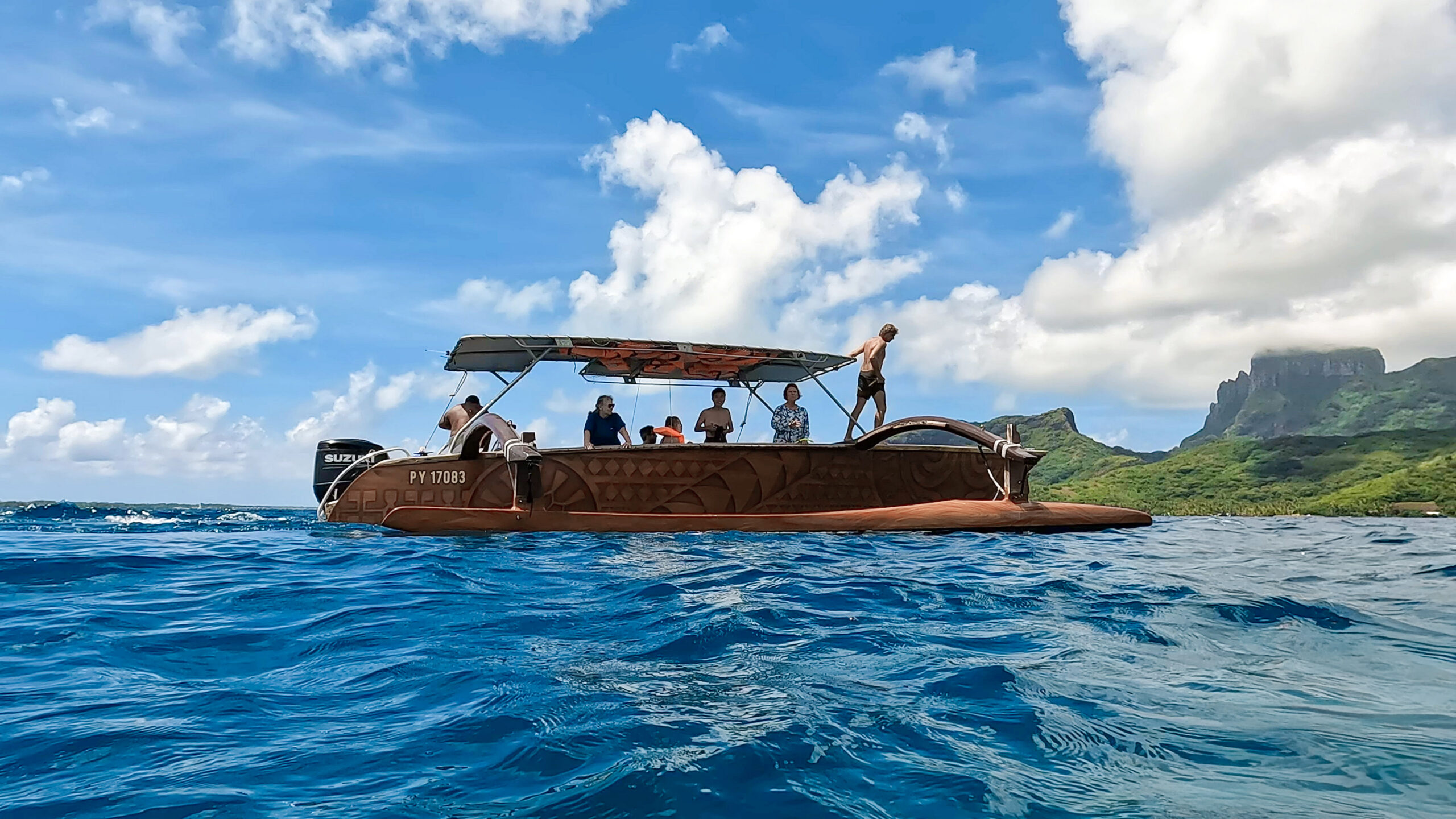
| Rohivai Tours | Small groups, max 12 guests | Carved brown wooden hull with cultural storytelling |
| Teremoana | Longtime local authenticity, full-day value | Large white motorized outrigger, Polynesian crowd |
| Lagoon Service | Largest fleet, most consistent reviews | Traditional outrigger fleet, standard or luxury |
| Bora Bora Cultural Tours (Narii) | Culture-first travelers | Decorated outrigger with hammock and woven seating |

Keishi Lagoon Tours: Best for the Full Private Day Experience
This is the tour we did ourselves, and it is the one we recommend when people want more than just the standard lagoon circuit. Keishi runs a traditional Polynesian-built boat that is genuinely beautiful on the water, and the family behind it has been on this lagoon for generations.
When your guide knows the lagoon the way Keishi does, you notice the difference. They know where the rays are moving on a given morning. They know which coral section is clearest that day. They know the island in a way that a newer operator simply cannot replicate.
The boat photographs beautifully, the experience is personal, and if you book the private full-day option you will get the motu, the history, the fishing spots, and the kind of day that does not feel like a tour at all. This is our top pick for families or anyone who wants the real thing. Read our full Keishi Lagoon Tour review →

Maohi Nui: Best for Photos and Cultural Authenticity
Maohi Nui runs the most visually distinctive boat on the entire lagoon. A traditional yellow and green outrigger canoe with carved black tattoo designs down the hull, a red outrigger float, and real palm tree posts supporting the canopy. It does not photograph like anything else out there. If your priority is coming home with photos that feel completely Polynesian and unmistakably Bora Bora, this is the boat you book.
Patrick Tairua, who runs Maohi Nui, is the son of the last Polynesian chief of Bora Bora. Tours include the standard lagoon snorkel stops plus a motu lunch traditionally cooked in an underground oven and ukulele music on the water. Small group sizes and a cultural depth you do not get from the bigger operators.

Bora Bora Manu Lagoon Excursion: Best for the Classic Group Experience
Bora Bora Manu runs a navy blue open boat with a canopy that seats a larger group comfortably. Multiple boats running daily, well-reviewed, and they book easily through Viator and Marriott Bonvoy activities. Guides Chris and Jeff get mentioned in reviews constantly. If you want the classic group lagoon tour with a polished booking experience and no surprises, this is the straightforward choice.
The tour hits all three standard snorkel stops plus a Polynesian buffet lunch on Motu Fanfan. Reliable, well-organized, and a solid mid-range price point.


Rohivai Tours: Best for Small-Group Cultural Storytelling
Rohivai is the carved brown wooden boat you will see on the lagoon with tribal tattoo designs along the hull and a matching print canopy. The operation was relaunched in 2023 by a Polynesian couple who cap their shared tours at 12 passengers, which makes a genuine difference in how the day feels. Smaller group, more time at each snorkel stop, and guides who actually have space to talk to you about what you are seeing.
Guides Coco and Malaki are consistently named in reviews. Based at Matira, full-day tours include the coral garden, shark and ray sandbank, motu lunch, and cultural storytelling throughout the day. The boat itself photographs beautifully with Mount Otemanu in the background.

Teremoana Tours: Best for Longtime Local Authenticity and Full-Day Value
Teremoana Tours, also known as Nono’s Tours after longtime operator Nono Levard, is one of the oldest and most respected lagoon tour operations on the island. Frommer’s calls it their longtime favorite, and that reputation is earned across decades of running this exact tour. The fleet runs two 14-meter motorized outrigger canoes out of Pointe Matira near Pension Chez Nono.
Full-day tours depart 9:30 AM and return 3:30 PM. The itinerary covers the stingray and shark stop, manta rays in season, a motu lunch with Polynesian barbecue, and the coral garden. Ukulele music and Polynesian songs throughout the day.
At 10,000 XPF per adult (roughly $85 USD), it is among the most affordable full-day tours on the island, with half-price tickets for children under 12. This is the tour for travelers who want an authentic local experience at a working-class price point, not a curated luxury version.


Lagoon Service Bora Bora: Largest Operator & Most Consistent Reviews
Lagoon Service is the largest tour operator on the island and the one you will see most consistently on the water. They run traditional Polynesian outrigger canoes in both standard and luxury configurations, and their guides are consistently rated among the best on the island. Multiple guides, multiple boats running daily, and a review track record built over years of operation.
The classic group tour is three snorkel stops plus a motu lunch, exactly what most people picture when they imagine a Bora Bora lagoon day. The guides sing. There is usually a ukulele at the motu. The food is good.
Their luxury outrigger canoe is a newer addition to the fleet and features a hammock, hand shower, and sunbathing area at the front. If you book with Lagoon Service and want the more aesthetic boat, ask specifically for the luxury configuration.


Bora Bora Cultural Lagoon Tours (Narii): Best for Culture-First Travelers
Narii runs a one-person operation out of his family’s Polynesian outrigger canoe, the Oti’a Are, and his tours lean heavily into Bora Bora’s cultural history alongside the lagoon snorkeling.
The boat itself is stunning, with traditional tattoo designs painted along the hull, a hammock net on the side, built-in mood lighting for sunset cruises, and woven interior seating made from local plant material. It photographs unlike anything else on the lagoon.
Full-day tours include a stop at his family’s private motu with a botanical garden, cultural demonstrations in Polynesian traditions, flower garland making, and storytelling about the island. If you want to come home feeling like you actually understood something about French Polynesian culture, not just floated over it, Narii is the guide for that.

Other Tour Operators Worth Considering
These operators show up consistently on Viator and TripAdvisor with strong reviews. We saw them on the water throughout our two months but did not ride with them personally.
Reef Discovery
Reef Discovery consistently earns top ratings on TripAdvisor and has a marine biologist on their guide team. They operate modern powerboats rather than traditional outriggers, so if aesthetic Polynesian canoe photos are the priority this is not the boat for that. If you want the highest-rated operation on the island with a guide who can actually explain the marine ecosystem, this is your pick. They also offer a kids-specific treasure hunt tour.
Moana Adventure Tours
Moana Adventure Tours has been running Bora Bora tours since 1969 and has one of the largest fleets on the island, including 17 boats and 14 jet skis. They operate Cap Camarat powerboats for private tours and offer combo jet ski and snorkel packages. Good for travelers who want to combine multiple activities in one booking.
H2O Bora Bora
H2O Bora Bora caps their shared tours at seven people, which makes a real difference in how the day feels. They are a family-run operation and reviews consistently mention how quickly David and Aimee respond to booking inquiries and how flexible they are with scheduling. Good pick for couples or small families who find the idea of a large group tour exhausting.
O-Sea Bora Bora
O-Sea Bora Bora runs small-group tours with guide Hiro, who gets named in reviews consistently. Modern vessel, personalized attention, and a strong local reputation.

Which Bora Bora Lagoon Tour Should You Actually Book?
If you’re still stuck, here is the shorthand based on what we saw during our two months on the water:
- For the best photos: Book Maohi Nui or Bora Bora Cultural Lagoon Tours (Narii). Their outriggers are the most iconic and aesthetic on the lagoon.
- For families who want privacy: Book Keishi Lagoon Tours. The personalized attention and family-run vibe make for a much more relaxed day with kids.
- For small groups and storytelling: Book Rohivai Tours. The 12-person cap keeps the experience intimate and the guides are phenomenal.
- For the best value: Book Teremoana Tours. You get the full authentic experience at a significantly lower price point than the luxury operators.
No matter which boat you choose, the lagoon is the star. Just remember to book directly and do it early, especially if you have your heart set on a specific aesthetic for those Mount Otemanu shots.
Can You Snorkel on Your Own in Bora Bora?
Here is something most visitors never realize: the perimeter road runs right along the water for most of the island, and if you have a rental car and you see a stretch of water that looks good, you can just get in. No fee, no tour operator, no booking required. The whole coastline is accessible that way if you are comfortable in open water.
We spent two months driving that road and we watched locals do exactly this constantly. Kids spearfishing off Puhia Point after school. A guy in his va’a outrigger canoe working the area around Outuareho Point, which looks absolutely stunning from a drone and produced some of the most beautiful footage we captured on the island. This is just how people use the water here. The lagoon is not a resort amenity. It is where people live.
That said, there are three spots worth calling out specifically for visitors, each with dedicated guides going deeper on parking, access, and what you will actually see.

Matira Beach
Matira Beach is the most accessible shore snorkel on the island. Public beach, easy parking, walk straight in. The best snorkeling is off the northern end. Swim out toward the rocks and you will start finding coral and fish within 50 meters of shore.
Reef fish, some coral, occasional rays. You will not reach the main coral garden from here and you will not see sharks, but for a free morning snorkel before your resort day kicks in, it is completely worth it.

Te Faie Aro Ocean Park
Te Faie Aro Ocean Park sits on the north end of the island and feels more like a local spot than a tourist one. The entry is a small pull-off similar to the manta ray cleaning station, and on weekends and after work you will see locals here, families, kids in the water, people unwinding after their day. That alone tells you the snorkeling is worth something. Full breakdown coming in a dedicated article.

Rent Your Own Boat From La Plage Bora Bora
If you want more independence than a shore snorkel but are not ready to book a full guided tour, La Plage Bora Bora offers self-drive boat rentals that put you on the lagoon entirely on your own schedule. They are based in Matira on the south end of the island and have been operating since 2008.
No boat license is required for their 6hp boats, which come in a 13-foot Quintrex or a 16-foot pontoon configuration. If you have a license you can step up to a 30hp model with more range.
Before you head out, the team gives you a full briefing including a custom map of the lagoon, a GPS tracker, a mobile phone, and a rundown of where you can and cannot go. They cover the dos and don’ts of the lagoon, the no-go zones, reef navigation, and the best snorkel spots to hit on your own. A cooler is included.
Rental starts from around $178 USD for a half day. Free car transfer is included from anywhere on the main island, and if you are staying on a motu resort they will coordinate meeting you at the dock when your hotel shuttle drops you off. The Aquarium coral garden is directly across from their boat base, so you can be snorkeling within minutes of leaving the dock.

The Eagle Ray Spot Off Fareone Point
Our local contact Hanui pointed us to this one. A concentration of spotted eagle rays hangs off Fareone Point on the southern tip of the motu, and from the water it is one of the more spectacular things you can see in the lagoon. The InterContinental Thalasso is the closest resort at about 2.4 miles along the motu, and Le Moana on the main island sits about 1.6 miles across the water.
Neither of those distances is realistic for most visitors. There is no path or road along the motu. Getting there on foot means either picking your way along the exposed limestone reef on the ocean-facing side or wading along the shallow lagoon side for 2.4 miles, with street dogs, locals who live on that motu, and a near-certain trespassing situation the whole way.
The 1.6-mile open water crossing from Le Moana is a serious open water swim, not a recreational snorkel. A La Plage rental boat or a private tour that routes past Fareone Point is the realistic way to get here.


Snorkeling With Manta Rays on Your Own
Manta rays appear on guided lagoon tours when operators get lucky positioning guests at the right time. Several of the operators above, Reef Discovery especially, have built strong reputations for manta ray encounters. But you do not need a tour to see one.
There is a free, publicly accessible manta ray cleaning station on the north end of Bora Bora, on the south side of the same point as Te Faie Aro Ocean Park. Search “station de nettoyage des Mantas” on Google Maps and it drops a pin right on the spot. No signage, no infrastructure, just a gravel pull-off and one of the most remarkable wildlife encounters on the island sitting right below the surface.
Alex followed a manta ray over a thousand feet along the reef wall on one visit, watched it make a full loop and come back in on a second pass moving in cleaning mode, fish visibly working its cephalic fins. The rays stay at 40 to 50 feet.
From the surface the experience is still extraordinary, but getting truly close requires some breath-hold ability. The full guide covers how to read manta ray behavior, what time to arrive, how to navigate the reef, and what honest expectations look like for snorkelers versus freedivers.
What About Resort Snorkeling?
This is a question we get all the time and the answer is more nuanced than most resort websites will tell you.
The motu resorts (St. Regis, Four Seasons, InterContinental Thalasso, Conrad, Westin) all sit in the same lagoon. That lagoon has significant boat traffic throughout the day from tour operators, resort shuttles, and private charters. All that boat movement stirs up the sandy bottom constantly.
On top of that, ocean swells crash against the eastern reef, and that water works its way through the channels and passages of the motu into the lagoon, mixing cold deep ocean water into the warmer lagoon water and clouding visibility from the other direction.
The result is that open lagoon snorkeling directly from most overwater bungalow decks tends to offer limited visibility, usually just a few feet on a busy day.

Resort Lagoonariums
What the motu resorts offer instead is a lagoonarium, which is an enclosed or semi-enclosed snorkeling area on the property where the marine life is concentrated and somewhat protected from boat traffic. The quality of these varies significantly by resort.
Of the three resorts we stayed at, the St. Regis has the best lagoonarium. Moana, their resident Napoleon humphead wrasse, has lived there for years and swims right up to you. The lagoon coral is healthy, there is a cultural walk alongside it, and the whole experience feels deliberate rather than incidental. Read our full St. Regis Bora Bora review →
The InterContinental Thalasso lagoonarium is the highlight of that property’s water experience as well, with good fish variety and visible coral restoration happening on-site. Open lagoon visibility off the bungalow deck during our stay was only three to four feet. Read our full IHG Thalasso review →
The Conrad Bora Bora Nui, once it reopens, may have the best shore snorkeling of any resort on the island. It sits directly adjacent to the main coral garden, which has the clearest water and healthiest coral we saw anywhere around Bora Bora. We have not stayed there yet and will update this section once we do.
For guests at the Westin, the snorkeling accessible from the beach is worth doing, especially in the early morning before boat traffic picks up.
If you are still deciding which resort to book, our Bora Bora day pass guide breaks down every motu resort’s day pass options, and the St. Regis day pass is its own deep dive if you want to experience the lagoonarium without an overnight stay.


Frequently Asked Questions
The short answer is that open lagoon snorkeling from motu resort bungalows is generally mediocre, regardless of which resort you choose. Boat traffic stirs up the sandy bottom constantly, and ocean swells crashing on the eastern reef push water through the motu’s channels into the lagoon, mixing cold deep ocean water in and clouding visibility from the other direction.
What you are really comparing is the quality of each resort’s lagoonarium. Of the resorts we stayed at, the St. Regis wins on lagoonarium experience. For shore snorkeling access to the actual coral garden, the Conrad Bora Bora Nui likely wins due to its physical location, though it is currently undergoing renovation and we will update this once we have stayed there.


No. All tour operators accommodate beginner swimmers and provide life vests. The snorkel stops in the lagoon are calm, protected water with no significant current. Children of all ages do these tours. That said, the more comfortable you are in the water, the more you will see.
Yes, it is safe. The blacktip reef sharks you will encounter on lagoon tours are small, calm, and completely used to humans. They are not a threat. The stingrays are more interactive than the sharks. As long as you do not stand on the reef, touch the coral, or harass the marine life, you will be fine.
Most standard tours do not offer night snorkeling. Some operators run sunset cruises that include a brief snorkel stop as the light fades, but dedicated night snorkeling excursions are not a standard offering. Ask individual operators if this is something you want.
If you have gear that fits you well, yes. A mask that seals properly to your face makes a bigger difference than most people expect. If you are renting, make sure to test the seal before you get in the water. Fins are less critical on a guided tour since you are not covering distance, but if you have them and they pack easily, bring them.
The dry season from April through November offers the most consistently clear water and calm conditions. That said, the lagoon is snorkel-able year-round. The wet season from December through March brings more rain and slightly more variable visibility, but plenty of guests snorkel successfully during those months.
Manta ray season in the broader French Polynesia region peaks roughly July through November, though they are present in Bora Bora’s lagoon throughout the year.
Yes, every motu resort can arrange lagoon tours. The practical note is that you may not get your preferred boat or operator if you wait until you arrive and book through the concierge. If a specific boat matters to you for photos or experience, book directly with the operator before your trip.
More Bora Bora Content From Our Two Months on the Island
Resort reviews and day passes:
- St. Regis Bora Bora full review
- InterContinental Thalasso honest review
- St. Regis Bora Bora day pass guide
- Bora Bora day pass guide — every resort compared
Things to do in Bora Bora:
- The secret manta ray cleaning station
- Our Keishi Lagoon Tour experience
- Hiking in Bora Bora — free self-guided trails
- Where to get flower crowns in Bora Bora
- La Villa Mahana — is Bora Bora’s most famous restaurant worth it?
Getting to Bora Bora:
More snorkeling in French Polynesia:


Leave a Reply


style
Farm Rio Souvenir Scarves Dress Review: Midsize Sizing, Fit & Vacation Styling testing
style
Vacation Look No. 3 | Farm Rio Golden Nature Maxi Dress Outfit


Have a brand story to tell? We'd love to hear what you have in mind.
And everywhere in between
Bora Bora to Baja


Be the first to comment