
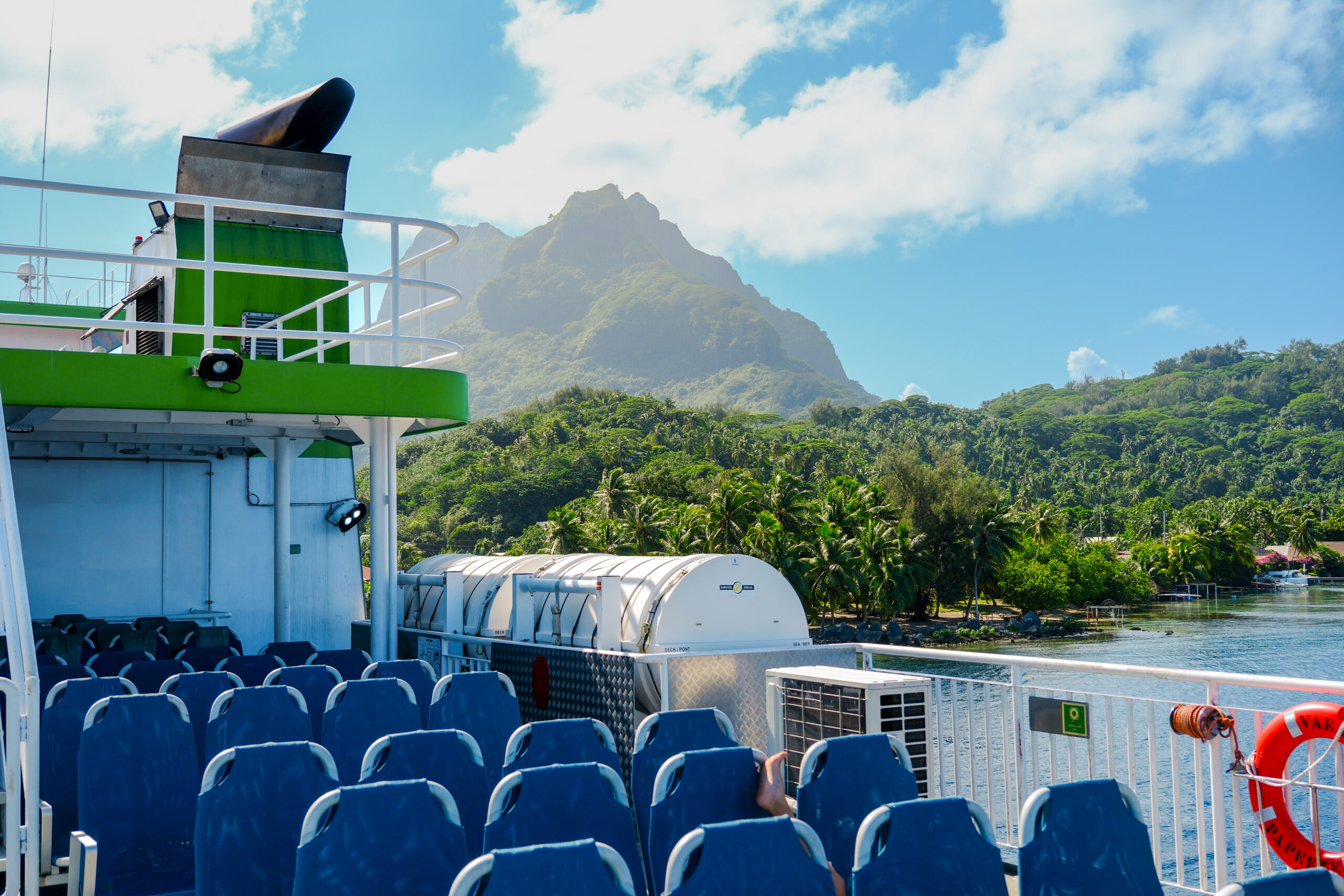
Apetahi Express vs. Vaeara’i: Which Ferry to Bora Bora Should You Take?


The Edit: Two ferry companies connect Papeete to Bora Bora through the Society Islands: the Vaeara’i, an overnight cargo and passenger vessel that departs Friday nights and arrives Saturday mornings in approximately 12 to 14 hours, and the Apetahi Express, a daytime catamaran that runs Wednesday, Friday, and Sunday and covers the same route in roughly 7 hours. This post compares both ferries across cost, comfort, food, travel time, luggage, arrival logistics, and which type of traveler each one is best suited for, based on firsthand experience on both.

QUICK FACTS
| Quick Facts | Apetahi Express | Vaeara’i Ferry |
| Ferry Type | Passenger catamaran | Cargo and passenger vessel |
| Operator | Tuatea Ferries | Vaeara’i Ferry |
| Route | Papeete to Bora Bora via Huahine, Raiatea, Taha’a | Papeete to Bora Bora via Huahine, Raiatea, Taha’a |
| Travel Time | About 7 hours | About 12 to 14 hours |
| Departure Days | Wed, Fri, Sun (from Papeete) / Thu, Sat, Mon (from Bora Bora) | Friday night |
| Departure Time | 6:00 AM from Papeete / 9:10 AM from Bora Bora | About 8:00 PM from Papeete |
| Check-In | Baggage check on pier, board 1 hour before departure | Return by 7:30 PM for 8:00 PM departure |
| Arrival in Bora Bora | Vaitape public pier (main town pier) | Cargo pier, about 1.8 miles north of Vaitape |
| Arrival in Papeete | Main Papeete ferry terminal, taxi line at south end | Main Papeete ferry terminal |
| Ticket Price | 6,000 XPF (~$54 USD) per person, one way | 9,500 XPF (~$85 USD) per person, one way |
| Round Trip | 12,000 XPF (~$108 USD) | Verify current rate at vaearai.com |
| Luggage Included | 1 checked bag (23kg) + carry-on (15kg) + personal item (5kg) | 1 checked bag per person up to 23kg |
| Extra Bags | Additional fee applies | About $7 USD per extra bag (may not be enforced) |
| Infants | Free under 2 years old | Verify current policy |
| Refund Policy | Non-refundable (weather cancellations excepted) | Verify current policy |
| Food Onboard | Cafe: paninis, croissants, quiche, beer, snacks | Full galley: hot meals, cheeseburgers, fish dishes, breakfast items |
| Seating | Open seating across 3 decks — get on early for best spots | Mix of cafeteria tables, reclining seats, benches, outdoor deck |
| Booking | Online at tuateaferries.com, QR code sent by email | Online at vaearai.com or in person at the terminal |
| Best For | Couples, solo travelers, daytime crossings, clean arrivals | Families, budget travelers, overnight adventurers, locals |
Two Ferries, One Route: Here’s the Difference
If you’ve started researching how to get from Tahiti to Bora Bora without flying, you’ve probably come across two names: the Apetahi Express and the Vaeara’i. Both cover the same route through the Society Islands, stopping at Huahine, Raiatea, and Taha’a along the way. That’s where the similarities end.
The Vaeara’i is a cargo and passenger ferry. It runs overnight, hauls freight alongside passengers, and arrives at a working cargo pier north of Vaitape. It’s the ferry locals have been riding for years, the one that carries bicycles and boxes and everything in between.
The Apetahi Express is a catamaran built specifically for passengers. It runs during the day, moves faster, docks at the main public pier in Vaitape, and feels closer to a commuter ferry experience than a cargo crossing.
We’ve done both directions on both ferries, the overnight Vaeara’i coming into Bora Bora, and the Apetahi Express heading back to Papeete on our last morning. Neither is the wrong choice. But they are very different trips, and the one that’s right for you depends entirely on what you’re optimizing for.


A Quick Note on How the Ferry System Works
If you’re new to inter-island travel in French Polynesia, the ferry situation can feel confusing. There is no single ferry company that runs all routes. For the Tahiti to Bora Bora route specifically, you have two choices: the Apetahi Express (operated by Tuatea Ferries) and the Vaeara’i.
For the short Tahiti to Moorea crossing, that’s a completely different set of operators: Aremiti, Terevau, Tauati, and Vaeara’i all run that 30-minute route. This post is focused on the Bora Bora route only.
Cost: How Do They Actually Compare?
Ticket Prices Side by Side
The Apetahi Express charges a flat 6,000 XPF per person one way, no matter where you’re going. Whether you’re hopping off at Huahine after a couple of hours or riding all the way to Bora Bora, the ticket price is the same. That works out to roughly $54 USD per person, or about $108 USD round trip. Infants under 2 ride free. There are no separate fare tiers for adults versus children, everyone over two pays the same rate.
The Vaeara’i runs at 9,500 XPF (~$85 USD) per person one way for the Tahiti to Bora Bora route. That’s actually closer to the Apetahi price than most people assume. For budget-conscious travelers, both ferries represent meaningful savings over flying. The inter-island flight from Papeete to Bora Bora runs roughly $150 to $250 USD per person depending on timing. One traveler in our research reported saving $650 for their group by taking the ferry instead, though they spent the next two days seasick, which we’ll get to shortly.

Luggage: Where the Vaeara’i Has the Edge
Where the Vaeara’i wins on cost is luggage. Each person gets one checked bag up to 23kg, and extra checked bags run about $7 USD each, and in our experience, they didn’t end up charging us for the extras at all. Carry-ons and backpacks weren’t weighed or charged on our crossing. If you’re moving real amounts of gear, suitcases that crept over 23kg on the Air New Zealand flight, extra bags, bulky equipment, the Vaeara’i is more forgiving in practice than the official rules suggest.
The Apetahi’s luggage policy is more structured. Every ticket includes a personal item under 5kg, a carry-on under 15kg, and one checked bag up to 23kg. Extra checked bags carry an additional fee. There’s a scale at the Vaitape pier, and baggage check-in happens with a staff member and a clipboard before you board. Come in close to the limits and you’ll probably be fine. Come in well over and factor in the fee.

Island Hopping? The Tuatea Pass Is Worth a Look
One Apetahi-specific option worth knowing if you’re visiting more than two islands: the Tuatea Pass covers unlimited travel for 30 days across all seven islands on the route for 20,000 XPF (~$180 USD) per person. It pays for itself on your third leg. The pass starts on your first trip and you have a year from purchase to use it. If your itinerary includes Bora Bora plus two or more other islands, run the math before you book individual tickets.
The Ride: What the Experience Is Actually Like
The Apetahi Express
The Apetahi Express is a catamaran built to move passengers efficiently, not cargo. It holds around 500 passengers and runs on three decks: a main deck with table and standard seating, an enclosed upper deck, and an open-air top deck. It’s clean, air-conditioned, and comfortable enough for a 7-hour crossing when the ocean cooperates.

Boarding and Seat Strategy
Boarding at Vaitape is more organized than what you’ll find on the Vaeara’i, but it still rewards the people who move fast. The ferry originates in Maupiti, so it already has passengers on board when it pulls into Vaitape. Once arriving passengers clear out and the luggage carts are switched, your line moves.
Get on, claim your seat immediately before doing anything else. Baggage check-in happens on the pier with a staff member and a clipboard before you board, aluminum luggage carts with the Apetahi logo are staged near the dock, each destined for a different island. She’ll tell you which cart is yours.
Seat selection matters more than it seems on a 7-hour crossing. The best seats are table seats on the starboard side toward the back of the main deck. On the Bora Bora to Papeete run, the sun works against the port side for most of the journey.
Starboard stays cooler and shadier. The rear tables give you more room to spread out. Neither side has a perfect view at every island stop, docking sides rotate, but starboard keeps you out of the sun for the bulk of the crossing and that matters by hour four.

What the Crossing Is Actually Like
The first stretch out of Bora Bora has some roll to it once you clear the reef pass. The day we traveled, winds were running about 15 knots gusting to 25 or 30 with wind chop stacking on top of whatever swell was running. Not violent, but enough to notice, especially with drinks on the table in front of you.
The protected stretches inside the reef around Raiatea and Taha’a are glassy and calm. Then the final open-ocean run from Huahine to Papeete, roughly 100 miles with the wind up and the boat pushing against it at around 20 knots, is where the crossing gets real.
That last leg is the one that earns the “puke express” nickname locals use for the longer ferry routes. Take motion sickness precautions seriously regardless of what the forecast says: sit toward the middle of the boat, eat something light before boarding, and bring medication.
Going upstairs as you approach Moorea from the water is one of the best moments of the whole crossing. You watch the island materialize out of the horizon slowly, the cloud cap forming over the peaks. It’s something you genuinely cannot get on a 45-minute flight. Don’t miss it by staying in your seat.

The Vaeara’i
The Vaeara’i is a different kind of journey altogether. It’s a cargo and passenger vessel that is bigger, slower, and with a completely different energy onboard. It departs Papeete on Friday nights around 8 PM and arrives in Bora Bora the following morning, covering the route in 12 to 14 hours.
Check-in at the Papeete ferry terminal is on the north side of the building, closer to the military pier. Staff scan tickets and give you a colored destination wristband, ours were blue and said Bora Bora. Once you enter the pre-boarding area, you can’t really leave again. Handle anything you need to before that point.

Seating, Sleeping, and Luggage on the Vaeara’i
Seating is a mix of cafeteria tables, standard passenger seats, reclining seats with varying degrees of actual recline, bench seating, and an outdoor deck area with covered plastic couch-style seating and little coffee tables. The second deck has chairs grouped in sets of four, good for families who want to claim a cluster and spread out.
Corner seats recline significantly more than middle ones. After the first island stop, the boat thins out and seat options open up. Upgrading mid-crossing is completely normal.
The most useful thing to know going in is how people actually sleep on this boat. Locals who’ve done this crossing dozens of times come prepared. They sleep across chairs, on benches, on the floor, wrapped in blankets with pillows they brought. It looks chaotic at first and then starts making complete sense.
We slept on the floor with a beach towel at one point and got decent rest. Bring a blanket or large beach towel, a small pillow or neck pillow, a hoodie, comfortable pants, and earplugs or noise-canceling headphones, and keep all of it accessible, not buried in checked luggage.
Bags are handled differently here than at an airport. There are no barcode tags, no scanning systems. Your checked bags go onto a large rolling cart that gets loaded onto the ferry. At each island stop the cart comes off so passengers for that island can grab their bags.
When you arrive at your destination, your bags are waiting on that same cart. Make your luggage easy to identify, since there’s no tagging system, a plain black suitcase in a pile of plain black suitcases is an invitation for confusion.
We use Apple AirTags in our bags, and at one point during the crossing they showed our luggage as still sitting at the previous stop. Not accurate, everything was there when we arrived, but it’s the kind of AirTag lag that will spike your blood pressure unnecessarily if you’re not expecting it.

The Vibe That Makes the Vaeara’i Worth It
Our crossing had an impromptu jam session in the main seating area, musicians played ukulele and sang for hours, the whole boat lit up, and when the lights-out announcement came they packed everything up without being asked. That communal energy is the soul of the Vaeara’i. You’re on a working cargo ferry with locals moving between islands, families heading home, and everything in between. It feels like French Polynesia in a way that an airport never does.
One thing worth noting from our experience and confirmed by others: the ride on the Vaeara’i was smooth. The swell was running from the stern, so the boat rode with it rather than against it. That’s not always the case, but it’s worth knowing that overnight crossings can be calmer than a daytime catamaran running directly into a trade wind chop.
Food: A Practical Comparison
The food on both ferries is honest ferry food. Neither is trying to be a restaurant. But they are not the same experience, and the differences matter on a long crossing.

Food on the Apetahi Express
There’s a cafe stand on the main deck. The menu covers ham and cheese paninis, a smoked fish panini, Nutella croissants, quiche, a small flatbread pizza option, and grab-and-go items from a refrigerated case. There’s a panini and soda combo for 800 XPF (~$8 USD), which is decent value.
Drinks include sodas, water, beer in 12 or 18-ounce sizes, and Heineken. We ordered three ham and cheese paninis and one poisson fume panini, smoked fish and cheese. The ham and cheese was the crowd favorite for a reason. The fish panini was fine once we added some hot sauce from our bag, but plain it leaned toward neutral.
Island food service tends that direction, so if you have strong flavor preferences, bring snacks. Both card and cash are accepted. One detail worth noting: the cafe also keeps seasickness bags near the counter. Not a warning, just useful context.


Food on the Vaeara’i
The Vaeara’i has more to work with. The galley runs a full menu across dinner and breakfast. We ordered a toasted ham and cheese panini, a cheeseburger and fries, and a Chinese-style fish with tomatoes and rice.
It was Chinese New Year on our crossing, so there were decorations up and the galley had a livelier energy than usual. The locals cleaned out the poisson cru within the first hour, which says something about the quality of that dish specifically.
The honest overall take: average food executed well enough for a long overnight ride. I thought the panini was above average. By morning, there were donuts, croissants, coffee, and waffles. If you have picky eaters or dietary restrictions, bring backup snacks. But you won’t go hungry on either ferry.
Vibe and Who’s On Board
The Apetahi Express
The Apetahi skews toward a mix of locals making inter-island trips and tourists doing the same route. It’s quieter and more organized than the Vaeara’i. There are TVs playing movies. People read, sleep, look out the window. It’s comfortable and relatively uneventful when the seas are calm.
The community vibe is there but lighter. You might chat with the person next to you. You might not. It’s a daytime transit experience more than a cultural immersion, though the community atmosphere at Huahine and the other island stops, watching locals come and go, the dock scenes, the island approaches, gives it texture that a 45-minute flight never could.

The Vaeara’i
The Vaeara’i is primarily a locals ferry. Tourists are there, but you’re in the minority. It’s the ferry people use when they’re moving home, heading to visit family, transporting cargo. Kids run around. Families spread out with blankets. Musicians play until it’s time to sleep. One of the community members in our research put it perfectly: “Be prepared for ukulele songs and laughter.”
That communal energy is either the best part of the crossing or irrelevant to you depending on what you’re looking for. If you want to feel like you actually traveled between islands instead of just teleporting by plane, the Vaeara’i delivers that feeling more completely than anything else on this route.

Arrival: Where You End Up Matters
This is one of the most practical differences between the two ferries and one of the least discussed.
Arriving in Bora Bora on the Apetahi Express
The Apetahi Express arrives at the Vaitape public pier, the main pier in town. You walk off the gangway and you’re in Vaitape. Restaurants, shops, resort boat bases, scooter rentals, all of it is right there. The Avis rental car office is maybe 200 feet from the pier. If your resort’s mainland boat base is in Vaitape or nearby, you may not even need a taxi. It is a genuinely easy arrival after a 7-hour crossing.

Arriving in Bora Bora on the Vaeara’i
The Vaeara’i arrives at a cargo pier about 1.8 miles north of Vaitape. It’s a working industrial dock and it has storage buildings, loading equipment, cargo activity. There’s no taxi rank, no signage, and nothing that feels like a passenger arrival point.
When we arrived on the Vaeara’i, we called a taxi and waited 15 minutes. Nobody came, almost certainly because we hadn’t specified which pier we were located. I ended up walking to Avis in Vaitape to rent a car. That ended up being the right call, but it’s not the morning you want after an overnight crossing.
Arrange transportation before you get there. If your Airbnb host or accommodation offers pickup, take it and confirm they know to come to the cargo pier specifically. Calling a taxi? Tell them “cargo pier north of Vaitape”, not just “ferry terminal.” That distinction matters more than it should.
The arrival itself, watching Bora Bora come into view from the water as the ferry approaches, is one of the best parts of the Vaeara’i crossing regardless of what pier you’re docking at. You can start seeing Mount Otemanu from a distance as the ferry clears the last island stop and heads into the lagoon. The island reveals itself slowly, and after 12 to 14 hours of crossing through the night, that arrival feels earned in a way that stepping off a 45-minute flight never does.

Which Ferry Is Right for You?
Take the Apetahi Express if…
You want a daytime crossing, a clean arrival in Vaitape, and a faster trip overall. The Apetahi Express is the more practical choice for couples, solo travelers, and anyone with time constraints. The flat 6,000 XPF fare is easy to budget, the boarding is organized, and stepping off onto the main pier in Vaitape town means you’re immediately where you need to be, close to resort boat bases, rental cars, restaurants, and everything else.
The tradeoff is the open ocean. On rough days, particularly during the trade wind season from June through August, the Huahine to Papeete stretch is legitimately uncomfortable. Sit starboard side, rear of the main deck, away from direct sun. Eat something light before boarding. Bring motion sickness medication regardless of what the weather forecast shows, the wind chop is often worse than the swell forecast suggests.

Take the Vaeara’i if…
You want the full inter-island experience and don’t mind an overnight crossing. The Vaeara’i is the better choice for families, budget travelers, and anyone who values the journey as part of the trip. The overnight timing works naturally for families, kids fall asleep, you arrive in the morning, and you haven’t burned a full day in transit. The luggage policy is more forgiving in practice, and the boat is larger and slower than the Apetahi, which often means a smoother ride when the swell is running from the stern.
The things that make the Vaeara’i memorable are the musicians, the communal sleeping, the locals traveling between islands with their actual lives packed on that cart, are also the things that make it feel nothing like a tourist transfer. You leave Papeete with city lights behind you, move through the islands overnight, and arrive watching Mount Otemanu emerge from the horizon in the morning. That sequence is hard to replicate any other way.
Come prepared: blanket or large beach towel, small pillow, hoodie, comfortable pants, earplugs. Keep all of it in your carry-on, not in checked bags. And plan your transportation from the cargo pier before you arrive.

The Move Nobody Talks About
Take the ferry one way and fly the other. This is the strategy seasoned travelers and several locals recommend, and it’s the one we’d give first if a friend asked. Take the Vaeara’i into Bora Bora, arrive by sea, feel the island reveal itself as the ferry crosses the lagoon, and show up somewhere that feels earned. Then fly home.
The Air Tahiti flight back to Papeete is 45 minutes, the views from the air over the lagoon are spectacular, and you don’t spend your last day of vacation fighting open-ocean chop. You get both experiences. You optimize each direction for what it does best.

Frequently Asked Questions
Is the ferry cheaper than flying from Tahiti to Bora Bora?
Yes, meaningfully so. The Apetahi Express runs 6,000 XPF (~$54 USD) per person one way. Inter-island flights typically run $150 to $250 USD per person depending on timing. For a family of four, the savings add up quickly. Whether the cost difference is worth the time and the rougher crossing is the question only you can answer based on your travel style and how prone you are to motion sickness.
Is the ferry rough? Will I get seasick?
It can be, and it’s worth taking seriously. The locals have a nickname for the longer ferry routes that involves the word “express” and the word “puke,” and they’re not wrong. The worst stretch is the open-ocean run between Huahine and Papeete, roughly 100 miles of nothing between you and the wind.
One traveler in our research group described encountering 10 to 20 foot swells and spending two days recovering. That’s an extreme case, but it happens. The calmer stretches, inside the lagoons around Raiatea and Taha’a, are smooth. The open-ocean sections are not predictable. Bring medication regardless of the forecast.
Should I take the ferry one direction and fly the other?
This is actually the best option for most travelers. The ferry into Bora Bora gives you the arrival experience, coming in through the reef pass with the lagoon opening up in front of you is something you can’t get from a plane window. The flight home saves your last day of vacation from being a 7-hour transit. If you’re going to do one ferry leg, make it the inbound one.
Will my resort pick me up from the ferry dock?
It depends on the ferry and the resort. If you’re arriving on the Apetahi Express at the Vaitape public pier, most resort boat bases are nearby and pickup logistics are generally straightforward. If you’re arriving on the Vaeara’i at the cargo pier, you need to specifically coordinate with your resort or accommodation to confirm they know which dock to come to. Several resorts offer ferry pickup but require advance notice, contact them before you arrive, not when you’re standing on the dock.
Is there a direct ferry from Moorea to Bora Bora?
No. There is no direct ferry from Moorea to Bora Bora. To get between those two islands by sea, you would need to return to Papeete and board the Apetahi Express or Vaeara’i from there. That adds significant time and makes the journey a two-day commitment at minimum. If you’re island hopping between Moorea and Bora Bora, flying is the practical choice.
Should I book Apetahi Express tickets in advance?
Yes. The Apetahi runs only three days per week in one direction and capacity is limited. During peak travel periods, Easter week, July, August, boats fill up. The tickets are also non-refundable, which means if you wait too long and your preferred departure sells out, you’re stuck adjusting your itinerary rather than just losing a deposit. Book online at tuateaferries.com as soon as your travel dates are confirmed.
Can I get a refund if my plans change?
Not on the Apetahi Express. Tickets are strictly non-refundable. The only option if you need to cancel is to transfer the ticket to another traveler, which is allowed. Keep this in mind when building your itinerary. If your trip dates are flexible or you tend to adjust plans on the fly, flying gives you more options.

Two Ferries, One Trip: Here’s What We’d Tell a Friend
Both ferries will get you to Bora Bora. Neither will make you regret taking them. But they are genuinely different experiences, and choosing the right one matters more than most travel guides acknowledge.
The Apetahi Express is the better practical choice for most travelers, daytime crossing, clean arrival at the Vaitape public pier, flat pricing, and a faster trip. The Vaeara’i is the more memorable experience, overnight, communal, cargo-ship soul, and an arrival that feels earned after 12 to 14 hours of crossing through the Society Islands.
If you have time for one, take the Apetahi. If you have time for both, take the Vaeara’i into Bora Bora and the plane home. You’ll have stories from both and regrets from neither. If you need a place to stay in Papeete before either crossing, the Kon Tiki Tahiti is directly across the street from the ferry terminal and one of the easiest pre-ferry stays on the island.


Curated by us, for you. We may earn a commission on pieces you shop through our links


The Vanity Case
Shop the edit
Just Landed
Shop the edit
Finishing Touches
Shop the edit
Leave a Reply


style
Farm Rio Souvenir Scarves Dress Review: Midsize Sizing, Fit & Vacation Styling testing
style
Vacation Look No. 3 | Farm Rio Golden Nature Maxi Dress Outfit


Have a brand story to tell? We'd love to hear what you have in mind.
And everywhere in between
Bora Bora to Baja


Be the first to comment