

Pacific
Asia
Mexico & Baja
USA
Europe
Carribean
Hawaii
Space-A & Military Travel
Family & Worldschooling
Disney & Theme Parks
Resort Reviews
Content Creator
Outfits
Resort Wear
Kids
Packing
Skincare
Makeup
Hair
Exclusive Codes
Finishing Touches
Dress Code
Latest Finds
About
Contact
Military Discount Codes
Shop the Holiday Edit
Apetahi Express: Everything You Need to Know Before You Board


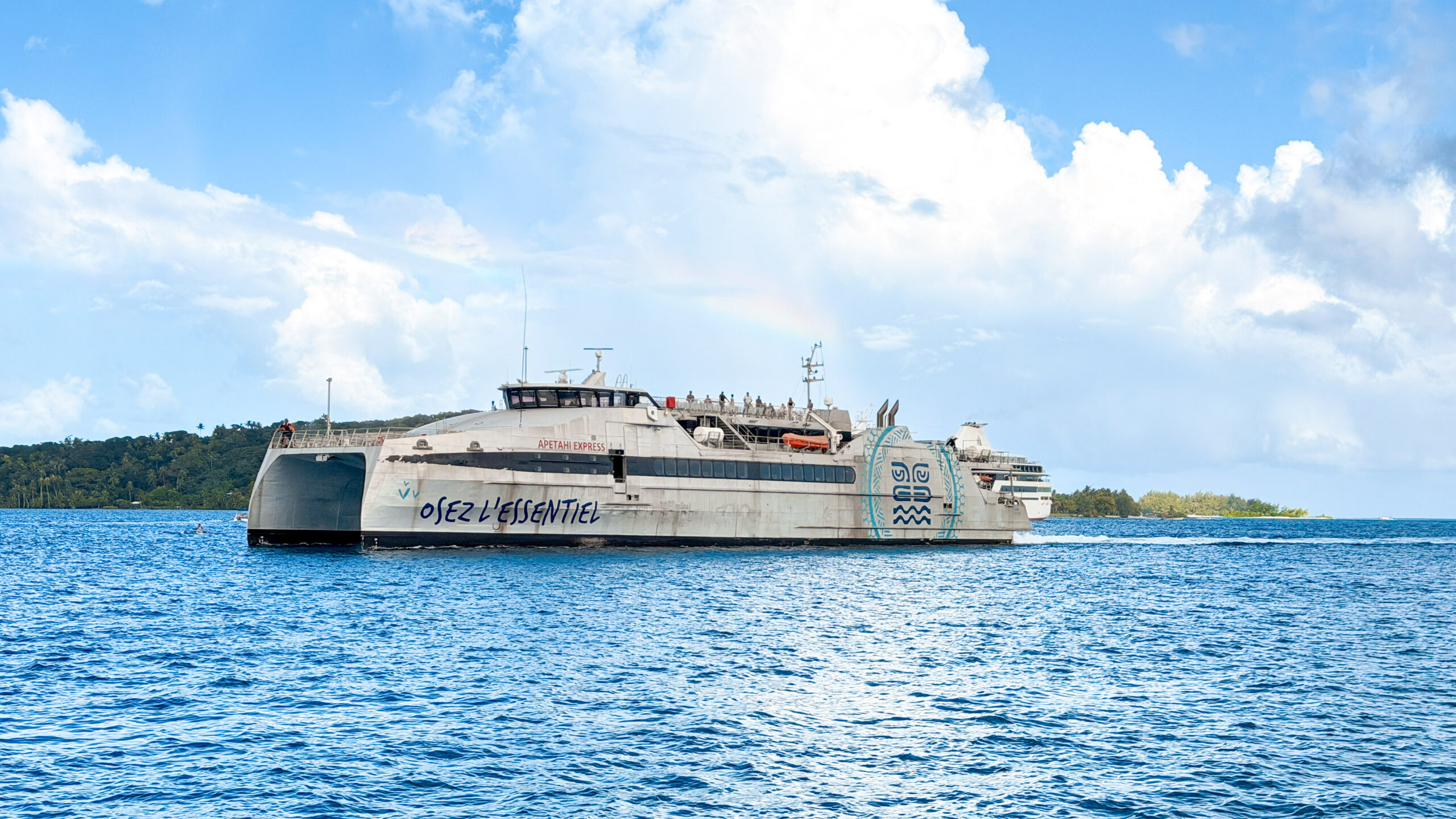
The Edit: The Apetahi Express is a passenger catamaran ferry operated by Tuatea Ferries connecting Papeete to Bora Bora via Huahine, Raiatea, and Taha’a. The Bora Bora to Papeete crossing departs at 9:10 AM on Thursdays, Saturdays, and Mondays and arrives around 4:10 PM, covering the route in approximately 7 hours. This post covers how to book, what boarding looks like at Vaitape, what the boat and food are like, how rough the crossing can get, and what to expect when you arrive at the Papeete ferry terminal.

QUICK FACTS
| Detail | Information |
|---|---|
| Ferry Company | Apetahi Express / Tuatea Ferries |
| Route (our trip) | Bora Bora to Papeete via Huahine, Raiatea, Taha’a |
| Travel Time | Approximately 7 hours |
| Departure Days (Bora Bora) | Thursday, Saturday, Monday |
| Departure Time (Bora Bora) | 9:10 AM |
| Arrival in Papeete | Approximately 4:10 PM |
| Booking | Online at tuateaferries.com — QR code ticket sent by email |
| Ticket Price | 6,000 XPF one way (~$55 USD) / 12,000 XPF round trip (~$110 USD) |
| Infants under 2 | Free |
| Checked Bag Allowance | 1 bag per person up to 23 kg |
| Carry-On Allowance | Up to 15 kg included |
| Personal Item | Under 5 kg included |
| Payment on Board | Credit card and cash accepted |
| Boarding Location (Bora Bora) | Vaitape public pier |
| Arrival Location (Papeete) | Papeete ferry terminal — taxi line on south end |
| Best For | Families, travelers who want a daytime crossing, island hoppers |
| Not Ideal For | Anyone prone to seasickness on open ocean stretches |
| Dry Dock | September 18–29 annually (no service) |

Why We Ended Up on the Apetahi Express
We had originally planned to keep island hopping after Bora Bora. The idea was to hop to Taha’a for a couple of days and do the vanilla plantation tour, pick up some local rum, slow things down before heading back to Tahiti. It made sense on paper. What we didn’t fully account for was Easter week.
French Polynesia is deeply Christian. Captain Cook’s arrival in the 18th century set off a wave of missionary influence across the Society Islands that shaped the culture in ways that are still completely present today.
Easter isn’t a long weekend here, it’s a serious holiday, and travel moves accordingly. We’d already been burned by Easter week travel in Mexico years before, so we knew better than to assume things would run normally.
The Apetahi Express was slammed. The island-to-island route we wanted, Taha’a to Huahine, wasn’t bookable through the ferry system for our dates. And the Vaeara’i, the overnight cargo ferry we took on the way in, wasn’t running its usual route that week. The next available departure wasn’t until April 10th, which wasn’t going to work for us.
We regrouped. Everything we’d wanted to do in Taha’a, the rum, the vanilla, the slower pace, turned out to be findable in Papeete if you knew where to look. So we scrapped the island hopping plan and booked straight back.
If you’re traveling through French Polynesia around any major Christian holiday, factor that into your planning well in advance. The ferries keep running, but the schedules tighten and seats go fast.

How to Book the Apetahi Express
Unlike the Vaeara’i, which we booked in person at the terminal counter, the Apetahi Express is fully bookable online at tuateaferries.com. You pick your route, select your departure date, enter passenger details, and pay. A QR code ticket gets sent to your email and lives on your phone, no printing required.
We booked about a week out, which felt comfortable under normal circumstances. During holiday periods, book earlier. Passenger ferries in French Polynesia don’t sell out the way flights do, but Easter week is its own category. We did the research, figured out our options were limited, and locked in our tickets before the window got any tighter.
One thing worth knowing: Apetahi Express tickets are non-refundable.

The Tuatea Pass: Worth It If You’re Island Hopping
If you’re planning to visit more than two islands on this route, the Tuatea Pass is worth serious consideration before you book individual tickets. For 20,000 XPF (roughly $180 USD), you get unlimited travel for 30 days across all seven islands served by both the Apetahi Express and the Tauati Ferry. The islands included are Tahiti, Moorea, Huahine, Raiatea, Taha’a, Bora Bora, and Maupiti. The pass pays for itself on your third trip.
At 6,000 XPF per one-way ticket, three individual legs would run 18,000 XPF. The pass costs 20,000 XPF and covers everything after that for the rest of the 30-day window. If your itinerary covers three or more islands with separate stops along the way, say Papeete one day, Huahine the next, and Bora Bora after that, the pass pays for itself before you even finish the trip.
A few things to know about how it works. The pass is personal and non-transferable, so each person in your group needs their own. It covers adults and children over two at the same price. Infants under two travel free. The 30-day clock starts on your first trip, not the purchase date, and you have up to one year after purchase to take that first trip.
You’ll need to have a photo added to the pass at one of their agencies or emailed in after purchase. Advance booking is still required for Leeward Islands routes and the pass gives you unlimited access, but you still need to reserve your seat.
Buy it online at tuateaferries.com or in person at one of their agencies in Papeete. If your plans change, you can’t get your money back. During the July and August Mara’amu season, when strong southerly winds kick in, the ferry will text you if conditions get bad enough to affect the crossing. At that point you can swap your ticket, request a refund, or board anyway. Outside of that window, once you’ve booked, you’ve booked.

Boarding at Vaitape, Bora Bora
Getting Your Bags Checked
Boarding the Apetahi Express in Bora Bora is more organized than the Vaeara’i, and the location is much more convenient. The ferry docks right at the Vaitape public pier, the main pier in town, not the cargo pier north of Vaitape where the Vaeara’i arrives.
If you have a rental car, you can pull directly next to the covered palapa area near the Air Tahiti office, drop your bags in the shade, and then park. The Avis office is maybe 200 feet from the pier, which made dropping off the rental car seamless.
What caught us off guard was that baggage check-in happens before boarding, right on the pier. The Apetahi has aluminum luggage carts with their name and logo on them staged near the dock, and a staff member with a clipboard works through the line checking names and counting bags.
Each cart is destined for a different island, there’s a cart for Huahine passengers, one for Raiatea, one for Taha’a, and one that goes all the way through to Papeete. She’ll tell you which cart is yours.
The bags get loaded onto the carts and transported into the hold. Our bags are heavy, and the guy doing the loading looked like he’d been at it for decades. We helped load ours, shuffled some soft luggage around to keep the stack stable, and called it good. Nobody weighed our bags, though we did spot a scale on the way out. Whether that’s actively used for passengers or for cargo, we’re not sure.
The official allowance is one checked bag per person up to 23 kg, one carry-on up to 15 kg, and a personal item under 5 kg. Extra bags incur a fee. Come in under the limits and you probably won’t have a problem either way.


Getting on the Boat
If you haven’t taken this ferry before, the boarding process isn’t immediately obvious. Amanda asked the clipboard lady which line to join and where exactly to board, which was the right call, there’s no giant sign pointing the way.
When the ferry pulls in, it docks, lowers the ramp, and offloads arriving passengers first. Once they’re off and the luggage carts are switched out, your line moves. It goes fast. The ferry accepts scooters, motorcycles, bicycles, and push scooters including electric kick scooters. No cars or trucks.
Drop your bags with the clipboard lady when you arrive, then hang out under the covered palapa area near the Air Tahiti office until the ferry pulls in. If you’ve got time to kill before boarding, the Vaitape shopping strip is right there. Our shopping in Bora Bora guide covers every shop worth your time, from pearl shops and boutiques to the Marché de l’artisanat, all within a short walk of the pier. When it docks, get in line, the whole process moves fast from there.
If you’re departing from Papeete, the official boarding times apply: checked baggage passengers one hour before departure, carry-on only passengers 30 minutes before, and boarding closes five minutes before departure.
One thing worth knowing: the ferry originates in Maupiti and stops at Bora Bora before continuing on, so it already has passengers on board when it arrives at Vaitape. We were among the first ten people to board from Bora Bora, so seat selection was easy.

Choosing Your Seat
This one matters more than you’d think, and we figured it out through experience rather than advance knowledge. Go for a rear table seat on the main deck, you’ll have room to spread out, put bags down, and actually be comfortable for a nearly seven-hour crossing.
Which side of the boat stays shaded depends on the time of year. We traveled in early April with the sun tracking north, which put direct sun on the port side for most of the journey. If you’re traveling during the summer months when the sun shifts further north, that could flip. The rear table seats give you the most flexibility either way, easy to adjust based on where the light is hitting.
The docking sides vary by stop, starboard at Bora Bora and Taha’a, port at Huahine, and port in Papeete, so neither side wins on views at every stop. Pick shade over views and you’ll be happier by hour four.
If you want to go upstairs to the open-air deck, which you absolutely should at some point, especially as you approach Moorea, do it. But claim your table first.

The Boat Itself
The Apetahi Express is a proper passenger catamaran, nothing like the Vaeara’i. If you’ve ever taken a fast ferry between islands in Europe or a high-speed catamaran to a day trip destination, the vibe is similar. It holds around 500 passengers and has three levels: the main deck with seating, an enclosed upper deck, and an open-air top deck.
The main deck has a mix of table seating and standard seats. It’s clean, functional, and air-conditioned. The upper enclosed deck offers more seating if the main level fills up. The open-air top deck is the move for views, but during rough stretches you’ll get wet, a little ocean spray is normal, and on windier days it’s more than a little.
The TVs on board were cycling through a train documentary and eventually an old Western with no audio, which is exactly the kind of ambient background noise that makes a long ferry crossing feel normal. Nobody’s winning any entertainment awards, but it passes the time.
The bathrooms are at the back of the main deck.


Food and Drinks on the Apetahi Express
There’s a café stand on the main deck that covers the basics. We grabbed three ham and cheese paninis and one poisson fumé panini, smoked fish and cheese. The ham and cheese was the crowd favorite for a reason.
The fish panini was fine once we hit it with some Huy Fong sriracha, we travel with a bottle, no cap, but on its own it was fairly plain and I did not taste any smoke flavor. Island food service tends toward neutral flavors, so if you have strong preferences or picky eaters, bring some snacks.
The full café menu included ham and cheese paninis, a smoked fish option, Nutella croissants, quiche, a small flatbread pizza situation with sauce, cheese, and pepperoni, and various grab-and-go items from a refrigerated case. There was a deal going, a panini and a soda for 800 XPF, which is decent value. Drinks included sodas, water, and beer in 12 or 18-ounce options, plus Heineken.
The café accepts both credit card and cash.
One note: They also keep seasickness bags near the counter. That’s not a warning, just useful context if you or someone in your group tends toward motion sickness on open water.


What the Crossing Is Actually Like
Bora Bora to Taha’a
The first stretch out of Bora Bora is the roughest part of the early portion of the trip. Once you clear the reef pass and hit open water, you’ll feel it. The day we traveled, winds were running about 15 knots gusting to 25 or 30, with wind chop stacking on top of whatever swell was running.
It’s not violent, but it’s rolly enough that you notice it, especially if you’re at a table and have drinks in front of you. Not our first rodeo on this water, so we settled in, grabbed the sandwiches, and let the kids get used to it.

Inside the Reef: Raiatea and Taha’a
Once you enter the protected lagoon system around Raiatea and Taha’a, everything smooths out. The reef does exactly what a reef is supposed to do, it flattens the swell on the ocean side, and you’re suddenly in glassy, calm water. The stops at these islands are quick.
The boat pulls in, offloads passengers and bags for that island, loads new ones, and keeps moving. You can watch it all from your seat without getting up. The docks at each stop have that same mix of cargo infrastructure and local life that characterizes inter-island travel in French Polynesia, not scenic in a resort brochure way, but genuinely interesting if you’re paying attention.


Raiatea to Huahine: Reef Passes, Motus, and Surfers
The stop at Raiatea felt more like a proper terminal than the other islands. It’s a long concrete pier with a cleaner, more public feel compared to the more secured, gated area where the Vaeara’i docks. Worth noting if you’ve taken both ferries.
Leaving Raiatea is one of the more scenic moments of the whole crossing. The channel out runs right past Motu Ofetaro park with reef on both sides, and the water is the kind of blue that makes you wish you had more time. People were out there enjoying the day as we passed, it looked like a great spot to spend a few hours if you ever have the chance. The ferry exits through Te Ava Piti Pass before hitting open water again.
Kids were surfing the reef break just off the channel as we pulled in to Huahine, the water was as blue as anywhere we’d seen on the trip, and the ferry picked up a solid crowd before continuing on to Papeete.


Huahine to Tahiti: The Long Stretch
The final leg from Huahine to Papeete is the longest open-ocean stretch on the route, covering roughly 100 miles. With the wind up and the boat running against it at around 20 knots, you’ll feel every bit of it. The wind chop was still present, the swell was manageable, and we were getting occasional light spray on the upper deck. Not dangerous, but enough to keep you honest.
We slept for an hour or two somewhere in the middle of this stretch. If you’re in a seat with something claiming it, a bag, a jacket, you’re probably fine. If your seat looks empty, someone might take it while you’re wandering. Just something to keep in mind on a fuller boat.
As we got within about 40 miles of Moorea, we went upstairs to the open deck. Moorea came into view off to the side. It’s one of those moments that’s hard to get any other way. On a plane you’re at altitude and it’s over in seconds. On the ferry, you watch the islands materialize out of the horizon slowly, the cloud cap forming over the peaks from the trade winds pushing moisture up the windward slopes. It’s genuinely worth being up there for.
The wind picked up a little in the channel between Moorea and Tahiti, and someone on the upper deck lit a cigarette about an hour outside of Papeete. On a vessel carrying 500 people, that’s not a minor annoyance, it’s a fire risk.
Amanda flagged the crew inside. They went looking for the person. We went downstairs and started getting our things together. Nothing became of it, but if you’re on a boat and you see someone smoking in a no-smoking area, say something. It’s worth the awkward moment.


Arriving in Papeete
The Apetahi Express docks at the main Papeete ferry terminal, which is a meaningfully better arrival situation than the cargo pier where the Vaeara’i drops you. You’re in town. The terminal is walkable to the waterfront, close to taxis, and generally navigable.
Disembarkation
The disembarkation process is where things slow down. There’s a single-person gangway off the vessel. One lane. For 500 people. Everyone funnels through it at the same time, some with luggage they carried on, some heading downstairs to collect checked bags, some meeting people, some hailing taxis. It becomes a crowd fast.
If you have somewhere to be and want to get out efficiently, start making your way toward the second deck gangway before the boat fully docks. Being 50th off instead of 300th makes a real difference when everyone is competing for the same exit.
Getting Your Bags
Checked luggage is unloaded and waiting once you get off. The bags from the Bora Bora cart will be there. We didn’t have any issues with ours, but in a crowd that size, keep an eye on your stuff. Nobody messed with anything on our trip, but it’s a busy terminal and common sense applies.
Getting a Taxi
The taxi line is at the south end of the ferry terminal building. There’s signage, but in the post-ferry crowd it can take a few minutes to figure out your bearings. Walk south along the terminal, follow the crowd, and you’ll find it. Taxis at the Papeete ferry terminal only accepted cash in our experience, come prepared.
If you want to minimize wait time, get off the boat early and walk directly to the taxi line before the rest of the passengers catch up. We ended up mid-pack and waited a bit, which was fine but avoidable.

Tips for a Smoother Apetahi Express Experience
Book in advance during holidays. French Polynesia takes Christian holidays seriously, Easter, Christmas, and other major dates affect ferry schedules and availability more than you’d expect. Don’t assume you can sort it out on arrival.
Board strategically. Seating is first come, first served, so once you’re on, move quickly. Starboard side, rear table, main deck. You’ll thank yourself around hour four.
Bring snacks if you’re picky. The café is fine but limited, and the flavors lean neutral. Hot sauce travels well.
Get to Vaitape pier early. Baggage check-in happens on the dock, not at a separate counter. Give yourself time to drop bags, park the car if you have one, and get through the line without rushing.
Go upstairs as you approach Moorea. The approach from the water is something you genuinely cannot get on a plane. Don’t miss it by staying in your seat.
Plan your disembarkation. If you have a tight connection or just want to get moving, position yourself near the gangway before the boat docks. The single exit lane creates a bottleneck that clears slowly.
Know the dry dock window. The Apetahi Express goes into dry dock every year from September 18th through 29th. No service during that period. If your trip falls in that window, you’ll need to fly or plan around it.

Apetahi Express vs. Vaeara’i Ferry
These two ferries serve the same islands but are completely different experiences. The Vaeara’i is an overnight cargo and passenger ferry. It is slower, rougher around the edges, and a genuinely immersive way to see how locals and goods move between islands. The Apetahi Express is a modern passenger catamaran that gets you there in daylight in roughly seven hours with a café on board and actual seat options.
We’ve taken both directions. The Vaeara’i from Papeete to Bora Bora on the way in, the Apetahi from Bora Bora to Papeete on the way back. If you want the full inter-island experience, one of each is the move.
Pricing between the two is closer than you’d expect, a Vaeara’i adult one-way ticket from Tahiti to Bora Bora runs 9,500 XPF (~$85 USD), so the decision really comes down to whether you want a daytime crossing with views or an overnight that frees up a day on either end. Both are worth doing at least once.

Frequently Asked Questions
Does the Apetahi Express go to Bora Bora?
Yes. The Apetahi Express runs between Papeete and Bora Bora via Huahine, Raiatea, and Taha’a. Departures from Papeete run Wednesday, Friday, and Sunday. Departures from Bora Bora (via Maupiti) run Thursday, Saturday, and Monday.
How long is the Apetahi Express from Bora Bora to Papeete?
The crossing takes approximately 7 hours. The ferry departs Bora Bora at 9:10 AM and arrives in Papeete at approximately 4:10 PM.
How do I book the Apetahi Express?
Book online at tuateaferries.com. You’ll receive a QR code ticket by email. Tickets are non-refundable outside of weather-related disruptions during Mara’amu season.
Where does the Apetahi Express dock in Bora Bora?
The Apetahi Express boards at the Vaitape public pier, the main pier in Vaitape town. This is different from the cargo pier north of Vaitape where the Vaeara’i arrives.
Where does the Apetahi Express arrive in Papeete?
The ferry arrives at the main Papeete ferry terminal. The taxi line is at the south end of the terminal building.
Is the Apetahi Express rough?
It depends on conditions and where the swell and wind are coming from. The open ocean legs are Maupiti to Bora Bora, Bora Bora to Taha’a, Raiatea to Huahine, and Huahine to Papeete, those are the stretches where you’ll feel it if conditions are up.
The protected sections inside the reef around Raiatea and Taha’a are generally calm. The longest and most exposed leg is Huahine to Papeete, which is where seasickness is most likely to become an issue. During the July–August Mara’amu season, the ferry will notify you by text if conditions are severe enough to affect the crossing.
Can you bring luggage on the Apetahi Express?
Yes. Each ticket includes one checked bag up to 23 kg, one carry-on up to 15 kg, and a personal item under 5 kg. Extra checked bags incur an additional fee.
Is there food on the Apetahi Express?
Yes. There’s a café on board serving paninis, croissants, quiche, drinks, beer, and snacks. A panini and soda combo runs 800 XPF (~$8 USD). Credit card and cash accepted.
How much does the Apetahi Express cost?
A one-way ticket is 6,000 XPF per person (approximately $55 USD). A round trip is 12,000 XPF (approximately $110 USD). Infants under two years old travel free. There are no separate fare tiers for adults versus children, all passengers over two pay the same rate. Tickets are purchased online at tuateaferries.com.
Is there a ferry pass for multiple islands?
Yes. The Tuatea Pass covers unlimited travel for 30 days across all seven islands served by the Apetahi Express and Tauati Ferry. The islands included are: Tahiti, Moorea, Huahine, Raiatea, Taha’a, Bora Bora, and Maupiti. It costs 20,000 XPF (roughly $180 USD) per person and pays for itself on your third trip. The pass is personal and non-transferable. The 30-day window starts on your first trip, and you have one year from purchase to take it. Buy it at tuateaferries.com.
Does the Apetahi Express run during Easter week?
The ferry does run during Easter week, but schedules can be modified and boats fill up faster than usual. Book well in advance if you’re traveling around Easter or any major holiday in French Polynesia.


Curated by us, for you. We may earn a commission on pieces you shop through our links


The Vanity Case
Shop the edit
Just Landed
Shop the edit
Finishing Touches
Shop the edit
Leave a Reply


Have a brand story to tell? We'd love to hear what you have in mind.
And everywhere in between
Bora Bora to Baja


Be the first to comment