
Shopping in Bora Bora: The Few Shops Actually Worth Your Time


The Edit: This guide covers shopping in Bora Bora across 11 firsthand-visited main-island shops, from upscale clothing boutiques and the pearl shop next door to artist studios, handmade-only gift shops, the open-air Marché de l’artisanat, and the hardware store with the snorkel gear nobody mentions online. It includes what each shop sells, the brands carried, the vibe walking in, and which shops earn your time when you have minutes off a cruise ship instead of hours. Best for cruise passengers, ferry arrivals at the Vaitape pier, resort guests on a day trip into town, long-stay Airbnb renters, honeymooners hunting a real keepsake, and parents who need to replace a kid’s lost snorkel mask or outgrown swim trunks.
At a Glance
| Category | Details |
|---|---|
| Location | Bora Bora main island (Vaitape + north side) |
| Shops Reviewed Firsthand | 11 |
| Categories Covered | Clothing, pearls, art, handmade gifts, local artisans, retail brands, hardware and snorkel gear |
| Walkable From Cruise / Ferry Pier | Yes, most of the post |
| Cash or Card | Most shops take cards. Marché and roadside-style stands are cash only (French Pacific Franc (XPF)). |
| Hours | Vary by shop. Check Google Maps before you go. Sunday and holiday closures common. |
| Best For | Cruise passengers, ferry arrivals at Vaitape, day-trip resort guests, long-stay travelers, honeymooners, parents replacing kid gear |

We spent two months on Bora Bora’s main island, walking the same loop road past the same shop windows until we’d been inside every one worth being inside. Most travel coverage of shopping in Bora Bora stops at the Marché de l’artisanat and calls it a day. There are ten more shops worth knowing about, and a handful of them sit three minutes from where the cruise ship boats drop you off.
If you’re walking off a cruise ship or stepping off the Vaitape ferry pier with a few hours to spend, this is the shopping rotation. If you’re staying on the island long enough to need real things, like a new mask after the kid lost the old one or a dress for the sunset dinner you weren’t planning on, this is also the rotation. The first half of the post covers everything you can walk to from the pier. The second half is the shops worth driving to if you’ve got a rental car or a willing taxi driver.
Quick Recommendations
- Best for High-End Resort Wear & Linen: Bora Bora Original & Secrets Bora Bora
- Best for Authentic, 100% Locally Made Souvenirs (Honey, Rum, Soaps): Teavanui Shop
- Best for Intricate Marquesan Wood Carvings: Secrets Bora Bora
- Best for Investment/High-Grade Tahitian Pearls: Héritage by Bora Bora Original
- Best for Budget Pearls, Hairpieces, & Woven Bags: Marché de l’artisanat
- Best for Bold, Vibrant Boho Prints (Johnny Was Vibe): Fantasy La Galerie
- Best for Replacement Surf & Snorkel Gear: Reef Bora Bora
Vaitape on Foot
Almost every shop worth your time on Bora Bora’s main island is clustered along the loop road in Vaitape, walking distance from where the cruise tenders and ferry boats dock. You can hit five or six of them in under an hour if you’re moving fast. If you’ve got a full afternoon, you’ll loop through twice and still find something new. We’re starting at the south end of the strip, closest to the main pier, and walking north.

Bora Bora Original
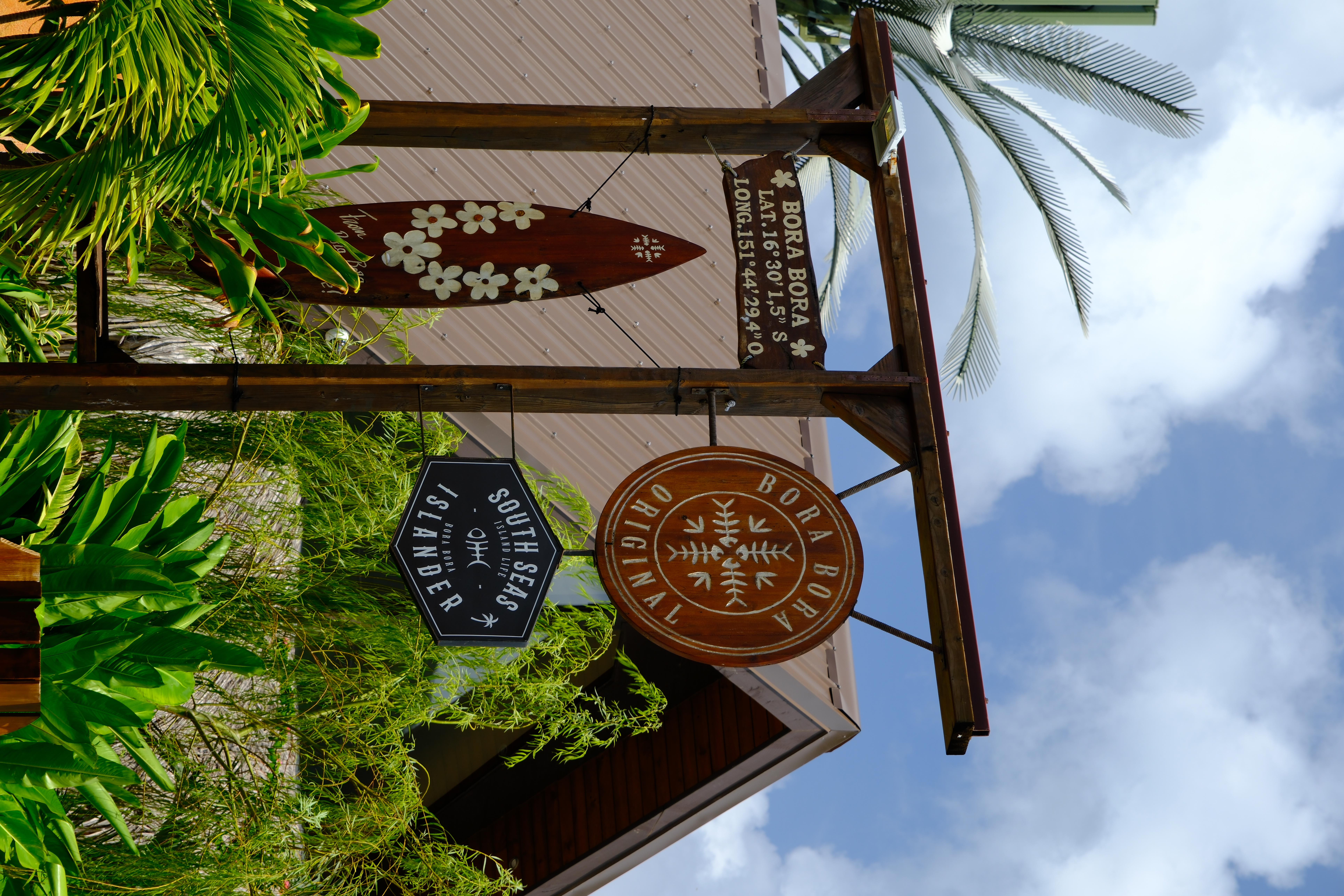
Bora Bora Original sits a short walk from the cruise tender pier and the main Vaitape ferry terminal, just down the street from the bank. You can’t miss it. It’s one of the bigger storefronts on the strip and it backs up to the bay, which you don’t realize until you’re inside browsing and look up to find a window full of lagoon behind the back rack.
Most of what they sell is the South Seas Islander brand. For men: Hawaiian-style tropical prints, button-down shirts, swim trunks, casual shorts, sun shirts, sunglasses, hats. For women: bikinis (tops, bottoms, one-pieces), bike-short-and-sport-top sets, long dresses, and pareos. The print direction is in the same neighborhood as Hawaii brands like Benoa and Kenny Flowers, but with a cleaner, more two-tone feel for both men and women.
Fabric quality is real. They carry linen and modal pieces, not just cotton-poly basics, which matters if you’ve been to one too many island gift shops selling glorified beachwear that pills after one wash.
They also stock a few non-South-Seas-Islander brands tucked in, including the long sleeve button-ups for men and a clearance rack in the back worth a look. Beyond clothing they carry Coqui Coqui perfume (the Mexico-made brand out of the Yucatan), local wood carvings, and small decorative pieces for the house.


The Vibe Walking In
Hip, trendy, upscale, more like a surf shop crossed with a small designer boutique than a souvenir store. Island music plays in the background. There’s a big couch in the main floor for the husband you’re dragging around, two dressing rooms, and a back door that opens onto a small seating area on the bay. The staff are warm without being pushy, never once gave us the hover-and-sell treatment, and rotate between this shop and the pearl shop next door. You’ll spot the same handful of people at both.

What to Expect to Pay
Not crazy cheap. You’re paying real money for the linen and modal pieces, and the brand pricing is comparable to what you’d see at a nicer boutique in Hawaii or California. The clearance rack in the back is where the deals live if you’re hunting. What you’re paying for here is quality you can wear for years, not a one-trip souvenir tee.
If you’re walking the Vaitape strip and only have time for one upscale clothing stop, this is it. Hours vary, check Google before you walk over, and note that the same owner runs the pearl shop next door, which is where we’re going next.
Héritage by Bora Bora Original
Walk out the back door of Bora Bora Original, take a few steps along the back patio, and you’re at Héritage. Same owner, same staff rotation, same bay view. The difference is the merchandise.
Héritage is the pearl shop. They carry the full range, from the classic Tahitian black pearls most people associate with French Polynesia to the harder-to-find champagne and peacock colors. They sell loose pearls, settings, finished pieces, rings, earrings, necklaces, and bracelets, plus a handful of carved wood pieces and traditional log drums scattered around the floor as decor.
What makes the experience here different from the other pearl shops on the island is how the staff handle browsing. They don’t hover. They notice what catches your eye and then quietly start pulling things from the safe in the back to show you.
When we mentioned the champagne-colored pearl Amanda already had from Moorea, the lady working the floor pulled out a piece roughly the size of a green grape, perfectly round, perfectly lustrous, that she said was valued somewhere between fifteen and twenty-five thousand US dollars just for the pearl on its own. That’s an eight-to-ten-year nacre buildup. You don’t see pearls like that on the standard shop floor.


What She’ll Actually Teach You
She walked us through what to look for in a pearl. Luster (the depth of the shine, not just the surface brightness). Rings (the visible growth lines, which signal authenticity and tell you how old the pearl is). Surface quality. Shape. Size relative to color rarity. None of it felt like a sales pitch. It felt like the conversation you’d have with a jeweler who actually cares whether you walk out with a pearl you love or a pearl you regret.
This is the part most travel coverage of Bora Bora shopping gets wrong. You’re not going to learn anything about pearls scrolling Pinterest or reading blog posts that copy-paste the same five sentences about Tahitian black pearls. You walk into a shop like Héritage, you ask questions, you let the lady pull a few pieces out of the case, and within ten minutes you’ll know more about pearls than you ever did before.
What to Expect to Pay
Pearl prices in French Polynesia are determined by size, luster, surface quality, shape, and color rarity. A small classic black pearl on a simple setting can run a few hundred dollars. A peacock or champagne piece with strong luster runs into the thousands fast. Anything truly rare or large, like the piece in the safe, runs into five figures. Most travelers walk out with something in the $200 to $800 range, which gets you a real Tahitian pearl on a thoughtful setting from a shop that took the time to explain what you were buying.
There’s a back patio with seating where you can sit and think about a piece before committing, which is a small detail that matters. You’re not getting pushed to decide standing at the case.
Should You Buy Pearls Here Specifically
If you’re trying to match a pearl you already own from somewhere else in French Polynesia, this is the shop most likely to pull something close out of the safe. If it’s your first pearl, the staff will spend real time walking you through what you’re looking at, so you leave understanding the piece rather than just owning it. And if you’re cross-shopping the island’s pearl scene, Héritage is a strong first stop, but walk through Secrets Bora Bora a few doors down before deciding, since the selections, vibes, and price points differ between the two.


Secrets Bora Bora
Stay on the same side of the street and keep walking. A few doors down from Héritage you’ll hit Secrets Bora Bora, on the corner of a two-story building it shares with an art gallery on the upper level. We skipped the upstairs gallery, but Secrets is worth the stop.
Secrets is Canadian-owned. The woman working the floor when we stopped in was European, likely Belgian, married to someone local and working there full-time. She was warm, sharp on the merchandise, and never pushed a thing.
The selection at Secrets is the most varied of any shop on the Vaitape strip. Clothing covers a wider brand mix than Bora Bora Original (which leans heavily on South Seas Islander), with linen shirts in the cuts and colors that actually work in the tropics: short sleeve, long sleeve, darker blues, and a full run of the boho chic neutral palette in soft tans, whites, and earth tones. They carry tops, bottoms, swimwear, and accessories for men and women, but the clothing isn’t what makes Secrets stand apart.


The Wood Carvings
Secrets has the strongest wood carving inventory on the strip. They source pieces from carvers in the Marquesas Islands, specifically Nuku Hiva, which has the larger trees needed for the bigger statues and tiki heads. The work is remarkable, hundreds of hours per piece on the more intricate items.
The carved boat axes are the standout. These are the traditional pieces used to carve out dugout canoes, with stone heads set into wood handles, decorated with carvings of manta rays and other Polynesian symbols across the surface. The carved wooden paddles next to them are the same story: functional shape, decorative surface, every inch detailed. They also carry traditional swords with shark teeth set into the edges, which is exactly the kind of piece you don’t realize exists until you’re standing in front of one.
These aren’t cheap. Some of the larger carved pieces run into the thousands of dollars, and they earn it. Whether the carvers are doing this full-time or as side work to feed their families, the craft is real.
The Pearl Selection
Secrets carries pearls too, but the selection is different from Héritage. Different farms, different styles of jewelry, different ranges. If you’re cross-shopping pearls, Secrets is a useful second stop, especially if you’re looking for pieces in mounted jewelry rather than loose pearls or simpler settings.
The Overall Vibe
Secrets feels more curated than its neighbors. The clothing reads less like a single-brand house and more like a buyer with taste pulled pieces from multiple lines that hold up in the tropics. The wood carvings give the back of the shop weight, the kind of presence you don’t get at a strict clothing store. The owner clearly cares about what they stock.
Walking the strip and want to see real Marquesan wood carvings without flying to Nuku Hiva yourself? This is the shop. Cross-shopping pearls? Swing through. Anyone hunting linen pieces in a more neutral palette than what Bora Bora Original carries will find their spot here.
Fantasy La Galerie Bora Bora
A few more steps along the strip and you’ll hit Fantasy La Galerie. We walked in roughly twenty minutes before closing, so the staff was already starting to pull display racks from the sidewalk and put things away for the night. That’s on us, not them. We did a quick walk-through and what we saw was enough to know what direction the shop runs.
The pattern direction at Fantasy is the most vibrant on the Vaitape strip. Bold prints, layered florals, rich color combinations, in the same aesthetic neighborhood as Johnny Was. If you love that look (statement pieces, expressive prints, the kind of dress people stop and ask you about), this is your shop. The shop leans into it across the whole inventory.
They carry the full range of what most Vaitape clothing shops carry: pareos, wraps, dresses, tops, bottoms, and accessories, plus pearls and pearl jewelry alongside the clothing. Outside the front of the shop they keep a display rack of pareos and lightweight fabric pieces visible from the loop road, so passing cars and walkers can see in. It’s the most visible-from-the-road clothing shop on the strip.
The Fabric Mix
The fabric content here leans more toward cotton and cotton-poly blends than the linen and modal pieces you’ll find at Bora Bora Original and Secrets. If you’re someone who pays attention to natural fibers in tropical heat, you’ll notice. If you don’t, the prints are the point and the pieces deliver on the print direction the shop is built around.
Who This Shop Is For
If you love the Johnny Was aesthetic, eclectic boho prints, or layered statement pieces, walk in and take your time when the shop is fully open (we’d plan for mid-morning to mid-afternoon rather than late day). It’s also the shop to hit if you’re gifting someone who dresses that way. For anyone hunting clean, neutral, modern pieces, you’ll do better one or two doors down.


Teavanui Shop Bora Bora
This is the shop on the strip where everything is made on Bora Bora. Not French Polynesia. Not Tahiti. Bora Bora. If you’re hunting a souvenir, a gift, or something to bring home that was actually made on the island you flew across the world to see, this is the only shop in Vaitape that delivers it.
That’s the whole pitch. Everything else about Teavanui (the size, the layout, the staff) is secondary to the fact that this is where the island’s makers stock their product.
A small number of items come from elsewhere in French Polynesia. The Coqui Coqui line on the shelf is from the Yucatan and you’ll find it at Bora Bora Original too. Everything else, you’re looking at product made by people who live here.


What They Carry
Local honey, made on Bora Bora. Soaps, made on Bora Bora. Candles, vanilla, monoi oil, local jam, locally made rum, locally produced salt, pottery, wood carvings, t-shirts, woven handbags, small decorative pieces like chopsticks and holders, and locally made chocolate.
The categories that matter most for travelers (the honey, the soaps, the vanilla, the monoi, the salt) all travel well, gift well, and beat anything you’d find in a resort gift shop on every metric: ingredients, craftsmanship, price, and story.

Why This Shop Matters
Most “souvenirs” in Bora Bora are imported and rebranded with a Bora Bora logo on the front. That’s true at the resort gift shops, true at most of the Vaitape clothing boutiques (which carry product from Hawaii, the Yucatan, France, and elsewhere), and true at the Marché de l’artisanat for some of the smaller goods. Teavanui is the answer to “is anything in this town actually from this island.”
The shop is small and easy to miss if you’re not paying attention. But if your goal is to walk out of Bora Bora carrying something made on Bora Bora, this is the only shop on the main island built around that promise.
Marché de l’artisanat
The Marché de l’artisanat sits right at the inner pier where cruise tenders drop passengers off, tucked behind the Avis counter in Vaitape. You can literally step off the tender and be inside the market in under a minute. It’s the open-air artisan market most “shopping in Bora Bora” articles online start and stop at. Those articles aren’t wrong that the Marché is worth a visit. They’re wrong that it’s the only stop, and they’re wrong about what you’ll find inside when you get there.
The Marché is a rotating-artist market. It’s not one shop with consistent inventory. It’s a covered space where local artists rotate in to sell directly to travelers, and the lineup of who’s there changes from week to week. That means two things.
First, what you walk into is genuinely a different experience depending on the day. Second, the Marché operates on cruise ship rhythm. When ships are in port and tenders are dropping passengers right next to the market, every booth is staffed, every artist is set up, and the whole space is alive.
When there’s no ship in the bay, half the booths are empty and the artists who do show up are casual about hours. That’s not a knock on the market. It’s the rhythm. If you want to time it right, look for days with a cruise ship in port, or stick to mid-morning visits on weekdays when ferry arrivals from Tahiti keep the town moving.
What You’ll Actually Find Inside
The product mix runs wider than you’d expect from a covered market. They offer Bora Bora souvenirs and local Tahitian crafts.
Pearls, Jewelry, and Wearable Craft
Pearls and pearl jewelry, but at a lower price tier than what you’ll find at Héritage or Secrets. These are the more accessible pearls (smaller sizes, simpler settings, less rare colors), priced for travelers who want a real Tahitian pearl without spending what a shop would charge for a higher-grade piece. They’re real pearls. They’re just not the safe-pull pieces.
Carved pearl shell hairpieces, which are one of the most striking things in the market and almost impossible to find anywhere else. The artists carve mother of pearl into hairpieces and into the curved fasteners that hold a pareo on the body (you slot the end of the pareo into the fastener and it holds the fabric in place without a knot). They’re functional, they photograph beautifully, and they’re a real piece of regional craft you can wear.
Coral and shell necklaces, earrings, rings, and bracelets. These are the pieces most travelers gravitate toward for their kids or for casual gifts, and they’re priced accordingly.
Textiles, Wood, and Everyday Pieces
Wood carvings in the smaller-piece category. Not the massive Marquesan work you’ll see at Secrets. More like figurines, tools, masks, decorative pieces. Still made on the islands, still by hand.
Woven palm leaf bags. The kind of small soft-sided bag that’s actually useful on the beach or in your suitcase, made out of pandanus and other local plant fibers.
Pareos, wraps, and the flower crowns that get the Marché its biggest mention in other travel content. We covered flower crown vendors in detail in our where to get flower crowns in Bora Bora post, including the specific vendor (Bora Hei) we recommend pre-ordering from. If a crown is on your list, start there.
How to Shop the Marché
A few practical things. Cash is the move. Some booths take cards, but plenty don’t, and the booths most worth buying from (the ones with the artist physically present) are the cash-only ones. Bring small denominations.
Don’t haggle hard. Prices at the Marché are generally fair already and the artists you’re buying from are the people who made what you’re holding. There’s no middleman markup to push back on.
Take time to walk all the way through before you buy anything. Inventory varies booth to booth, and the piece you commit to at the first table might exist in a better version four booths down. The Marché isn’t large. A full loop takes ten minutes and saves you the regret of buying the first version of something.
The Marché’s standout product is the work you can’t easily find elsewhere on the island. The carved wood pieces, the carved pearl shell hairpieces and pareo fasteners, and the woven palm leaf bags are handmade locally and the artists are usually right there at the booth. The pearls and flower crowns are also legit and worth a look, but those handmade pieces are what makes the Marché its own thing.


Reef Bora Bora
Reef Bora Bora is the last shop on the Vaitape strip worth knowing about, and it’s the one that solves the most practical problems. It sits roughly 2000 feet from where the cruise tender drops you off (about a 7-minute walk), making it one of the easier stops to fit into a short port-call window.
The shop itself is a retail spot in the proper sense of the word, more like a small department store than a boutique. They carry Dakine bags, backpacks, sling packs, sandals, sunglasses, tank tops, swimwear, towels, beach gear, and the kind of inventory you’d expect from a surf-and-travel retail shop in any beach town.
The shop isn’t large. You can walk through it in five minutes. But the inventory mix is the most useful on the strip for travelers who need to replace something rather than buy a souvenir.
When This Shop Earns Its Place
A few real-world scenarios where Reef is the answer.
If you’re on a long trip and the kid lost their sunglasses, outgrew their swim trunks, or trashed their sandals, you walk into Reef and walk out fixed in twenty minutes. None of the boutique shops on the strip solve that. They’re not built for it.
If you flew in with a checked bag that didn’t make the connection (a real Air Tahiti Nui scenario for some travelers), and you need a backpack, a beach bag, or a swim cover-up that day so you can actually go to the beach without your luggage, Reef is the closest thing to a proper retail store on the main island.
If you want a Dakine sling pack or backpack for the rest of the trip and you didn’t pack one, this is the shop. The Dakine inventory is legitimate retail, not gift shop markup.
The Cross-Link Worth Knowing
Reef is a few doors down from Iaorana Gelato, which is in our food places in Bora Bora hub for good reason. If you’re shopping the strip with kids, this is the natural break point. The kids get gelato while you do a Reef walk-through, and everyone leaves happy.
It’s also worth knowing that the Iaorana Gelato sold inside the Chin Lee grocery store across the strip is the same product at grocery store pricing if you’re staying in an Airbnb with a freezer.
Artist Studio – Jean-Pierre Frey
Tucked into the Vaitape loop road on the water side, sitting between Bora Bora Original and Reef Bora Bora, the Artist Studio for Jean-Pierre Frey is an easy add to your walking loop if it happens to be open. It’s not always open, which is part of the charm and part of the frustration depending on how you look at it. The studio seems to open when there’s reason to be open, which usually means cruise ship days when foot traffic from town is higher.
The story behind the studio is worth knowing. The work belongs to Jean-Pierre Frey, a French sailor and artist who crossed the Pacific the slow way, painting and sketching his way through the Caribbean before transiting the Panama Canal and continuing on into French Polynesia. He ended up settling in Bora Bora and passing away in the last few years. The studio is now run by family, and the merchandise is a mix of prints made from his original work.

What They Sell
The prints are mostly Bora Bora and French Polynesian scenes. Motus, beach bungalows, palm trees, paradise-style island compositions, plus a handful of pieces that draw on his Caribbean and trans-Pacific sailing years. These aren’t original paintings. They’re prints of his work, framed and unframed, in a range of sizes.
If you collect island or maritime art, his pieces have a real point of view. They’re not the airport-bookstore tropical prints you can buy anywhere. They’re a body of work from one man who spent decades on a sailboat looking at this kind of light, and the prints carry that.
The Catch
The honest catch is shipping. The shipping cost from Bora Bora on anything larger than a small unframed print runs steep. Roughly half the cost of the piece in some cases. If a print runs $300, the shipping might be another $150. That’s the kind of math that makes you walk out without buying instead of risking damage in transit on top of the markup.
There are workarounds. Smaller unframed prints roll into a tube and travel home in your carry-on, which sidesteps shipping entirely. If you find a piece you love at a size you can transport yourself, that’s the move. Anything larger is a harder calculation.
Who This Shop Is For
If you collect art, especially maritime or island art, or you’re hunting a piece with a real story to tell guests who ask about it years from now, this is the studio. The older woman working when we stopped in spoke limited English, which is normal in a French-speaking country.
Insider Tip: Don’t let the language barrier scare you off. Dropping a warm, polite “Bonjour” or “Ia orana” (the local Tahitian greeting) when you walk through the door goes a long way here.
Bring patience and a translation app if you need to ask detailed questions about the work or the artist. If you’re after a quick decorative print to remind you of the trip, the boutiques on the Vaitape strip carry smaller, easier souvenirs. This studio is for someone who wants a piece, not a print of a piece.
Once You’ve Got Wheels: Shopping Beyond the Main Strip
The Vaitape strip is where the polished retail lives. The shops worth driving to are the ones that don’t try to be polished, and that’s part of what makes them worth the drive.
Getting Around the Island
A few logistics worth knowing before you head past Vaitape.
Rental cars are the most flexible option for a half-day or full-day driving the loop. Avis is the only real rental operator on Bora Bora and they’re solid. We covered our 60-day experience with them in our Bora Bora rental car review. Scooters and small motorbikes are available through a handful of operators, but most travelers don’t end up needing one for a shopping run. If you’re staying at a resort, your concierge can arrange either.
Taxis work for travelers who don’t want to drive, but they’re not the urban hail-a-cab variety. You call the driver in advance, agree on a pickup time and a return time, and they wait for you (or come back at the agreed time). Our recommended driver Danny is reliable, English-speaking, and easy to coordinate with. His number is +689 87 71 79 11. Tell him where you’re going and when you want to be picked back up, and he’ll handle the rest.
Driving the loop once is worth doing during any Bora Bora stay regardless of whether you’re shopping. The full island loop is roughly 20 miles and takes about 45 minutes without stops. The road hugs the coastline most of the way, passes through small villages, and shows you the parts of the island that don’t exist on the resort side of the bay. If you can, build the shops below into a half-day drive and treat the rest of the loop as the bonus.
There are also small boutiques, roadside stands, and one-off shops scattered around the island beyond the two below. If a place looks open and inviting when you drive past, pull over. Most won’t be on Google Maps, and that’s exactly why they’re worth a look.

Boutique Vainia Bora Bora
Boutique Vainia is on the north side of the island, roughly opposite the Vaitape strip on the loop road. It’s not a single shop in the strict sense. It’s a small cluster of outdoor booths operated by a handful of local women, set up in front of and around what looks at first like just another roadside property. If they’re open, you’ll see the merchandise out front from the road. If they’re not, the lot looks closed up and you’ll drive right past.
That’s the first thing to know. There are no consistent hours, no posted schedule, and no website. The booths are open when the women running them are present, which usually means daytime hours when there’s enough foot or vehicle traffic to justify being there. If you pass and see the pareos and racks out, pull over.
What They Sell
The signature product is the locally made pareos. The women take cotton fabric (often a slightly more rustic weave than what you’ll find on the boutique strip in Vaitape), hand-dye it in different colors, and apply emblem-style patterns or hand-printed designs. The pieces are then air-dried before going out for sale. The result is a pareo that looks and feels different from the printed-by-the-yard fabric you’ll see in town. Less polished, more handmade, in colors and patterns that read as authentically island rather than tropical-print-from-a-factory.
Beyond the pareos, the booths carry tops, bottoms, and wraps for men and women, plus shell necklaces and small handmade jewelry pieces from the local artists who set up here. The product mix shifts depending on who’s set up that day, similar to the Marché but spread out across a small north-side property rather than a covered market.


Who This Shop Is For
If you’re driving the island loop, which is worth doing at least once during any Bora Bora stay, Boutique Vainia is one of the more rewarding pull-over stops on the route. The pareos are different enough from what’s in Vaitape that they’re worth the look even if you’ve already shopped the strip, and the experience itself, pulling over on a quiet stretch of the north side road and discovering whether the booths are open today, is a small adventure on its own.
This is the shop for travelers who want the part of Bora Bora that isn’t packaged for them. It’s the shop for the loop-road driver who’d rather find something unexpected than walk through a polished boutique. It’s the shop for someone who likes the story of how they got the piece almost as much as the piece itself.
If you have the time and the wheels, take the drive. The shops on the Vaitape strip aren’t going anywhere, and this one’s worth fitting in.
Bora Home Depot
Bora Home Depot is the shop nobody writes about, which is exactly why it earns its place at the end of this guide. It’s the local hardware store on the loop road, the kind of place locals come for tools, fishing gear, and household items.
The only reason we stopped in the first time was because the hose connecting the shower head in our Airbnb failed and we needed a replacement to fix it ourselves. That’s the level of hardware store this is, which is exactly the point. It’s a real fix-the-thing-in-your-rental store, not a curated travel boutique. While we were inside picking up the hose we noticed a wall of snorkel and fishing gear in the back, and it shifted the way we thought about where to send travelers who need that kind of replacement.
The reason it matters for this post is the snorkel and fishing gear.
What They Carry That Travelers Actually Need
Masks. Snorkels. Spear guns. Fishing tackle and gear. The kind of inventory you’d expect from a coastal hardware store in any island community, priced for locals rather than marked up for tourists.
This is the answer to one of the most common real-world problems travelers run into in Bora Bora. The kid lost their mask on day three. The snorkel that worked fine at home cracked in transit. Someone in the group decided to actually try spearfishing and needs basic gear. The resort gift shops will sell you a mask and snorkel set, but you’ll pay resort gift shop prices for entry-level product. Reef Bora Bora carries some beach gear but not the technical snorkel inventory. Bora Home Depot fills that gap.
If you’re someone who fishes or spearfishes, this is also the only spot on the main island where you can buy real spearfishing gear without flying in your own from home.
Worth Knowing Before You Go
Two things. First, this is a hardware store, not a dive shop. The selection covers basics, not specialized or premium gear. If you’re planning serious freedive trips or want a top-tier mask, bring your own from home. We always travel with our own gear (we go into detail on what’s worth packing in our snorkel gear worth buying post). Bora Home Depot is the replacement-and-emergency answer, not the upgrade-while-you’re-here answer.
Second, this is one of the few shops on the island where it’s worth asking a local where exactly it is. The signage is hardware-store-modest. Your Airbnb host will know it.
A Quick Word on Resort Boutiques
The three big overwater bungalow resorts on Bora Bora all have gift shops on property: the Westin, the St. Regis, and the InterContinental Thalasso. They sell what resort gift shops sell. Resort-branded merchandise, beach essentials at resort prices, a curated selection of pareos, small jewelry, sunscreen, snacks, and a few pieces of locally sourced art and craft.
We won’t repeat ourselves here. If you’re staying at one of these resorts and want to know what’s in their boutique specifically, we cover each one inside the full resort review:
- The boutique at the Westin Bora Bora review
- The boutique and spa boutique at the St. Regis Bora Bora review
- The boutique at the InterContinental Thalasso review
If you’re not staying at a resort and want the real shopping experience, everything above this section is where to go

What to Know Before You Go Shopping in Bora Bora
A few practical things that’ll save you time, money, or both.
Cash vs Card
Most of the polished shops on the Vaitape strip (Bora Bora Original, Héritage by Bora Bora Original, Secrets, Fantasy La Galerie, and Reef) take credit cards. Visa and Mastercard are standard. American Express acceptance is hit or miss across the island in general, so don’t assume it works.
The shops where cash is the move:
- The Marché de l’artisanat (most booths cash only)
- Boutique Vainia (cash safer than card)
- Roadside stands and small one-off shops you’ll pass driving the loop
- Bora Home Depot (cards usually work but cash is faster)
The local currency is the Pacific franc (XPF), but plenty of shops will quote you in USD or Euros if you ask. ATM access exists in Vaitape at the Banque de Polynesie and Banque Socredo. Pull cash before you head north for the day.
Hours and Closures
Hours vary across the island. Most listed hours on Google Maps are accurate, but a few real-world things will trip you up if you don’t know about them.
The Midday Lunch Closure
Most local shops in French Polynesia close from roughly 12:00 to 2:00 PM for the lunch break. Some shops shift the window slightly (11:30 to 1:30, 12:30 to 2:30), but the pattern is consistent. If you’re planning to shop after lunch, build in a buffer or shop in the morning before noon. The polished Vaitape boutiques are usually the most reliable about staying open straight through, but even some of them close for the break.
Sundays
A lot of travelers assume that if a cruise ship is in port, the shops will be open. They won’t always. We were in Vaitape on a Sunday with a cruise ship in the bay and the whole strip was a ghost town. Most shops were closed, the Marché was empty, and the cruise passengers who’d come ashore had nowhere to go. Sunday closures follow the local rhythm, not the tourist schedule. If your cruise port day lands on a Sunday, plan around the lagoon and the resorts, not the shops.
Holidays and Unannounced Closures
Unannounced holiday closures happen, especially around French and French Polynesian public holidays. The shops most likely to be open on a given day are the polished Vaitape boutiques. The shops most likely to be closed unexpectedly are the Marché de l’artisanat on non-cruise days (or any Sunday), Boutique Vainia, and the Artist Studio for Jean-Pierre Frey.
Shop the strip in the morning if you can. You’ll hit everything open, you’ll beat the midday closure, and you’ll have the afternoon free for the beach.
Taxes and Shipping
There’s no separate sales tax line at checkout. French Polynesia has a VAT built into displayed prices, so what you see is what you pay.
Shipping anything home from Bora Bora is expensive. The Artist Studio – Jean-Pierre Frey section earlier covers this in detail (shipping can run half the cost of the item itself). The workaround is the same across every shop: if it fits in your carry-on, take it with you. If it doesn’t, factor shipping into whether you really want it.
A practical note for travelers carrying pearls home: pearls are valuable, light, and small, which means they travel beautifully in carry-on. Just keep documentation of the purchase in case customs asks. Most travelers won’t be questioned on a single pearl piece, but a US customs declaration on anything over the duty-free limit is the safe move.
What to Wear Shopping
You won’t get turned away from any shop in Bora Bora for being in beachwear, because most travelers walk into Vaitape directly from the lagoon. That said, the boutique shops on the strip read as nicer environments than the average beach town shop. A cover-up and sandals at minimum is the move. If you’re planning to try on clothes, especially the linen and modal pieces at Bora Bora Original and Secrets, the dressing rooms aren’t built for sandy swimsuits. A rinse-off back at the resort or Airbnb between the beach and the strip is worth the trip.

Frequently Asked Questions About Shopping in Bora Bora
Yes. The main island has at least eleven shops worth knowing about, concentrated along the Vaitape loop road within walking distance of the cruise tender pier and ferry dock.
Tahitian black, champagne, and peacock pearls, monoi oil, vanilla, locally made honey and soaps, carved pearl shell hairpieces, woven palm leaf bags, wood carvings from the Marquesas, pareos, and prints from local artists.
Several pearl shops operate on the main island. Héritage by Bora Bora Original and Secrets Bora Bora on the Vaitape strip are the two we shopped firsthand and cover in this guide. Other pearl shops on the island we didn’t shop personally include Robert Wan Bora-Bora, Hina Pearls, Baldini Perles, and Tahiti Pearl Market Bora Bora. The Marché de l’artisanat also sells pearls at entry-level pricing.
Yes. All seven shops on the Vaitape walking strip are within a 10-minute walk of the cruise tender drop-off. Reef Bora Bora sits about 2000 feet from the drop, roughly a 7-minute walk.
Monoi oil, vanilla, locally made honey, soaps, salt, small shell or wood pieces, a real Tahitian pearl, or a print from Jean-Pierre Frey’s studio. Skip generic resort-branded merchandise and aim for locally made items that carry the story of the island back with you.
Not really. Pricing is set and posted at most shops. At the Marché de l’artisanat you’re buying directly from the artists who made the pieces, so haggling hard reads as disrespectful.
If you’re staying at the resort, sure, swing through. If you’re not, no. For real shopping, the Vaitape strip and the drive-to shops in this guide are the answer.
Hours vary by shop, but most close from 12:00 to 2:00 PM for the local lunch break and many close on Sundays regardless of cruise ship presence. Check Google Maps before you go and plan to shop in the morning when possible.
Closing: How to Actually Shop Bora Bora
If you take one thing from this guide, it’s that shopping in Bora Bora is real, the shops worth your time are mostly clustered along a 10-minute walk from where the cruise tender drops you off, and the assumption that the Marché de l’artisanat is the whole story sells the island short.
Here’s the cheat-sheet version of how to actually shop the island, depending on who you are.
For Short Visits
Cruise passengers with a few hours in port: Walk the Vaitape strip in the morning. Hit Bora Bora Original first, Héritage next door if pearls are on your list, Secrets a few doors down for wood carvings and a different brand mix, the Marché for handmade local pieces, and Reef if you need replacement beach gear or a Dakine bag. Skip the drive-to shops unless you’ve got a car waiting.
Ferry arrivals at Vaitape: Same strip, same plan. You’ve got more time than the cruise crowd, so factor in the midday lunch closure (12 to 2 PM most shops) and shop morning or late afternoon.
Resort guests on a day trip into Vaitape: Take the resort shuttle in, do the strip in the morning, grab lunch, do the drive-to shops in the afternoon if you have a rental car or Danny on call. If you’re shopping for a meaningful keepsake, prioritize Héritage or Secrets for pearls and Teavanui for the made-on-Bora-Bora gifts.
For Longer Stays
Long-stay travelers and Airbnb renters: You’ve got the rare luxury of going back to a shop on a second or third visit before committing. Use it. Walk the strip on day one without buying. Sit with what you saw. Go back on day three for what stuck.
Parents on a longer trip with kid gear that broke or got lost: Reef Bora Bora for clothing and accessories. Bora Home Depot for replacement masks, snorkels, and fishing gear. Don’t pay resort gift shop prices for the same items you can buy in town for less.
Honeymooners hunting a real keepsake: A Tahitian pearl from Héritage or Secrets is the call. Take the time at the shop. Let the lady pull pieces out of the safe. Buy something you’ll wear for years, not something that says “honeymoon” on the price tag.


Curated by us, for you. We may earn a commission on pieces you shop through our links


The Vanity Case
Shop the edit
Just Landed
Shop the edit
Finishing Touches
Shop the edit
Leave a Reply


style
Farm Rio Souvenir Scarves Dress Review: Midsize Sizing, Fit & Vacation Styling testing
style
Vacation Look No. 3 | Farm Rio Golden Nature Maxi Dress Outfit


Have a brand story to tell? We'd love to hear what you have in mind.
And everywhere in between
Bora Bora to Baja


Be the first to comment