





saltyvagabonds
Saltyvagabonds
Destinations

Asia
Bali
Japan
Korea
Malaysia
singapore
Thailand
Vietnam
Europe
Germany
France
U.K.
North America
Canada
Mexico
Oceania
Polynesia
Micronesia
Hawaii
Guam
Indonesia
All Travel Blogs
Travel Tips
Planning
About us
usa
Destinations
Travel Tips
Planning
About us
All Categories
Travel Tips
Worldschooling
Digital Nomad
Travel Hacking
Travel with kids
Lifestyle
Military Travel
Packing
All Travel Tips
Tech


Travel Hacking with
Chase Points
Military Space A Flights
Guide









Food Places in Bora Bora: Where Locals Actually Eat
Two months on Bora Bora’s main island, eating where locals eat. From $8 pork over rice at Chin Lee to a fire show on the lagoon to a Bocuse-trained kitchen above Matira. This is where we’d send a friend.

If you click on links we provide, we may receive compensation.


The Edit: This guide covers food places in Bora Bora off the resort property, from sit-down dinners and beachfront lunch spots to gelato, coffee, and roadside fruit stands. It includes firsthand reviews of five restaurants on the main island, real prices in XPF and USD, two in-article spotlights on Hello Sunshine and Iaorana Gelato, and recommendations sorted by what you’re actually looking for. Best for travelers arriving by cruise, ferry, or staying long enough to eat off the resort menu.
At a Glance
| Detail | Information |
|---|---|
| Location | Bora Bora main island (off-resort) |
| Reviewed restaurants | Snack Matira, Tama’a Maitai, Bora Bora Beach Club, Bora Bora Yacht Club, La Villa Mahana |
| In-article spotlights | Hello Sunshine, Iaorana Gelato, fruit stands |
| Price range | ~$8 USD grab-and-go to $375+ USD fine dining |
| Cuisines covered | French Polynesian, French, Italian, casual American |
| Reservation needed? | La Villa Mahana only (book months ahead) |
| Cash or card? | Most accept card, fruit stands cash only |
| Best for | Cruise arrivals, ferry travelers, long-stay Airbnb renters, day-trippers off motu resorts |
We spent two months living on Bora Bora’s main island, eating off the resort menu every single day. This is where we actually went, what it cost, and what we’d send a friend to.
What we noticed pretty quickly: most of the food coverage you’ll find online for Bora Bora is the same handful of resort restaurants, photographed from the same angle, reviewed by people who flew in for three nights and never left their motu.
That’s not wrong. It’s just incomplete. Bora Bora has an entire food scene that lives on the main island, run by locals, and the only way you find it is by being on the island long enough to drive past the same fruit stand fifteen times before you finally pull over.
If you’re staying at a motu resort, you don’t need to do all of these. Even one or two off-resort meals during your trip will change what you remember about Bora Bora. If you’re staying on the main island for longer, this is your rotation.
Why This Isn’t the Resort Restaurant List
Most “best of” food coverage for Bora Bora is essentially a list of motu resort restaurants. The Lagoon by Jean-Georges at the St. Regis. Lagoon Sushi at the Conrad. Bamboo at the St. Regis. They’re great. They cost what they cost. We’ve eaten at them and written about them in detail.
This post is the other half of the island.
It covers off-resort restaurants on the main island. The places locals actually run. The roadside snacks. The ice cream stand. The lady selling mangoes on the side of the road in front of a church.
The fine-dining spot run by a Bocuse-trained chef that sits above Matira Beach and quietly outperforms every resort kitchen we’ve tried at the same price point. None of these spots are at the St. Regis, the Westin, the Conrad, the Four Seasons, or the InterContinental Thalasso. None of them require a resort day pass or a $20 boat shuttle to reach.
If you want the resort restaurant rankings, that lives in our Best Restaurants in Bora Bora guide. If you want the rest of the island, you’re in the right place. Either way, your stomach wins.

Just Off the Boat in Vaitape on Foot
If you’re flying in, you’re landing at the Bora Bora airport on its own little motu and getting whisked off to your resort by boat. Different post for you. But if you’re arriving on the Air Tahiti boat shuttle, the Apetahi catamaran, or any of the inter-island ferries, you’re landing at the Vaitape pier and the eating decisions start immediately.
The walkable circle from the pier is small. Most of Bora Bora’s eating happens spread out along the main road, and you need wheels to reach the good stuff. But you have a few honest options right here within a few minutes of getting off the boat.
The Chin Lee Grab-and-Go
Chin Lee is the main grocery store in Vaitape and it’s where locals actually buy their food. Walk in toward the back and you’ll find the hot prepared food case. We’re talking pork with rice, fresh poisson cru, fish with rice, sushi plates, the kind of food someone’s grandma made that morning. Plates run about $8-10 USD, which is wild compared to anything you’ll touch at a resort lunch counter.
This is what the people who live here actually eat for lunch. There’s no atmosphere to it. You grab a plate, you pay at the front, you walk back out into the sun. But the food is real, the price is right, and there’s no waiting on a table.
Pro tip: get there around noon when the line forms with locals on their lunch break. That’s when the food has been out the shortest time and the selection is best.
The Fruit Stand You’ll Pass on Your Way to Chin Lee
Heading from the pier toward Chin Lee, you’ll pass the Evangelistic Church of Vaitape on the main loop road. Right across from the church, in front of the Police Municipale building, a local woman sets up about four small tables loaded with mangoes, pineapple, bananas, and whatever else is in season that week.
You literally can’t miss her. She’s between you and the grocery store. Cash only. Prices are friendly. We bought from her over and over during our two months on the island. We’ll come back to the fruit stand culture and the Pofai Bay rotation later in this post, but if you’re hungry the second you step off the boat, this is the fastest, freshest, cheapest thing you can put in your hand.
Spots You’ll See on Foot
A couple of other walkable options are worth naming so you don’t waste a stop.
Bobcat Wine & Coffee House. We walked in expecting a restaurant. It’s not. It’s more of a grab-and-go and drinks spot with a basic menu. Perfectly fine if you want a coffee or a glass of wine while you shop the Vaitape stores, but skip it if you’re actually hungry and looking for a meal. For the walkable Vaitape shopping strip Bobcat sits next to, our shopping in Bora Bora guide covers every shop worth your time from pearl shops to boutiques to the Marché de l’artisanat.
Pizzeria Paradisio. Walkable from the pier. We haven’t eaten here, so we won’t pretend we have. It’s on our next-trip list, and we’ll update this section once we’ve tried it.
Past these spots, you’re looking at a rental car or taxi to reach everything else worth eating. Which is exactly where the next section picks up.
Once You’ve Got Wheels (The Daytime Spots Worth the Drive)
A rental car or taxi changes everything. The walkable circle from Vaitape was small, but the moment you can move, the whole island opens up. Most of the good casual eating sits south of Vaitape, near Matira Beach. Two spots stand out for lunch and casual sit-down food, both of them places we went back to more than once during our two months on the island.
Snack Matira (Beach Lunch on Matira Beach)
If you’ve only got one casual lunch in you, make it this one. Snack Matira sits right on Matira Beach with a covered seating area, table service, and a view straight out into the lagoon. The food is real and the prices are reasonable, which is a sentence you don’t get to write often in Bora Bora.
We ordered fish, we ordered burgers, we brought the kids, we sat for a long time. This is one of the few spots on the island where you can have a full sit-down lunch without resort-level prices and without compromising on food quality.
A couple of practical notes. They close at 4 PM every day, so this is a lunch and early-afternoon play, not a late-day move. They’re also closed Mondays and on local holidays, so check before you drive over. There’s a parking area right next to the building, and you can easily pair it with a beach afternoon on Matira.
Full breakdown of what to order, what it costs, and what makes it worth the drive in our Snack Matira review.


Restaurant Tama’a Maitai (Hotel Maitai Polynesia)
This one comes with a small asterisk. Tama’a Maitai is the restaurant at Hotel Maitai Polynesia, which means yes, it’s technically a hotel restaurant. But Hotel Maitai is a small mid-tier hotel on the main island, not one of the motu luxury resorts this post is fenced against. It’s not a brand most travelers will recognize, the dining room doesn’t feel like a hotel restaurant when you’re sitting in it, and they welcome outside diners without making a big deal of it.
We ate here and the food was solid. It’s a reliable sit-down option for lunch or an easier dinner, especially if you’re already in the Matira area and don’t feel like driving back into Vaitape. Full notes on the menu, vibe, and what to expect in our Restaurant Tama’a Maitai review.
Both of these are great daytime moves. But once the sun starts heading toward the lagoon, the conversation shifts, and that’s where the real off-resort gems live.


Is Off Resort Dinner Worth the Splurge
A nice off-resort dinner in Bora Bora isn’t cheap. But the two dinner spots below are where you actually get your money’s worth, which is more than most resort restaurants can claim. We’ve eaten the $200+ dinner at the St. Regis Lagoon and walked out underwhelmed. We’ve also eaten a $375 dinner at La Villa Mahana and walked out full, impressed, and quietly stunned at the kitchen. The number on the bill matters less than what it buys you.
Bora Bora Yacht Club (Dinner With a Fire Show)
If you want one dinner where the experience is the experience, this is it. The Yacht Club does a fire dance show with dinner, and we consider it the best-kept secret on the island. The food is good, the show is real, and the bill is meaningfully softer than what you’d spend at a motu resort dinner.
Their happy hour runs 4-6 PM daily, half price at 1,000 XPF, which is a nice way to settle in before the show starts. Pair it with sunset and you’ve built yourself a real evening without leaving the main island.
Full breakdown of what to order, what the show is actually like, and what it costs in our Bora Bora Yacht Club review.


La Villa Mahana (The Splurge That Punches Above Its Price)
This one’s earned. La Villa Mahana is run by Chef Damien Rinaldi-Dovio, who trained under Paul Bocuse in France before opening here. The dining room has six or seven tables. You book it months in advance or you don’t book it at all. The bill ran us about $375 with wine pairings and roughly $275 without.
What you’re paying for: a kitchen that doesn’t put salt and pepper on the table because the food doesn’t need it. Synchronized silver dome plate reveals. A vegetarian menu that’s a fully designed experience, not an afterthought. A wine and music progression that builds with the meal. We’ve eaten at fine dining around the world, and this kitchen punches well above its motu-resort competitors at a similar price point.
Practical notes: book months ahead, park across the street at the neighboring restaurant, and bring a phone or camera that handles low light. The room is warm and candlelit.


A Quick Note on Vini Vini Bar & Restaurant
While we’re talking dinner, Vini Vini at Le Moana also deserves a mention specifically for its happy hour, which runs daily from 5:30-7:00 PM and is one of the better windows on the main island. Worth knowing about if you’re already in the area or working a happy hour rotation into your trip. Full happy hour breakdown across the island in our Best Happy Hour in Bora Bora guide.


Sunset and Feet in the Sand
There’s one move that’s hard to beat in Bora Bora: a casual dinner table on the beach with the sun dropping into the lagoon in front of you. Most of the resort-side sunset spots are gated behind a day pass or a $200+ dinner. Off the resort menu, you’ve got one standout for this, plus a happy hour overlap with a spot we already covered.
Bora Bora Beach Club (The Sunset Dinner)
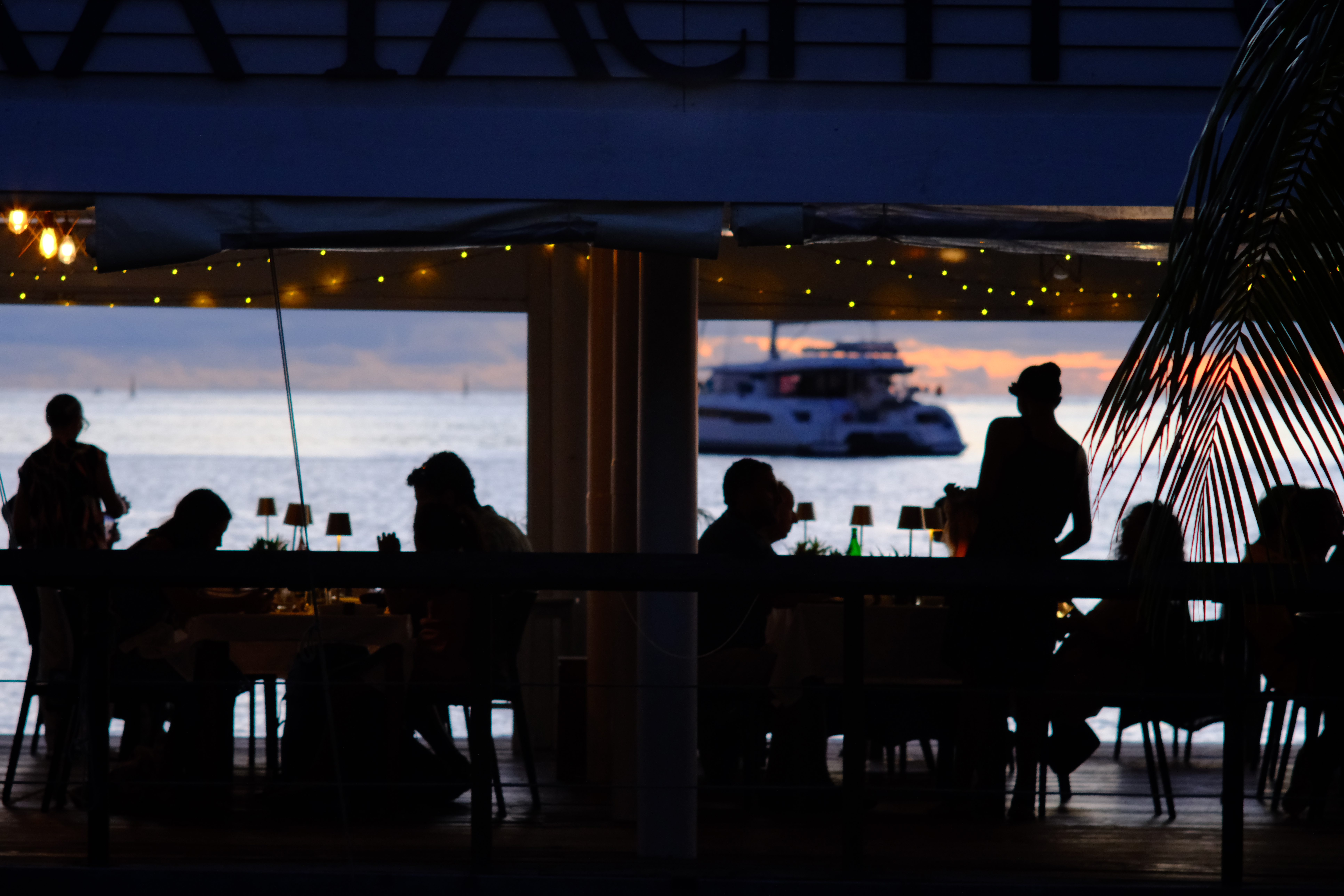
This is the off-resort sunset table. The Bora Bora Beach Club sits on the perimeter road right in the heart of Matira, central between Snack Matira and the Plage Publique. It’s a casual sit-down restaurant with cotton napkins, real glasses, a proper bar program, and tables they pull out onto the sand at sunset. Open until around 11 PM, which makes it one of the only main-island spots where you can actually do a full sunset-into-dinner without rushing.
Happy hour runs 4 to 6 PM at about 25% off. Cocktails drop from 2,000 XPF to 1,500 XPF, which lines up perfectly with the back end of the golden hour. Mains land in the 3,100 to 3,700 XPF range (about $28 to $33 USD). We rolled out at $114 USD for four people, three mains, two drinks, and water.
One catch worth knowing: the night crew doesn’t show up until around 6 PM. If you arrive before then, expect a slower service rhythm during the lunch-to-dinner changeover. Solution is simple. Show up between 4:30 and 5:00 to claim the sunset table you want, order the second a server walks past, then settle in.
Full Beach Club breakdown, menu, prices, and the one timing catch in our Bora Bora Beach Club review.


A Note on Yacht Club Happy Hour
We covered the Yacht Club back in the dinner section, but worth a quick callback here. Their happy hour also runs 4 to 6 PM and it’s actually a stronger discount than the Beach Club. Half price at 1,000 XPF rather than 25% off. The trade is location: the Yacht Club isn’t beach-feet seating like the Beach Club. If your priority is the cheapest sunset drink, the Yacht Club. If it’s the actual feet-in-sand sunset table, the Beach Club. Both work.

Quick, Cheap, or Sweet (The In-Between Bites)
Not every meal in Bora Bora needs to be a sit-down event. Some days you’re cruising the perimeter road, you swam too long, you got hot, and you just want a quick bite or something cold. Two off-resort spots cover this for us, and neither one is a full restaurant. That’s actually the point.
Hello Sunshine (Coffee, Breakfast, Grab and Go)
Hello Sunshine is a roadside stop, not a sit-down restaurant. There’s no covered indoor dining, just a small outdoor seating area tucked under banana palms and coconut palms right on the perimeter road. We drove past it a dozen times before we finally stopped.
The menu is bigger than the building suggests. Empanadas (cheese, ham and cheese, shredded chicken) run 750 to 950 XPF, which is about $7 to $9 USD. Bubble waffles range from 800 to 1,200 XPF depending on toppings, with options that load up with Nutella, fresh banana, vanilla ice cream, Oreo, M&M’s, or homemade salted butter caramel. Smoothies, frappuccinos, milkshakes, iced lattes, and a 600 XPF iced coconut round out the drink side. They also offer plant-based milk for the dairy-free travelers, which is rare on the island.
When we stopped, we ordered ham and cheese empanadas, smoothies, coconut water, and bubble waffles loaded with ice cream and sprinkles. One of the bubble waffles came with a fresh banana inside. Solid food, friendly prices, exactly the kind of place where people cycle in and out grabbing something quick.
Budget tip: they run a Combo Sunshine deal at 2,000 XPF (about $18 USD) that gets you a bubble waffle, a smoothie, and an empanada. That’s a full snack-stop meal for under twenty bucks, which is hard to beat on this island.
A couple of practical details worth knowing. The view from the road is unexpectedly great. You’ve got both Mount Mata Pupu and Mount Otemanu in your line of sight while you eat. Staff is friendly. They take credit card. There’s no restroom on site, but there’s a public toilet nearby that should cover you.
This is the spot for the morning fuel-up before a hike, the post-snorkel sugar fix on the way back to your accommodation, or a quick breakfast if your Airbnb doesn’t have one built in.


Iaorana Gelato (Homemade Italian Ice Cream)
Iaorana Gelato is the spot we kept coming back to when we wanted something cold and sweet after a hot day. We learned about them in Moorea before we ever got to Bora Bora, since Iaorana has a presence on both islands. The Bora Bora location runs a full menu of pizzas, panzerotti, burgers, and sandwiches alongside the gelato, but we only tried the gelato, so we can’t speak to the food side.
What we can speak to is the gelato itself. They’ve got the standard flavors plus a few that lean more local, including taro, mango swirl, and a couple of others we hadn’t seen elsewhere on the island. Real gelato, egg-based rather than the cream based ice cream most Americans grow up on, which is what gives it that denser, richer texture.
Price honesty: it’s not cheap. A scoop runs about $3.50 USD, so three scoops put us at around $12. Pricey for what it is, but on an island where most desserts are gated behind a resort restaurant bill, it’s still the cheaper option.
Budget tip: their gelato is also sold at the Chin Lee grocery in Vaitape. So if you’ve got a kitchen or freezer at your accommodation and you don’t need the storefront experience, you can stock up there and skip the trip. The location is still worth a stop if you’re curious about the full menu.


Eating Like a Local (The Fruit Stand Rotation)
If there’s one thing that separates a tourist from someone who’s actually lived on the island for a week, it’s the fruit stand rotation. Bora Bora doesn’t have a Whole Foods. It doesn’t have a farmer’s market in the American sense. What it has is a network of small roadside stands run by locals selling whatever is in season, and once you start using them, you don’t really stop.
We bought from the same stands repeatedly over our two months on the island. Same faces. Same hands. Same mangoes that were ripe enough to eat in the car on the way home. This is the cheapest, freshest, most authentic food experience available to you here, and it costs almost nothing.
The Fruit Stand by the Evangelistic Church of Vaitape
We covered her in the Vaitape walking section earlier, but she’s worth coming back to because she’s the one we used most. Set up in front of the Police Municipale building right across from the Evangelistic Church of Vaitape, this woman runs about four small tables stacked with whatever the week brought in. Mangoes, pineapple, bananas, sometimes papaya, sometimes fresh coconut water still in the husk.
If you’re staying anywhere near Vaitape or you make grocery runs to Chin Lee, you pass her every time. We bought from her on the way in, on the way out, and once just because we drove past her on a hot day and the mangoes looked perfect. Cash only. Prices are friendly.
The Pofai Bay Roadside Sellers
The other side of the rotation is Pofai Bay. The stands here are spread along the road near Pofai Bay rather than concentrated in one spot, so the move is to drive slow and see what’s open the day you go. Some days there are three stands, some days there’s one, some days there are five. Locals set up when they have something to sell and pack up when they don’t.
The variety can be better here than the Vaitape spot depending on the season. We had some of the best pineapple of our entire trip from one of the Pofai Bay stands.
How to Use the Fruit Stands
A few practical notes if you’ve never bought from a roadside stand before.
Cash only, every single time. Plan ahead and pull cash from one of the ATMs in Vaitape. The exchange to XPF makes everything feel cheaper than it is, but for fruit you’re spending small bills. Prices are usually posted on a handwritten sign or printed on a small piece of cardboard. If they’re not, ask, and don’t haggle. The prices are what they are.
Buy whatever’s in season, not what you want. Imported fruit is wildly expensive on the island. Local fruit, in season, is the move. If you see something at the stand you’ve never tried before, just buy it. Worst case you’re out a dollar.
Bring a small reusable bag. Some stands hand you a plastic bag, some don’t. We carried a small cotton tote in the car for exactly this reason.

Why This Section Matters
If you take one thing away from this entire post, take this. The fruit stand rotation is how locals actually eat. It’s how we ate for two months. It’s the cheapest, freshest, most real food experience on the island, and it sits in plain sight on the side of the road that thousands of resort guests drive past without ever stopping.
You don’t need to plan it. You don’t need to research it. You just need to slow down, pull over, and buy a mango from a real person.
What Does Eating Off Resort Actually Cost?
The honest answer: less than the resort, but more than you’d think. Bora Bora is not the Philippines, not Mexico, not Thailand. Real food sit-down dinners are going to cost real money no matter where you eat. The win of going off-resort isn’t that food is cheap, it’s that you get meaningfully better quality and atmosphere for what you spend.
Here’s roughly what we paid across the spots covered in this post. Prices in Bora Bora can shift without notice, so treat these as ballpark rather than gospel. Your bill may vary.
| Spot | What We Got | XPF | USD (approx) |
|---|---|---|---|
| Chin Lee grab-and-go | One prepared plate | ~900-1,100 | $8-10 |
| Fruit stand | A mango or two, bananas, papaya | ~200-500 | $2-5 |
| Hello Sunshine | Combo Sunshine (waffle + smoothie + empanada) | 2,000 | ~$18 |
| Iaorana Gelato | Three scoops | ~1,400 | ~$12 |
| Snack Matira | Family lunch with drinks | varies | $40-60 |
| Tama’a Maitai | Casual lunch | varies | $40-60 |
| Bora Bora Beach Club | Family dinner, three mains, two drinks, water | 12,850 | ~$114 |
| Bora Bora Yacht Club | Dinner with fire show | varies | check review |
| La Villa Mahana | Fine dining, two with wine pairings | varies | ~$375 |
| La Villa Mahana | Fine dining, two without pairings | varies | ~$275 |
How That Stacks Against Resort Pricing
For comparison, here’s what we actually paid for dinner at the St. Regis Lagoon by Jean-Georges (the resort restaurant this guide is fenced against):
| Item | Price |
|---|---|
| Evian water | $11 |
| Mahi mahi | $76 |
| Catch of the day | $78 |
| Kids tomato pasta | $19 |
| Truffle mashed potatoes | $23 |
| Total (no alcohol) | ~$207 |
That’s $207 for four people, no drinks, no dessert, at the resort. At the Beach Club a week later, we paid $114 for the same family, three mains, two cocktails, and a bottle of water. Same lagoon view, half the price, dinner we’d actually choose to repeat.

The Cumulative Math
If you’re staying for a week or longer, the off-resort rotation isn’t a one-meal savings, it’s a per-day shift. A family of four eating one resort dinner a night will easily clear $2,000 USD on food alone for a week, and probably more once drinks, dessert, and breakfast in the room get tacked on.
The same family rotating Chin Lee for lunch, fruit stands for snacks, casual dinners at Snack Matira or the Beach Club, and saving the resort splurges for two or three special nights can land closer to $800 to $1,000 for the week.
And that’s even with cooking at home. Groceries at Chin Lee and Super U in Vaitape are not cheap. The grocery stores do carry items at PPN pricing (the French Polynesian government’s price-controlled essentials program), which helps on basics like pasta, beans, rice, dish soap, laundry soap, toothpaste, and similar household goods.
The PPN tagging is most visible on dry goods. Fresh fish like local tuna held similar per-pound prices in Bora as in Tahiti when we shopped there, even though we didn’t always see the PPN tag on it. But fresh meat, imported produce, and most everything else still hits hard. There’s no version of Bora Bora where food is the bargain part of the trip. The off-resort rotation just keeps it from running away from you.
That’s not a small adjustment. That’s an entire excursion budget. That’s the manta ray snorkel, the lagoon tour, the fire show dinner, and a flower crown to take home.
Where to Spend Vs Save
If you only do two or three nice meals during your stay, here’s where we’d put the splurge:
- One sunset dinner at the Beach Club
- One fire show dinner at the Yacht Club
- One blowout at La Villa Mahana if it’s in the budget
And here’s where we’d save:
- Daily lunch from Chin Lee or fruit stands
- Snack stops at Hello Sunshine or Iaorana
- Casual meals at Snack Matira when you’re at the beach anyway
That rotation lets you actually eat across the island without your food budget eating your trip.
On Our Next-Trip List
Two off-resort spots came up enough in conversations with locals and in our own driving around that they deserve a mention even though we haven’t eaten at either one yet. Including them here isn’t a recommendation, it’s a placeholder. We’ll update this section the next time we’re back on Bora Bora with proper firsthand takes.
La Fermette Bora-Bora
La Fermette sits right next door to La Villa Mahana up above Pofai Bay. We parked in their lot during our Villa Mahana dinner and walked past it on the way in and out, but we haven’t eaten there ourselves. From the outside it’s an unusual concept for a tropical island.
A French Alpine-themed restaurant serving fondue, raclette, and ski-chalet comfort food in a wooden interior designed to feel like a mountain cabin rather than a beachfront spot. It opened in 2025, so it’s still relatively new on the island. The contrast alone is enough to put it on our list for the next trip.
Restaurant Saint James Bora Bora
Saint James came up on our radar as the recommended backup if you can’t get into La Villa Mahana. People on the island told us it sits in a similar fine-dining tier, just with a different vibe. French cuisine with Polynesian touches, lagoonfront, with terrace seating. It’s tucked into a small shopping complex in Vaitape alongside a pastry shop out front, which is exactly the kind of setup that makes it easy to miss from the main road.
We pulled in twice trying to check it out and gave up both times because the parking situation made it impossible to stop with the rental car and the kids in tow. So we never ate there ourselves. The restaurant runs breakfast through dinner service with a happy hour from 5:00 to 6:00 PM, which puts it on the radar for our Best Happy Hour in Bora Bora guide. It’s also on the list to actually try next time, parking permitting.
If you’ve eaten at either, drop a comment below. We’re collecting notes for the next trip and your real-time intel helps us decide where to prioritize when we’re back.
The Honest Verdict
If you take one piece of this entire post with you, take this: don’t eat every meal at your resort.
The food on Bora Bora’s main island isn’t cheaper than the resorts because food on Bora Bora is just expensive, full stop. But you get more for what you spend off the resort. You get a sunset table on the sand at the Beach Club instead of a sterile lagoon-view dining room.
You get a fire show and a real laugh at the Yacht Club. You get La Villa Mahana, a kitchen that quietly outcooks every resort restaurant we’ve eaten at the same price. You get $8 pork over rice at Chin Lee that tastes like someone’s grandma made it that morning. You get a mango from a lady in front of a church who waves at you the next time you drive past.
Those are the moments you’ll actually remember. Not the third $76 mahi mahi.
We spent two months eating off-resort and the bill at the end of it was a fraction of what most travelers spend in a single week of resort dining, and we ate better. Not always fancier. Better. That’s the whole pitch.
Pull off the road. Walk into the grocery store. Buy the mango. Sit at the Beach Club until the sun goes all the way down. Eat the gelato. You came all this way. Don’t eat like a tourist.
Frequently Asked Questions
Start with poisson cru, the national dish. Raw tuna marinated in coconut milk and lime with cucumber, tomato, and onion. You’ll find it everywhere from the Chin Lee grab-and-go counter to the fine-dining menu at La Villa Mahana. Beyond that, fresh local tuna in any form, mahi mahi, breadfruit, and tropical fruit straight from a roadside stand are the things you came here for.
Three picks depending on your vibe. The Bora Bora Beach Club for sunset on the sand with a real cocktail menu. The Bora Bora Yacht Club for dinner with a fire show. La Villa Mahana if you want a once-in-a-trip fine-dining splurge. All three are on the main island, none are resort restaurants, and we cover each in detail above.
More than you’d think. A casual sit-down dinner for four runs $100 to $150 USD off-resort. The same dinner at a luxury motu resort runs $200 to $300. A fine-dining splurge at La Villa Mahana lands around $275 to $375 for two. Grab-and-go from Chin Lee runs $8 to $10 per plate. A fruit stand mango is a couple of dollars. There is no version of Bora Bora where food is the cheap part of the trip.
The walkable options are limited. Chin Lee grocery has hot prepared meals ($8 to $10 USD per plate). The fruit stand in front of the Police Municipale building across from the Evangelistic Church of Vaitape has fresh mangoes, pineapple, and bananas. Bobcat Wine and Coffee House is good for a drink but not a real meal. Pizzeria Paradisio is walkable, though we haven’t tried it. Past those spots, you need a rental car or taxi.
Yes. The two main grocery stores are Chin Lee and Super U, both in Vaitape. Chin Lee has the better hot prepared food counter ($8 to $10 USD per plate), while Super U is a more traditional supermarket. Prices aren’t cheap, but some dry goods and household basics fall under PPN price-controls, which keeps things like rice, pasta, beans, dish soap, and toothpaste more affordable than fresh meat, imported produce, or anything off the list.
For full access, yes. Most of the best off-resort food is south of Vaitape near Matira Beach, and walking that distance in the heat isn’t realistic with kids or after a long travel day. A rental car or taxi opens up Snack Matira, the Beach Club, the Yacht Club, La Villa Mahana, Hello Sunshine, and the Pofai Bay fruit stands. If you’re only doing a day trip from a cruise ship or motu resort, taxis work but plan ahead. They’re not always immediately available at the pier.
Yes, generally. Depending on where you are on the island, the tap is either spring water or reverse osmosis. We drank it daily for two months without any issues. A few practical notes: not every restaurant pours tap on request (some will say it’s off and steer you toward bottled water), and bringing a refillable water bottle from home saves you real money across a week-long trip. Bottled water at restaurants runs $6 to $11 USD depending on where you are.






Leave a Reply



Planning
Tips
Destinations
Oceania
North America
Europe
Asia
Bali
Japan
Korea
Malaysia
singapore
Thailand
Vietnam
France
U.K.
Germany
Canada
Mexico
usa
French Polynesia
Micronesia
Hawaii
Guam
Indonesia
All Travel Blogs
Destinations
Planning
Tips
Destinations
Travel Tips
Planning
About us
Hotels
via Booking.com





Car Rental
Book a Bus/Train/Transfer
Find Cheap Flights
Get ESIM or SIM Card
Easy Currency Exchange
Book Tours & Attractions
Get Travel Insurance
via Discover Cars
via Skyscanner
via 12Go
via Wise
via Viator
via Visitors Coverage
via SimOptions
Destinations
Planning
Tips
All Categories
Travel Tips
Worldschooling
Digital Nomad
Travel Hacking
Travel with kids
Lifestyle
Military Travel
Packing
All Travel Tips
Tech
