





saltyvagabonds
Saltyvagabonds
Destinations

Asia
Bali
Japan
Korea
Malaysia
singapore
Thailand
Vietnam
Europe
Germany
France
U.K.
North America
Canada
Mexico
Oceania
Polynesia
Micronesia
Hawaii
Guam
Indonesia
All Travel Blogs
Travel Tips
Planning
About us
usa
Destinations
Travel Tips
Planning
About us
All Categories
Travel Tips
Worldschooling
Digital Nomad
Travel Hacking
Travel with kids
Lifestyle
Military Travel
Packing
All Travel Tips
Tech

Travel Hacking with
Chase Points
Military Space A Flights
Guide









Bora Bora’s Secret Manta Ray Spot: The One Roadside Pull-Off Everyone Drives Past
Most people leave Bora Bora without ever knowing the manta rays were there the whole time. We found the cleaning station on the north end of the island, floated out, and spent two hours in the water with them. Here’s exactly where to go and what to expect when you get there.

If you click on links we provide, we may receive compensation.


The Edit: A manta ray cleaning station sits just off the north end of Bora Bora, marked by nothing more than a gravel pull-off and a Google Maps pin called “station de nettoyage des Mantas.” This post covers exactly where to find it, what to expect in the water, how to read manta ray behavior when you get there, and what the experience is actually like for snorkelers and families. If you’re planning a trip to Bora Bora and manta rays are on your list, this is the guide you need before you go.

Quick Facts: Swimming With Manta Rays in Bora Bora
| Category | Details |
|---|---|
| Location | North end of Bora Bora, just past the curve south of Te Faie Aro Ocean Park |
| Google Maps Pin | Station de nettoyage des Mantas |
| Best Time to Arrive | Between 10am and noon |
| Cost | Free |
| Parking | Gravel pull-off roadside, park in front of or after the rocks |
| Reef Depth | Manta rays hang at approximately 40-50 feet |
| Best For | Snorkelers, freedivers, families with older kids |
| Honest Caveat | Close encounters require breath-hold ability or dive weights |
| What Else You Might See | Spotted eagle ray, reef fish, live coral |
| Nearest Landmark | Te Faie Aro Ocean Park |
The Spot Most People Drive Right Past
There’s a place on the north end of Bora Bora where manta rays show up regularly to get cleaned. No tour operator owns it. No resort charges you to access it. There’s no snack bar, no signage, no infrastructure of any kind.
Just a quiet country road, a gravel pull-off, a few rocks placed to keep people off a family’s property, and directly below the surface of that unremarkable stretch of water, manta rays going about their business like the ocean just knows how to do it.
Most people visiting Bora Bora never see it. They book lagoon tours, stay on the resort motus, and leave having had a beautiful trip. But if you’re the kind of traveler who wants the real thing, not the guided version, not the curated version, this spot is worth knowing about.
We found out about it through our Airbnb host Haunui, who offered to take us one morning after we’d been chatting about hot water issues at the house. He asked if we’d done the manta ray snorkel yet. We said it was on the list. He said text me the afternoon before, the night before, and the morning of, and he’d take us if he had availability. That’s how laid-back this whole thing was.

Why We Hadn’t Stopped There Before
We’d driven past this stretch of road more than once before we actually stopped. The reason we hadn’t pulled over is the same reason most people don’t. There’s no fence, no private property signs, no indication of anything. Just jungle on one side and water on the other. You genuinely don’t know if the waterfront is someone’s property or not, and you don’t want to find out by having someone walk out of their house.
Haunui cleared that up for us. His nephew owns part of that beachfront. He told us just park in front of or after the rocks, don’t move the rocks, his nephew put them there to keep people from parking on the property itself. There’s an overturned Jon Boat near the pull-off that acts as a landmark. Once you know that, the whole thing feels a lot more approachable.
How to Find the Manta Ray Cleaning Station
Search “station de nettoyage des Mantas” on Google Maps and it will drop a pin right on the spot. That’s the actual name of the location and the easiest way to navigate there. The cleaning station is located on the north end of Bora Bora, just past the curve south of Te Faie Aro Ocean Park. It’s on a quieter stretch of the perimeter road, less developed than the Matira end of the island, more homes in the jungle, no restaurants or shops around. It feels like a country road, which is exactly what it is.
When you get there, park completely off the road in the gravel and sand area near the palms. Avoid the sharp hairpin turn in that area if you can. Just easier to park before it and walk. If anyone from the property is around, wave and ask. In our experience they’re welcoming to people who approach with respect.

What Time to Arrive
Haunui told us to aim for between 10am and noon. That’s the window when manta rays are most reliably at the cleaning station. We left around 10am and were in the water not long after. We can’t speak to what happens later in the day, but the 10-to-noon window held up every time we went.
What the Reef Looks Like
Once you’re in the water, the layout is pretty straightforward. Walk or float straight out from the pull-off. The first 50 feet or so is dead coral and sand, flat and unremarkable. Then it gets rocky with some spiky vegetation along the bottom, so watch where you’re stepping or just float the whole way out like I do. After that you hit some shallow live coral, and then the shelf starts to drop.
The first drop takes you to maybe 15 feet. Then there’s a bigger drop, down to 50 or 60 feet, maybe more. That’s where the manta rays are. They cruise along the reef wall at roughly 40 to 50 feet, hanging in that deep section where the fish come in to clean them.
The Milk Jug Buoys
You’ll notice a couple of buoys out there that look like they’re made from plastic milk jugs. They are. Tour boats use them as anchor points so they can tie up near the reef without dropping an anchor into the coral or sitting in deep water. It works fine, it doesn’t damage anything, and it means the boats know exactly where to position themselves. When you see those buoys, you’re in the right area.
How to Get Out There Without Destroying the Reef
I like to float the whole way out rather than walk. There’s stuff on the bottom you don’t want to step on, sea urchins, coral, whatever’s living in the rocky section. Float flat, push along slowly with your hands, easy kick with your feet. I’ll often do this without my mask on until I get to the deeper water. It’s slower but it keeps you from doing any damage and keeps you from doing anything unpleasant to your feet.

What to Expect When You Get Out There
How to Read a Manta Ray
This is something I figured out over multiple visits and I haven’t seen it written anywhere else, so pay attention because it’ll really improve your experience.
Watch the cephalic fins.
Those are the wing-like curled structures on either side of the ray’s head, what you might call the “lip things.” They tell you exactly what the ray is doing.
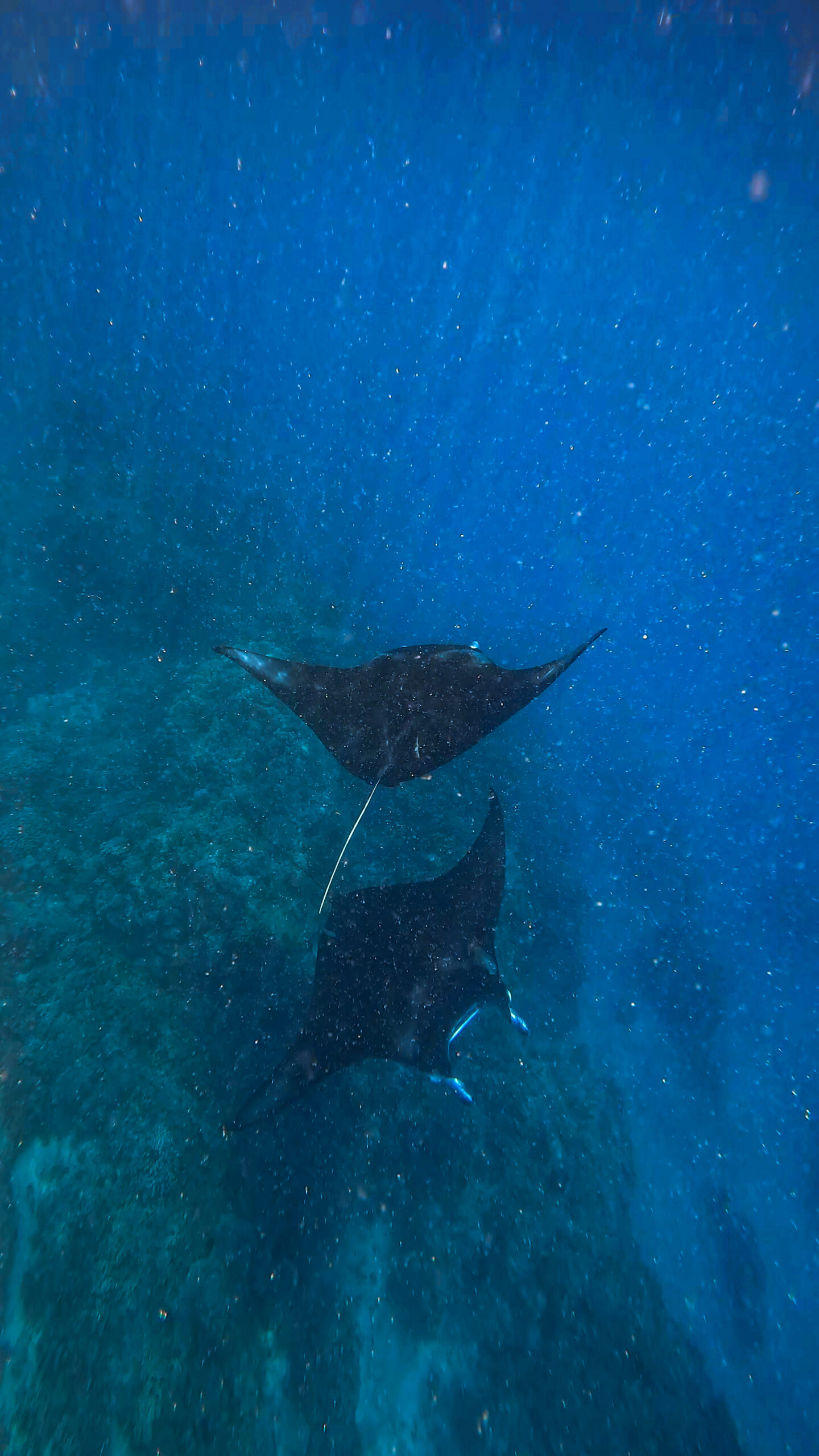
If the cephalic fins are rolled up and curled, the ray is in cleaning mode. It’ll be moving slowly, almost hovering, hanging around the reef so the fish can come in and pick parasites off its mouth, stomach, and underside. This is the encounter you want. The ray is calm, unhurried, and you have time to actually observe it.
If the cephalic fins are open and unfurled, the ray is feeding. It’s filtering plankton out of the water and it will be moving fast. You can still get photos and video, but it’s a different kind of encounter, more of a chase than a swim-with.
On our first visit we got the cleaning station behavior. Slow, deliberate, fish visibly going in and out of its mouth. On a later visit the ray came through fast with its fins open, eating plankton, and was gone quickly. Both were incredible to see, but they’re very different experiences. Knowing what you’re looking at changes everything.

The Manta Rays Do a Loop
Based on what we saw across multiple visits, the rays appear to do a loop. They come in to the reef from the deeper bay, cruise the cleaning station, then head east toward the channel and out into deeper water, then circle back. The first pass can sometimes feel like a scouting run, moving a little faster, checking things out. The second pass, if it comes, tends to be slower and more committed.
On our main visit we saw what we think was the same ray twice. The first time we chased it east along the reef for somewhere between 1,000 and 1,500 feet before it faded into the deep and I let it go. I didn’t want to get pulled into the channel. Then about 30 to 40 minutes later the charter group on the west side spotted it coming back in. That second pass was the real show.

The Honest Depth Caveat
The rays are at 40 to 50 feet. On the surface looking down, you can absolutely see them and it is genuinely incredible. But if you want the close, swim-underneath-it, right-next-to-it experience, you need to be able to get down to them. That means either some breath-hold ability or dive weights, ideally both.
I had my freedive fins with me which helped me keep pace with the ray and get down on it, but I’d left my 10-pound lead weight belt at home because of airline carry-on restrictions. I was working with snorkel gear only and still had an amazing time. Just managing expectations here. For families and non-divers, the surface view is real and worth it. Just know that the cinematic close-up footage you might have seen requires some dive skill to replicate.

Our Experience in the Water
We got there, geared up, floated out. The French couple already out there was pretty much the only other people around. Within maybe five minutes of getting into the deeper water we spotted a manta ray immediately, right in the deep section, 40 to 50 feet down, just doing its thing.
Everyone got excited. Amanda held position in the shallower water with the GoPro. I grabbed it and used my big freedive fins to keep pace with the ray. I dove on it for a close shot and that’s when I realized my mask had cracked at some point. It flooded completely on the dive. I ended up chasing a manta ray with one eye closed and a mask full of water, which is not ideal for content creation but makes for a decent story. Still got footage.
We followed it east along the reef for a long stretch before it faded toward the channel. I let it go. We regrouped, floated around, spotted a spotted eagle ray come through in the meantime. Then the charter group on the west side found the ray coming back in on its second pass, slower this time, clearly in cleaning mode, fish going in and out of its mouth. I linked up with the French couple and we all swam with it together.


The Shot That Got Away
At one point on that second pass I had a perfect straight-on shot. The ray maybe 20 to 30 feet away, turning toward me, everything lined up. And right as I was rolling on it, a couple of the charter guests swam directly into frame. Frustrating from a content perspective, not going to lie. But charter boats cost thousands of dollars to rent and those people were out there having the experience of their lives. Can’t be too mad about it.
Missing that shot honestly lit a fire under us. It’s part of what kept bringing us back to this spot, more time in the water, more chances to swim with them, more opportunities to get the footage we were after. And every time we went back we got something new out of it, even on the days the visibility was murky or the ray came through fast and feeding. You don’t regret the time you put in out there.

Two Hours in the Water
Total time in the water that day was about two hours. The ray came through twice, we had the eagle ray sighting in between, spent time just hanging on the reef watching the fish and coral after the action settled down. We snorkeled back along the reef to where the car was parked and called it. It was one of the best mornings we had in Bora Bora.
Missing that shot honestly lit a fire under us. It’s part of what kept bringing us back to this spot, more time in the water, more chances to swim with them, more opportunities to get the footage we were after. And every time we went back we got something new out of it, even on the days the visibility was murky or the ray came through fast and feeding. You don’t regret the time you put in out there.
On our last visit a pair of local dogs wandered down to the pull-off while we were in the water. Friendly as could be. One of them waded right into the shallows like it was the most normal thing in the world. We got photos of them on the beach with the car parked on the side of the road behind them, and honestly it’s one of the most Bora Bora moments we captured on the whole trip. No tourists, no tour boats in sight, just a country road, two dogs, and manta rays somewhere below the surface doing their thing.


Tips Before You Go
Bring Your Own Gear
You know your mask fits, you know it won’t leak, you know your fins. Rental gear from tours is fine but when you’re chasing a manta ray at 40 feet you want equipment you trust. We travel with our own snorkel setup every time we’re in French Polynesia. If you don’t already own a kit (or are due for an upgrade), our full snorkel gear guide breaks down exactly what we use and why.
Arrive Between 10am and Noon
That’s the window. We can’t promise the rays will be there every single day, this is wildlife, not a theme park, but that’s when they’re most reliably present at the cleaning station.
Be Aware of Boat Traffic
Tour operators do stop at this cleaning station. You’ll see snorkel boats doing slow passes through the area, spotters on board looking for rays. If they find one, they’ll put their guests in the water right there. But here’s the thing, seeing a manta ray is never guaranteed on a tour.
The boats come through, they look, and if nothing shows up they move on to the next stop. The best way to actually see one is to get in the water, explore the reef, and wait. Every time we’ve been out there it has taken anywhere from one to two hours of swimming and sitting in the water before a ray showed up. Patience is the whole game here.
Make yourself visible to any boats that come close, especially if you’ve got kids in the water, and wave if one passes near you. It’s not alarming, just part of the environment. If you want the full luxury resort experience while you’re on this end of the island, the St. Regis Bora Bora Day Pass is worth knowing about. It’s the closest five-star property to this stretch of water and an easy add-on to the same day. The Westin Bora Bora is also nearby on the same motu chain and is the closest Marriott Bonvoy points-eligible option if that matters for your booking.

Float, Don’t Walk
Skip the walking where you can. There’s stuff on the bottom you don’t want to meet.
Be Respectful of the Property
Park in front of or after the rocks. Don’t move them. If someone from the property is around, wave, introduce yourself, ask permission. In our experience they’re welcoming. Don’t abuse that.
Bring a Waterproof Camera or GoPro
Even from the surface the footage is worth having. The rays are big, they’re graceful, and they photograph beautifully even through 40 feet of clear water.

Is It Worth It?
Yes. Unequivocally.
This is a free experience on one of the most expensive islands in the world. You don’t book it through a tour operator. You don’t pay a resort day pass fee. You show up, you float out, and if the timing is right you’re in the water with an animal that looks like it’s flying through the ocean.
The spot is rustic, the vibe is quiet, and you’ll almost certainly have it mostly to yourself outside of the occasional charter group or snorkel boat passing through.
Tour operators do visit this spot, so you may have company in the water at some point. But no tour can guarantee you’ll see a manta ray, because no one can. What gives you the best odds is time in the water.
Every visit we’ve had took one to two hours of swimming, exploring the reef, and waiting before a ray came through. That’s not a knock on the experience, that’s just what swimming with wild animals actually looks like. If you’re willing to put in that time, your chances go way up.
If you’re the kind of traveler who likes finding the spots most people drive past, the free Cannon Hike is worth adding to your list too. Same energy, zero cost, and most tourists skip it entirely. For more off-the-beaten-path Bora Bora, hiking Mount Mata Pupu is another free half-day that most visitors never do.
If you’re already booking excursions in Bora Bora, this pairs well with a lagoon snorkeling tour. Check out our Keishi Lagoon Tour review for a look at the guided side of snorkeling the lagoon, and our full guide to snorkeling in Bora Bora for the complete breakdown of every lagoon tour operator and the other spots worth knowing about.
The manta rays don’t know you’re there to watch them. They’re just living their lives, getting cleaned, eating plankton, doing loops along the reef wall. The ocean knows how to do it. You just have to show up.






Leave a Reply


Planning
Tips
Destinations
Oceania
North America
Europe
Asia
Bali
Japan
Korea
Malaysia
singapore
Thailand
Vietnam
France
U.K.
Germany
Canada
Mexico
usa
French Polynesia
Micronesia
Hawaii
Guam
Indonesia
All Travel Blogs
Destinations
Planning
Tips
Destinations
Travel Tips
Planning
About us
Hotels
via Booking.com





Car Rental
Book a Bus/Train/Transfer
Find Cheap Flights
Get ESIM or SIM Card
Easy Currency Exchange
Book Tours & Attractions
Get Travel Insurance
via Discover Cars
via Skyscanner
via 12Go
via Wise
via Viator
via Visitors Coverage
via SimOptions
Destinations
Planning
Tips
All Categories
Travel Tips
Worldschooling
Digital Nomad
Travel Hacking
Travel with kids
Lifestyle
Military Travel
Packing
All Travel Tips
Tech
