





saltyvagabonds
Saltyvagabonds
Destinations

Asia
Bali
Japan
Korea
Malaysia
singapore
Thailand
Vietnam
Europe
Germany
France
U.K.
North America
Canada
Mexico
Oceania
Polynesia
Micronesia
Hawaii
Guam
Indonesia
All Travel Blogs
Travel Tips
Planning
About us
usa
Destinations
Travel Tips
Planning
About us
All Categories
Travel Tips
Worldschooling
Digital Nomad
Travel Hacking
Travel with kids
Lifestyle
Military Travel
Packing
All Travel Tips
Tech


Travel Hacking with
Chase Points
Military Space A Flights
Guide









Tahiti Iti Pearl Farm Review: Prices, What’s Included, and Whether the Pearl Is Worth It
We almost skipped the pearl farm. Every option from Bora Bora meant a boat to another island and a bill north of 600 dollars a head. Then we found a working farm on Tahiti Iti you can drive to, and spent a day on it with our kids.

If you click on links we provide, we may receive compensation.


The Edit: The Tahiti Iti Pearl Farm is a working Tahitian pearl farm on a solar powered floating platform off Teahupo’o, reachable by car from Papeete with no inter-island flight or charter boat required. This review covers the four package options ranging from 3,500 to 18,000 CFP, what the day includes, the snorkeling and oyster lines, how picking and opening your own oyster works, and the cash only booking rules. It documents a family of four’s April 2026 visit to help travelers decide whether the pearl add-on and the shared tour format are worth it.
At a Glance
| Detail | Information |
|---|---|
| Experience | Tahiti Iti Pearl Farm (La ferme perlière de Tahiti) |
| Location | Teahupo’o, Tahiti Iti, French Polynesia |
| Drive time | About 1 hour 35 minutes from the Papeete market |
| Getting there | Drive yourself, park inside the gate, short boat ride to the floating platform |
| Duration | Meet at 10:00, back on land by 14:30 |
| Forfait 1 Poe, the pearl package | 18,000 CFP, about 165 USD. Presentation, meal, pick your own oyster, keep the pearl |
| Forfait 2 Avaïti, the day package | 9,000 CFP, about 82 USD. Presentation and meal, no oyster |
| Forfait 3 Tama, the child package | 3,500 CFP, about 32 USD. Presentation and meal for kids, no oyster |
| Huître supplémentaire, extra oyster | 9,000 CFP, about 82 USD. Add to any package. Same price for adults and children |
| Included | Pearl farming presentation, lunch, snorkeling, kayak, free time on the reef |
| Not included | Snorkel gear, towels, drinks beyond lunch |
| Payment | Cash only, paid on site |
| Booking | Email tahitiitipearlfarm@gmail.com or Facebook message. Reservation required |
| Bring | Mask and snorkel, towel, water shoes, reef safe sunscreen, cash |
| Accessibility | Not wheelchair accessible. Narrow ramp and boat boarding |
| Restrooms | On land only. No toilet on the platform |
| Best for | Families, first time pearl buyers, travelers staying on Tahiti |
| Our visit | April 2026, party of four, 39,500 CFP total |

The package names are a mix of French and Tahitian. Forfait means package, poe means pearl, and tama means child. The short version: Poe is the one where you come home with a pearl, Avaïti is the same day without one, and Tama is the kids’ rate. If you book Avaïti or Tama and still want a pearl, you add an oyster for 9,000 CFP, which works out to the same total as Poe for an adult and less for a child.
We almost skipped the pearl farm entirely. The first time we looked into it, we were living on Bora Bora, and every option pointed us off the island. The one that kept coming up was a full day trip over to Taha’a, seven or eight hours with a vanilla plantation, a rum tasting, lunch on a motu, and a stop at a pearl farm. It looks lovely.
It also runs about 685 dollars per adult, which for the three adults in our family came to more than 2,000 dollars before we counted our eleven year old. There is a place on Bora Bora that sells pearls, but as far as we could tell they bring them in rather than grow them. So we let the idea go. Then we got to Tahiti and found out there is a working pearl farm on the peninsula that you can drive to.
That is the part almost nobody mentions. When people talk about visiting a pearl farm in French Polynesia, they usually mean Rangiroa or Taha’a, and both of those mean another flight or another boat. The Tahiti Iti Pearl Farm sits out on the reef near Teahupo’o, the same stretch of coast the Olympic surfers rode in 2024. It is one more reason to give the main island a proper look, and we have a full list of things to do in Tahiti if you are building an itinerary.
You park at a gate on the shore, take a short boat ride out, and spend the day on a floating platform anchored right above the oyster lines. Our whole day for four people, including a pearl to take home, came to 39,500 CFP. That is roughly 360 dollars.
We had been to Tahiti before and never once heard about this place. This past April we finally went, paid in cash on the dock like everyone else on the boat, and came home with one small black pearl and a much better understanding of how they are made. So here is what it costs, what the day actually includes, and whether adding a pearl is worth it.

How to Book the Tahiti Iti Pearl Farm
A this time, there is no booking button. No calendar, no availability grid, no instant confirmation. You email them, or you message them on Facebook, and then you wait.
That threw us at first. We are used to seeing what is open before we commit to a date. Here you send a request, and someone writes back when they write back. Ours came back quickly, but plan for the possibility that it does not.
What to put in your first message
Keep it simple and give them everything they need in one go. How many adults, how many children, roughly which dates you are hoping for, and most importantly, how many oysters you want.
That last part matters more than anything else in this section. The oysters do not sit under the platform waiting for guests. The crew goes out ahead of time and brings the ones for your group up from the deeper line, so the count has to be set before you arrive. If you decide on the boat that you want a pearl after all, there may not be one for you.
We booked three adult day packages, one child package, and one extra oyster for our daughter, because her birthday was the reason we went at all. You can reach them at tahitiitipearlfarm@gmail.com, or through their Facebook page, La ferme perlière de Tahiti. They will ask for a phone number or WhatsApp so they can reach you the morning of.

Cash only, and no refunds
Two rules worth reading twice.
You pay in cash, on site, the day of. No cards. Work out what you owe before you leave your hotel and bring it with you, because there is no machine on a floating platform in the middle of a reef.
Where you meet
The meeting point is in Teahupo’o, out at the end of the road on Tahiti Iti. From the Papeete market it is about an hour and thirty five minutes of driving, so this is a full day out rather than a quick side trip. The timing works in your favor, though. A 10:00 meeting means leaving Papeete around 08:00, which puts you heading away from town while the rush hour traffic is all pouring in the other direction.
Search Tahiti ITI PEARL FARM in Google Maps and it will take you to the right spot on the shore, which is useful, because the entrance is easy to drive straight past. There is a wall and a gate, and the sign sits slightly past the driveway rather than right at it.
You park inside the gate. Someone will be there to point you in. Our appointment was 10:00, and we were back on land by 14:30.
Arriving at the Tahiti Iti Pearl Farm
The gate you will probably drive past
The road out to Teahupo’o narrows and quiets down the further you go. The farm does not announce itself the way a tour operator might. You are looking for a wall and a gate painted bright green, and the sign sits a little past the driveway rather than right at it, which is exactly why people sail past the turn.
The first look is underwhelming, and we want to be upfront about that. It is cinder block and concrete, not polished, not resort styled. If you are expecting a visitor center, you will wonder for a second whether you are in the right place. What you are actually looking at is a working operation, and that turns out to be the whole appeal.
Park inside the gate. Someone will wave you in.


Use the restroom before you get on the boat
There is a small office and waiting area on land, with restrooms and showers. Use them.
We are saying this early because there is no toilet on the platform. None. Once you are out on the water, your options are the ocean or waiting it out, and neither is a great way to spend an afternoon. The building on shore is your last stop, so treat it that way.
Worth noting for anyone who appreciates a small absurd detail: the men’s room has a big window looking straight out at the bay. You will not find a better view from a toilet in French Polynesia.
Checking in and meeting your group
Check in is casual. You pay your cash, they confirm how many people and how many oysters, and that is about it.
This is also where you find out you are not alone. We had assumed a quiet rainy season morning would mean a near empty boat, and we were wrong. We were grouped with several other families, most of them French speaking. Nobody hid this from us, we simply never asked, and it is the one thing we would have handled differently.
So ask. If you want a quieter version of this day, that conversation happens before you book, not on the dock.

The walk out and getting aboard
The pier out to the boat is narrow and there is no handrail. It is fine if you are steady on your feet, and it is a real obstacle if you are not.
On accessibility, our honest read is this. A wheelchair user is not getting onto that boat without someone physically lifting them, because it is a low, shallow draft panga and the pier does not accommodate much. The platform itself is a different story, since there is a bench outside and seating inside and enough room to be comfortable once you are there. So the barrier is the boarding, not the destination. If your group can safely manage the transfer, the day works. If not, this one is not for you.
Secure anything you cannot afford to lose before you step onto that pier. We learned this the hard way when our oldest lost her glasses over the side on the way out. The water there is only six to eight feet deep, but clear frames on a coral shelf are close to invisible. Alex went in, one of the crew went in, and two other guests stripped down and jumped in to help. The whole tour stopped for us. It was the crew member who later served our lunch who finally surfaced with them.
Everyone was gracious about it. We still would rather you clip your sunglasses to your shirt.

The ride out
The crossing is short, just a few minutes across the shallows.
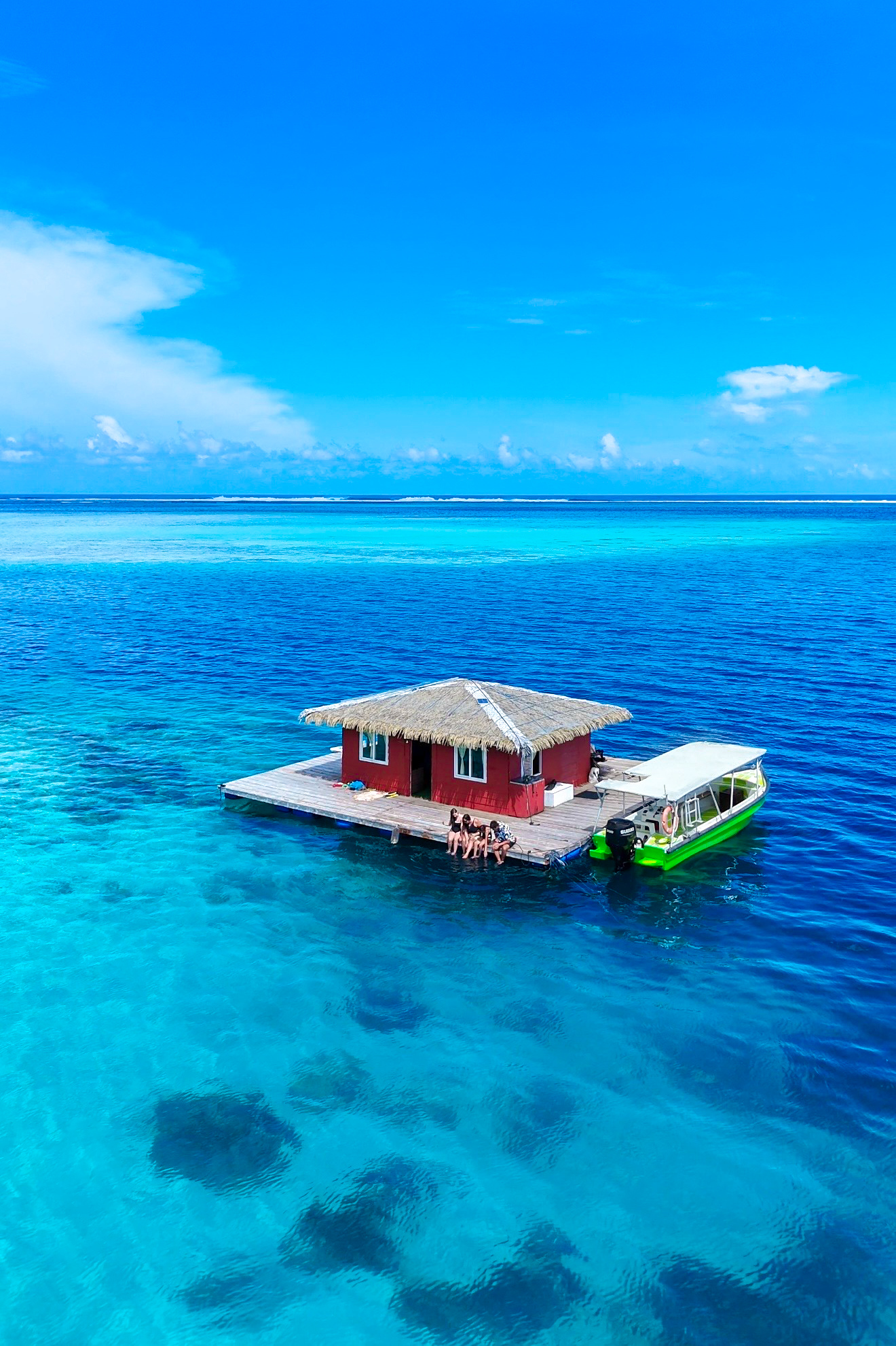
Then the platform comes into view, and the first impression from the gate gets completely rewritten. It is a floating deck with a small red building under a thatched roof, solar panels on top, a kayak and paddleboards tied alongside, sitting on water that goes from pale sand to deep blue at the reef edge. It looks like something someone built because they loved it, which is more or less what happened.
What You Learn Out on the Platform
Everyone comes off the boat, and then they split the group. French speakers inside, English speakers out on the bench in the open air. Evans took our group, and his English was strong.
That split turned out to be the best part of the day. Once we were sitting outside with only our family and one other couple, it stopped feeling like a tour. It felt like someone showing us around his work.
The conch horn
Before any of it starts, they bring out the conch shell and get people trying to blow it. Most of us are bad at it. There was some joking about having to swim back if you could not get a note out.
It is a small thing. It also sets the tone for the whole day, which is warm and unhurried and a little bit funny.


How a pearl actually gets started
The presentation runs somewhere between thirty minutes and an hour, and it is more educational than we expected. This is not a sales pitch with a gift shop at the end.
Evans works through the biology first. What an oyster is, how it feeds, how it builds shell. He has props, including shells from oysters more than ten years old, so you can hold the thing rather than look at a diagram. Then he walks through the life stages, from babies so small you would never spot one, to a young shell, to the heavy adults that go on the lines.
Long before any of this, Tahiti had pearls with nothing in the middle. No bead, no core, solid all the way through, and shaped however they came out. Nobody planted them. They just turned up now and then in oysters people were harvesting for the shell.
The round pearl is the newer idea. That came from Japan in the early 1900s, when they worked out you could put a small bead inside an oyster on purpose and get a predictable shape. That technique is the reason a Tahitian pearl industry exists at all.
Here is how it works. Someone opens the oyster and puts a tiny round bead inside. Along with the bead goes a small piece of tissue from another oyster. That tissue wraps around the bead and forms a little pocket. Then the oyster starts coating it, layer after layer, with the same shiny stuff that lines its shell. That coating is called nacre. Years of it is your pearl.


Why the round pearl you picture is the exception
You still get pearls with no core today. Sometimes the oyster pushes the bead back out but keeps the tissue. It still makes a pearl. There is just nothing in the middle, so it is solid all the way through and it grows into whatever shape it feels like.
Those are called keshi. Solid nacre, no middle, and prized for the way they catch the light. They are also getting harder to find, since farms now scan their oysters and re-implant the ones that spit the bead.
Once you know this, the pearls in shop windows read differently. A perfectly round pearl is not nature showing off. It is a bead doing its job under several years of nacre.
Ten years, and then they are done
Pearl oysters do not work forever. After several cycles, roughly the ten year mark, the quality falls off. Luster fades, color goes flat, and the farm stops using them.
Evans was matter of fact about it, and we appreciated that. It is a working farm, and the animals are livestock. Knowing that changed how we thought about the pearl our daughter picked, which we will get to.
We are leaving some of what he taught us out on purpose. Part of what makes the day good is hearing it from him, on the water, holding the shells. Go get that yourself.

Getting in the Water
Once the talk wraps up, the day opens up. There is a ladder off the side of the platform and you just go.
The oyster lines
This is what you came to see, and it is stranger and better than photos suggest.
One long line runs out from the platform, held in place with rope and big concrete blocks dropped on the bottom. Buoys mark where it goes. Hanging off it are rows of small black mesh pouches, and inside each one sits an oyster, quietly doing its work.
The platform is anchored right at the edge of the reef. On one side you have shallow sand and coral, ankle deep in spots at low tide. On the other, the bottom falls away to sixty or seventy feet and goes deep blue. You can float there and watch the whole thing drop off underneath you.
Evans told us manta rays move through here because of that deep water, which tracks with what we saw at the secret manta ray spot in Bora Bora where the rays loop the reef wall. We did not see one that day. You might.
The oysters get covered in growth over time, so the crew has to pressure wash them to keep them healthy. That work happens on days when they are not running tours. It is a good reminder that this is a farm first, and the visits fit around it.

Get your camera in first
Here is the tip we wish someone had given us.
While Evans is still talking, get in with your camera and shoot the lines. Nobody is in the water yet, nothing is stirred up, and you will get the clean shot of the rows that everybody wants.
Once the talk ends, everyone goes in at once.
Picking your oyster, and the timing tradeoff
If you paid for an oyster, the crew brings up the ones for your group and puts them in a basket by the ladder. You get in, look them over, choose yours, and carry it up.
There is a real choice to make here and it comes down to what you want from the moment.
Go in early and you get the widest pick. They only put out a few extras beyond what was booked, and people who see the excitement sometimes buy a second one on the spot, so the basket thins out fast.
Hang back and you get calm. That is what we did. We let everybody else go, and then our daughter picked hers from what was left with nobody crowding her. Fewer options, but she got to take her time, and that was worth more to us than choice.
Either one works. Just know which you are choosing before you are standing on the ladder.

One more thing worth asking for
The opening is the moment of the day. Someone takes a knife to your oyster and you find out what is inside.
If that matters to you as a family, ask Evans quietly not to announce yours. Everybody gathers around when an oyster gets opened, which is lovely when it is somebody else’s and less lovely when you are trying to watch your kid’s face. There is plenty of time at that stage, so it is not a big ask.
We did not think to do it. Next time we would.


Everything else out there
Nobody rushes you off the platform, and there is more to do than the oysters.
There is a kayak, and people take turns with it. You can feed the fish off the side and they come right up to you. Under the platform there were purple reef fish neither of us had seen anywhere else in French Polynesia.
The best surprise was the conch. There is a shallow patch a two minute swim away where you can stand up while the water washes past, and it is full of shells. They are spider conch, the same ones we kept finding at Rohotu Beach and other Tahiti snorkeling spots on the main island. You can pick them up and look at them properly. If you have never seen one alive, go do that.
Current was never an issue for us. It was calm the whole time.


Opening the Oyster
You carry your oyster up the ladder and hand it over, and then it happens right there on the platform.
There is no ceremony to it. Someone works the shell open, finds the pearl, and lifts it out. A few seconds, and years of work by an animal are sitting in someone’s palm.
Everyone crowds in. That is the part to plan for if it matters to you, and it is why we said to ask ahead about your own.


What you get is what you get
You do not choose your pearl. You choose an oyster, and the pearl inside is whatever it is.
That is the whole appeal, and it is also the honest catch. Ours came out pretty, a small dark pearl with decent shape. It was not flawless. Looking at it later, we think it was probably near the end of that oyster’s productive run, when the luster starts going.
Some come out beautifully. Some come out with a dent or a ridge, which happens when the bead sits too close to the wrong part of the oyster. You will see the same range at the market in Papeete, where the pearls that did not make the cut for the jewelry shops get sold.
So calibrate. If you want a mystery and a story, this is a great way to get one. If you want a specific pearl in a specific color and shape, buy it in a shop.
Evans drills and sets it right there
This part we did not expect at all.
He drills your pearl on the platform, in front of you, and mounts it. There are chains and settings on hand, including gold and silver. You pick, he fits it, and you leave wearing it.
Nobody ships it to you. Nobody takes it away to a workshop. It comes out of the water, out of the shell, onto a chain, and around your neck, all inside a couple of hours.
If you would rather keep it loose, they put it in a small velvet bag and you take it home that way.


Is the pearl worth 9,000 CFP
Depends who you are.
If this is your first Tahitian pearl, we would say yes. You watched it come out of the water. You know which oyster it came from. It cost about the same as a modest pearl in a shop, and it comes with a day attached to it.
If you already own pearls, or you are shopping for a piece you plan to wear for years, we would skip the add-on and just do the day. Buy the good one from a jeweler, where you can compare fifty of them under a light and pick exactly the one you want.
And if you are travelling with kids, know that the oyster costs the same for a child as for an adult. The day rate drops for children. The pearl does not. Three kids each wanting one is 27,000 CFP on top of your packages.
We booked one, for our daughter, because the trip was her celebration. That felt right. Four would not have.
Lunch on the Platform
Lunch is included in every package, and it is catered. It comes out to the platform and the crew sets it out for everyone.
It was really good. Grilled fish, chicken, salad, and poisson cru, which is the raw fish in coconut milk you will eat constantly in French Polynesia and never get tired of. Better than it needed to be for a spot with no road to it.
They also brought out samples of local beer for the adults, which was a nice touch nobody was expecting.


Bring your own everything else
Lunch is the only thing they feed you.
If you want a cocktail on a floating platform in the middle of a reef, and that is a reasonable thing to want, bring it yourself. Same with extra drinks, snacks for picky eaters, and anything with a dietary requirement attached.
You also bring your own towel and your own snorkel gear. More on the gear below, because it matters.
The music
They ran a speaker all day. Reggae and island stuff, kept low enough to talk over. It sounds like a small thing to mention but It is not. It is a lot of the reason the day felt relaxed instead of scheduled.

What to Bring to the Tahiti Iti Pearl Farm
Short list, and the first one is not optional.
Snorkel gear, which they do not provide
They do not provide it. This is stated plainly when you book and it is easy to skim past. If you show up without a mask, you are watching the best part of the day from the deck.
If you are coming from the United States, buy it at home. Gear runs 35 to 45 percent higher in French Polynesia. Alex paid 9,620 CFP for a Cressi mask here that costs about 60 dollars back home, and that was after his old one cracked mid-trip. Our full breakdown of the snorkel gear worth buying covers what we actually use and what we have replaced.
How much you need depends on what you plan to do. If you are staying near the platform and the oyster lines, a mask alone is plenty. Fins and a snorkel only earn their space if you are swimming out to explore the reef.
The rest of the list
- A towel. Not provided.
- Water shoes. Optional, and worth it if you plan to stand in the shallow patch where the conch are.
- Cash. Enough for the full amount, counted before you leave. No cards out there.
- Reef safe sunscreen. No shade to speak of once you are in the water.
- A waterproof camera. The oyster lines are worth shooting, and your phone in a pouch will do.
- Your own drinks. If you want anything beyond lunch.
And use the restroom on land before you get on the boat. There is no toilet on the platform.
Who the Tahiti Iti Pearl Farm Is For
This is a good day for a lot of people and the wrong day for a few.
Book it if you are one of these
Families. Evans is good with kids and the pacing suits them. Ours swam, kayaked, collected conch shells, and came home wearing a pearl she picked herself. There is a child rate, and the day is not so long that anyone melts down.
Anyone buying their first Tahitian pearl. You will understand what you are buying for the rest of your life. Even if you go on to buy a better one in a shop, this is the one you will tell people about.
Travelers staying on Tahiti. Most people treat Tahiti as the airport they pass through on the way to Bora Bora or Moorea. This is a real reason to give the main island a day.
Cruise passengers with time. You can do this without an inter-island anything. Just account for the drive.
People who like seeing how things are made. That is the actual product here. The pearl is a souvenir. The education is the thing.
Think twice if this is you
Anyone who cannot manage the boarding. The pier is narrow with no handrail and the boat is low. The platform itself is fine once you are on it, so the barrier is getting aboard, not being there.
Anyone who needs a bathroom on hand. There is none out there, and you are gone for hours.
Anyone shopping for a specific pearl. Go to a jeweler. You will get exactly what you want and you can compare.
Anyone expecting a private experience. Unless you have arranged something, you are sharing the platform.

Is the Tahiti Iti Pearl Farm Worth It?
Yes, with one condition. You have to want the education more than the pearl.
Buy the pearl somewhere else if the pearl is the point
If what you want is a beautiful Tahitian pearl, there are better ways to get one. Walk into a jeweler in Papeete or Moorea, look at fifty of them under good light, and pick the exact color, shape, and grade you want. That is how one of us bought a flawless champagne pearl that still gets worn constantly. The oyster you pull off a line is a lottery ticket by comparison.
But that is not really what this day is selling.
What you are paying for is a few hours on a working farm with someone who knows it well, learning how a pearl actually comes to exist. After this, you cannot look at a pearl in a shop window the same way. You know there is a bead in the middle of the round ones and you know someone put it there. You know it took years and that the oyster only has so many good ones in it.
The pearl our daughter carried home is not perfect. She watched it come out of an oyster she chose herself, in water she had been swimming in twenty minutes earlier, and she wore it home on a chain. She is going to have that pearl a lot longer than she has the memory of picking it, and she will have both.
The math, and the crew
Then there is the math. Four of us, a full day, lunch, snorkeling, kayaking, and a pearl for 39,500 CFP. The nearest equivalent from Bora Bora is about 685 dollars for a single adult, and that trip does not end with a pearl in your hand.
And there is the crew. We have done enough tours to know the difference between people running a schedule and people who like their job. Evans is the second kind. Nobody rushed us, nobody upsold us, and when our daughter’s glasses went into the water, half the boat went in after them. So yes. If you are on Tahiti with a day to spend, go.
Tahiti Iti Pearl Farm FAQ
A day at the Tahiti Iti Pearl Farm costs 3,500 to 18,000 CFP per person depending on the package, plus 9,000 CFP if you add an extra oyster. Forfait 3 Tama is 3,500 for children, Forfait 2 Avaïti is 9,000 for adults, and Forfait 1 Poe is 18,000 and includes an oyster. Our family of four paid 39,500 CFP total, which included one pearl.
Yes, you keep the pearl from any oyster you paid for. You pick the oyster, they open it in front of you, and Evans can drill and mount it on a chain right there on the platform. If you would rather keep it loose, they put it in a velvet bag.
Yes, especially if you are staying on Tahiti and want to see how Tahitian pearls are actually made. The full day for four people including lunch, snorkeling, and one pearl came to 39,500 CFP, compared to roughly 685 dollars per adult for the equivalent trip out of Bora Bora. The education and the crew are what make it, more than the pearl.
Book by email at tahitiitipearlfarm@gmail.com or by message on their Facebook page. There is no online booking calendar. Tell them how many adults, how many children, your preferred dates, and how many oysters you want, since the oysters have to be brought up ahead of your visit.
No, the Tahiti Iti Pearl Farm takes cash only, paid on site the day of your visit. Bring the full amount with you.
The Tahiti Iti Pearl Farm is in Teahupo’o, on the Tahiti Iti peninsula, about an hour and thirty five minutes from the Papeete market. Search Tahiti ITI PEARL FARM in Google Maps. Park inside the gate.
The tour runs about four and a half hours on the water, from a 10:00 meeting time to a 14:30 return. Add roughly three hours of driving round trip from Papeete, so plan on a full day.
Bring a snorkel mask, a towel, cash, reef safe sunscreen, water shoes, and a waterproof camera. Lunch is the only thing provided, so pack your own drinks and any snacks for picky eaters.
No, you bring your own snorkel gear to the Tahiti Iti Pearl Farm. A mask is the minimum. Fins and a snorkel are only worth packing if you plan to swim out to the reef.
Yes. Swimming, kayaking, fish feeding, conch shell hunting, and picking your own oyster all work well for children, and there is a child rate. Note that the oyster add-on costs the same for a child as for an adult.
No, the Tahiti Iti Pearl Farm is not wheelchair accessible. The pier is narrow with no handrail and the boat is low and shallow drafted, so boarding would require someone physically lifting the passenger. The platform itself has bench seating inside and out and enough room to be comfortable once you are aboard.
No, there is no bathroom on the platform. There are restrooms and showers on land at the meeting point, so use them before you board.
No, the Tahiti Iti Pearl Farm runs as a shared group tour. We shared the platform with several other families, and the group was split into English and French speaking groups for the presentation. Ask when you book if you want something different.
A keshi pearl is a pearl with no bead in the middle, made entirely of nacre. It happens when a farmed oyster pushes the bead out but keeps producing anyway. They come out in irregular shapes and are prized for their shine.
The extra oyster is worth adding if it is your first Tahitian pearl or you want the story attached to it. Skip it if you are shopping for a specific color, shape, and grade, since a jeweler lets you compare and choose exactly what you want.






Leave a Reply



Planning
Tips
Destinations
Oceania
North America
Europe
Asia
Bali
Japan
Korea
Malaysia
singapore
Thailand
Vietnam
France
U.K.
Germany
Canada
Mexico
usa
French Polynesia
Micronesia
Hawaii
Guam
Indonesia
All Travel Blogs
Destinations
Planning
Tips
Destinations
Travel Tips
Planning
About us
Hotels
via Booking.com





Car Rental
Book a Bus/Train/Transfer
Find Cheap Flights
Get ESIM or SIM Card
Easy Currency Exchange
Book Tours & Attractions
Get Travel Insurance
via Discover Cars
via Skyscanner
via 12Go
via Wise
via Viator
via Visitors Coverage
via SimOptions
Destinations
Planning
Tips
All Categories
Travel Tips
Worldschooling
Digital Nomad
Travel Hacking
Travel with kids
Lifestyle
Military Travel
Packing
All Travel Tips
Tech
