
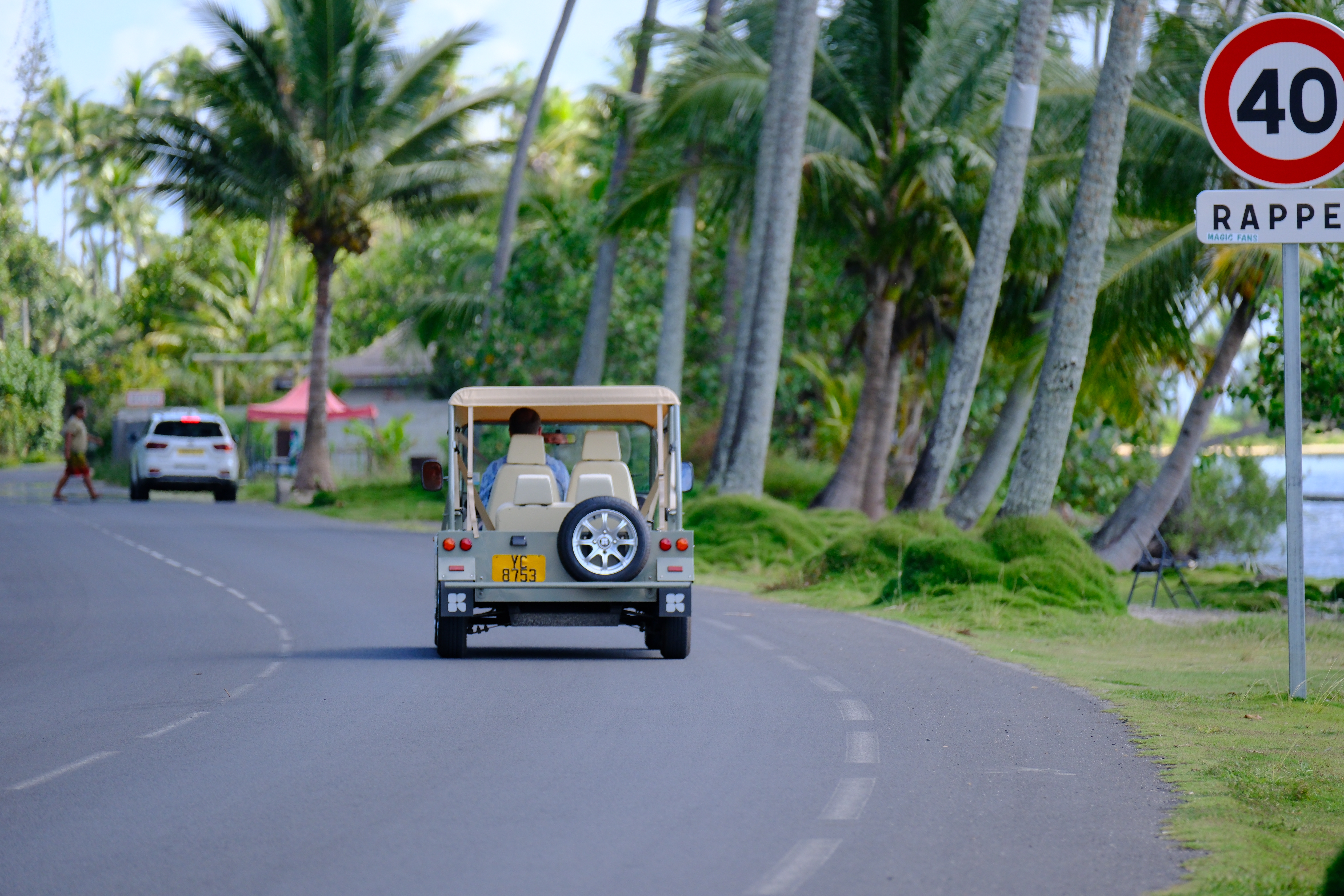
Bora Bora Transportation: Why Where You Stay Decides How You Get Around


The Edit: Bora Bora transportation works differently depending on whether you are staying on the main island or a motu resort. This guide covers rental cars, scooters, bikes, taxis, resort boat shuttles, walking distances measured by GPS, and the current status of le truck, with real prices in XPF and USD. It is written from a two month stay and answers the question most trip planners get wrong, which is whether you need a vehicle at all.
Bora Bora Transportation at a Glance
| Category | Details |
|---|---|
| Island size | One main loop road, roughly 20 miles around |
| Staying on the main island | Rental car, scooter, bike, taxi, or walking |
| Staying on a motu resort | Resort boat shuttle, on the resort’s schedule |
| Airport access | Motu Mute, boat only, you cannot drive there |
| Public transit | None you can plan around |
| Taxis | No roaming taxis, no rideshare, pre-arrange your driver |
| Typical taxi fare | About $40 USD round trip pre-arranged, closer to $80 if you take two separate cabs |
| Bike rental | 2,100 XPF per day standard, 4,200 XPF e-bike |
| Scooter rental | 6,800 XPF per day, roughly half a car |
| Terrain | Perimeter road is flat, climbs start when you turn off it |
| Best for | Anyone deciding whether to rent before they book |

Most people plan Bora Bora in the wrong order. They pick the resort first, fall in love with the photos, and then start wondering how they will get around once they land. By then the answer has already been decided for them.
Here is what nobody tells you. Bora Bora transportation is not one system. It is two, and which one you get depends entirely on where you sleep.
If you book an overwater bungalow on a motu, you are staying on an island off an island. No road connects you to town. Your transportation is a resort boat that runs on a fixed schedule, and a rental car would sit in a mainland parking lot doing nothing all week.
Stay on the main island instead and the opposite is true. One paved road loops the whole thing, roughly 20 miles around, and it links every beach, village, trailhead, and resort dock worth visiting. A car opens all of it. Without one, you are calling ahead and waiting.
We spent two months on the main island. We rented from Avis for 60 days, walked, rode resort bikes, and caught resort shuttles from three different docks. I also walked nearly two miles into Vaitape on our first morning after a taxi never showed up at the ferry pier.
So this guide covers all of it. Real prices in XPF and USD, real shuttle schedules, honest distances measured by GPS, and the parts other guides get wrong. That includes what actually happened to Le Truck.
Start With Where You Are Staying
Before you compare rental prices or look up taxi numbers, answer one question. Are you sleeping on the main island or on a motu?
Everything else follows from that. Bora Bora is a main volcanic island ringed by a barrier reef, and sitting on that reef is a chain of small flat islets called motus. Most of the famous overwater bungalow resorts sit on those motus. No bridge or road connects them to the main island, which means the two experiences have almost nothing in common once you step off the plane.
If You Are Staying on a Motu Resort
Your transportation is the resort boat, and that is close to the whole story.
Motu resorts run their own shuttles between the property and a mainland dock, on a published schedule you cannot change. Miss the last boat and you are not getting back. Most properties also restrict shuttle use to in-house guests and block it on arrival and departure days, which catches people off guard.
A rental car is nearly useless here. You would pick it up in Vaitape, drive it to your resort’s mainland dock, and leave it parked while you take a boat to your room. Some travelers do rent for a single day to explore the main island, and that can make sense. But renting for the length of a motu stay means paying for a car to sit at a dock.
One detail that surprises almost everyone: you cannot drive to the airport. It sits on Motu Mute, a separate islet across open lagoon water, and the only way in or out is by boat. Every arriving passenger takes a free ferry to Vaitape or a resort shuttle. There is no road, no bridge, and no walking it.


If You Are Staying on the Main Island
Now the island opens up.
One paved road loops the main island, roughly 20 miles around, and it connects everything. Vaitape for groceries and the ferry pier, Matira for the best public beach, hike trailheads, restaurants, resort docks, and the roadside pull-offs most visitors drive straight past. A car, a scooter, or even a bike puts all of it within reach on your own schedule.
We stayed on the main island for two months and kept a rental the entire time. Being able to leave for a trailhead at seven in the morning, stop at the store on the way back, and drive to dinner without coordinating with anyone is the difference between seeing Bora Bora and living in it for a while.
The Split Stay
Plenty of people do both, a few nights on the main island and a few in a bungalow. If that is you, rent for the main island portion and return the car before you head out to the motu. You get the freedom when it is useful and stop paying for it when it is not.
Getting Between the Motus and the Main Island
If your resort is on a motu, the boat shuttle is your only way in or out. Here is how that system actually works.
Every motu resort runs its own boats between the property and a mainland dock. The boats leave on a published timetable, they are usually limited to in-house guests, and most properties will not let you use them on your arrival or departure day. Learn your resort’s schedule on day one, because it quietly sets the shape of every plan you make.
Every Resort Uses a Different Dock
This is the part that catches people out. There is no single ferry terminal serving the motu resorts. Each property runs from its own mainland base, and they are scattered around the island.
| Resort | Mainland dock |
|---|---|
| St. Regis | Anau base |
| Westin | Anau base |
| InterContinental Thalasso | InterContinental Le Moana |
| Le Bora Bora by Pearl | Chancelade dock |
So if you are driving yourself to a dock, confirm which one before you go. We watched this go wrong on our own arrival, when a taxi dispatcher could not tell the cargo pier from the passenger pier and the driver waited at the wrong one. If you are heading out for a day visit rather than an overnight stay, our Bora Bora day pass guide covers which resort each shuttle serves and what a visit costs.


Two Different Ways Resorts Charge You
Some properties bundle transfers into a nightly fee. Others bill you per ride. The difference adds up fast.
The Westin folds round-trip airport boat transfers into its daily destination fee of 11,550 XPF, roughly $104 USD a night. There is no separate charge for the boat, and we broke that down in full in our Westin Bora Bora boat transfer guide. The St. Regis charges per trip instead, at 8,400 XPF each way from the airport, so a round trip runs about $165 USD for two people before you have moved anywhere else. Our guide on how to get to St. Regis Bora Bora has the full schedule and pricing.
Mainland dock crossings cost far less than airport runs at every property. At the St. Regis, the Anau crossing is 1,750 XPF one way, around $35 USD round trip, compared to $165 for the airport boat. If you are already on the island, use the mainland dock.
What This Means for Your Rental Car
You can usually drive to any of these docks and leave your car there, but do not assume a spot is waiting. These lots are primarily staff parking, and resort employees fill most of the spaces. We parked overnight at the Le Moana dock, the Westin mainland dock, and the St. Regis base in Anau, and it worked every time. At the St. Regis the attendant moved his own vehicle to make room for us.
Every dock has an attendant or a security gate. Tell them you are catching the shuttle for a day pass or an overnight stay and they will sort you out. Arrive with a little buffer rather than rolling up five minutes before the boat, because if the lot is tight you may need someone to shuffle cars.
That is the workaround for a split stay. Drive the main island, park at your resort’s dock, take the boat out, and pick the car back up when you return.

Taxis in Bora Bora
Taxis exist here, but not the way you are used to. There is no rideshare app, and you will not flag one down on the side of the road on a random afternoon.
There is one exception. Drivers do gather at the Vaitape pier when a cruise ship or a ferry is arriving, and they line up in a row waiting for passengers. If your timing lines up with an arrival and you are already in Vaitape, you can walk up and get a ride. The catch is that you have to be at that specific spot at that specific time. Miss the window, or arrive anywhere else on the island, and you are back to calling.
So for anything you actually need to plan, arranging by phone in advance with a specific driver is the way to do it. You cannot finish dinner and summon a car.
There is one exception worth knowing. Some restaurants run their own transport. Both La Villa Mahana and the Bora Bora Yacht Club will drive you back to your accommodation after dinner. If you are booking either one and do not have a car, ask about the shuttle when you reserve rather than sorting a ride out afterward.
What a Taxi Actually Costs
Fares run higher than most people expect on an island this small. The run we made was between the Vaitape area and the St. Regis mainland base at Anau, roughly a third of the way around the loop.
Pre-arranged with the same driver handling both directions, that ride cost $40 USD round trip. Booked as two separate one way cabs, the same trip runs closer to $80.
So the money-saving move is not haggling. It is arranging the return at the same time you book the pickup. One driver, one agreed rate, both legs.
Here is the more telling number though. Across two months on this island, we took exactly one taxi ride. We had a rental car the entire time, and it covered everything else. That is the clearest argument for renting that we can give you. Two resort day passes at different docks and you have already spent more on taxis than several days of a car.
The Driver We Used
We used Danny, a reliable English-speaking driver based in Vaitape, and he is the one we recommend. He drove Addison to her St. Regis day pass, collecting her at 9:30 for the 11:00 boat and waiting at the dock for the 6:00 return. He was on time both directions and the $40 round trip rate held exactly as quoted.
His number is +689 87 71 79 11, and he told us directly that we could share it with readers.
Say Exactly Which Dock You Mean
This one cost us an hour on our first morning.
We came in on the overnight ferry to Bora Bora from Tahiti and called for a taxi from the pier. The problem is that the Vaeara’i does not dock at the main passenger pier in Vaitape. It arrives at a cargo pier about two miles north of town. The dispatcher did not distinguish between the two, so our driver went to the passenger pier and waited there while we waited somewhere else entirely.
After fifteen minutes we gave up. I walked the 1.9 miles into Vaitape, rented a car, and drove back for the family and the luggage.
That morning is a good illustration of the taxi rule. Ferries do bring drivers to the pier, but the Vaeara’i does not arrive at the pier where they wait. Two miles up the coast at the cargo terminal there was nobody, and the dispatcher we called sent our driver to the wrong one.
Name your exact pier, dock, or resort base when you book, and confirm the driver repeats it back to you. Bora Bora has multiple piers, four separate resort docks, and a cargo terminal, and none of them are interchangeable.

Renting a Car
For most people staying on the main island, this is the answer. One car covers groceries, trailheads, restaurants, resort docks, and every roadside stop in between, and it does it on your schedule instead of someone else’s.
Avis is the main operator, with offices in Vaitape near the ferry pier and near Matira Beach on the south end. Both share a fleet and the same staff rotate between them.


What It Costs
A day rate on the entry-level class runs 11,900 XPF, roughly $107 USD. But the published long-stay tiers drop that sharply. At seven to ten days the daily rate falls to 7,000 XPF, and past three weeks it drops to 4,500. If you are staying a week or more, the daily cost is nothing like the headline number.
One quiet money saver: the entry-level class is manual transmission only. Automatics sit a tier up and cost more every single day. If you can drive a stick, you keep the low rate. If you cannot, budget for the upgrade.
Two Things to Know Before You Book
You cannot drive to the airport. It is on Motu Mute and reachable only by boat, so a rental covers the main island and nothing else.
And book ahead if a cruise ship is in port. The island fleet is small, and ship days empty it fast.
We rented for 60 days across three contracts and drove the same small car for about fifty of them. The full breakdown of pricing tiers, insurance, the credit card coverage cap, fuel, parking, and what the roads are actually like lives in our Bora Bora rental car review.

Bora Bora Scooter Rental
A scooter is the most affordable motorized way to get around Bora Bora, and for the right traveler it is the smarter choice over a car.
We rented a car rather than a scooter for our two months here, so what follows is the pricing, the road conditions we drove every single day, and an honest read on who the scooter actually suits.
What a Scooter Rental Costs
Avis rents a Peugeot Tweet 50cc automatic, seats two, from both the Vaitape and Matira offices.
| Duration | Scooter | Entry-level car |
|---|---|---|
| 4 hours | 5,500 XPF | 9,500 XPF |
| 8 hours | 6,200 XPF | 10,800 XPF |
| 24 hours | 6,800 XPF | 11,900 XPF |
That is roughly $61 USD a day against $107 for the entry-level car, and the gap holds at every tier. Optional zero-deductible insurance runs 1,500 XPF a day on the scooter class if your credit card does not already cover you.
Fuel is barely a line item. A 50cc burns almost nothing, and fuel prices here are government-regulated at around 181 XPF a liter, so there is no point shopping stations.
What the Roads Are Like on Two Wheels
This is the part that actually decides it.
One paved road loops the island, roughly 20 miles around, two lanes the whole way. The speed limit caps at 60 km/h and drops to 30 or 40 through Matira, near schools, and in town. A 50cc keeps up with traffic without effort, so you lose nothing in travel time.
The road is genuinely flat for almost its entire length. Our GPS logged zero elevation gain across a two mile stretch of it. The one real climb sits on the east side, south of the St. Regis mainland dock near the waste facility, and a 50cc will feel it with two people aboard.
There are no sidewalks anywhere except a small section in Viatape. You share the lane with pedestrians, cyclists, kids, and dogs, and there is debris after storms. Traffic is slow and drivers are calm, so this is manageable, but it means staying alert rather than sightseeing while you ride.
Two Things That Will Catch You Out
Rain here arrives fast and hits hard, and there is nowhere to hide on a scooter. During the wet season you should expect to get soaked at some point. Pack a dry bag for a phone and camera.
Outside Vaitape there are no streetlights. Night riding means your headlight and nothing else, on a road shared with people walking in the dark. We drove it plenty and it is fine at low speed, but it is darker than most visitors expect.
Who Should Rent a Scooter
Solo travelers and couples staying five to seven days, traveling light, mostly moving between accommodation, the beach, restaurants, and a trailhead or two. For that trip the scooter does everything a car does for half the money, and parking stops being a problem entirely, which matters on cruise ship days when Vaitape and Matira beach fill up.
A friend of ours who sails through French Polynesia on a chartered catamaran rents a scooter every time he is here, and will not bother with a car. His reasoning is simple. The island is small, he is usually travelling with one other person, and a scooter does everything they need. That is the profile this works for, two people travelling light on an island you can circle in under an hour.
Skip it if you are traveling with kids, hauling groceries for a family, carrying real luggage between accommodations, or visiting in peak wet season. A car is worth the difference.
Bora Bora Bike Rental
A bike is the most affordable way to get around Bora Bora, and on an island this flat it works better than you would expect for short trips.
Avis rents standard bikes at 2,100 XPF a day, about $19 USD, and e-bikes at 4,200. Half day rates run 1,900 and 4,000. Some accommodations include bikes, so ask before you pay for one.
The Loop Is Flatter Than It Looks
Our GPS logged zero elevation gain across nearly two miles of the main road. It hugs the lagoon close to sea level for most of its length, so hills are not what you are fighting.
There is one real climb on the east side, south of the St. Regis mainland dock near the waste facility. A standard bike handles this island fine, and if you cannot pedal that stretch you get off and walk it up like anyone else would. There is a paid cannon site up there with someone collecting a fee at the bottom. Worth knowing that a second set of WWII guns sits on the west side above Faanui, and Bora Bora’s free cannon hike gets you to those for nothing.
The e-bike is still worth the extra 2,100 XPF for a different reason. Assist is nice to have when you want it. In this heat and humidity, showing up to dinner or a beach without being soaked in sweat is worth something, and that has nothing to do with the hill.
Why I Would Not Plan on Circling the Island
I have been riding road bikes since 2007 and have logged more than 21,000 miles, so I want to be clear that the distance is not the issue. The full loop is roughly 20 miles, which is an easy morning for anyone who rides regularly.
The conditions are the issue. You are on a single-speed rental bike, not your own bike with many gears to choose from. There is no shade for long stretches, the humidity is heavy, and the heat index climbs fast through the middle of the day. Rain arrives without warning and hard. There is no shoulder anywhere, so you share a lane with cars, scooters, pedestrians, and dogs.
For a few miles to a beach, a store, or dinner, a bike is ideal and I would take one over a car for that. For circling the island in an afternoon, most visitors will finish the day wishing they had rented a scooter.
What to Watch For
No sidewalks anywhere, so you share the lane with cars, scooters, pedestrians, and dogs. Traffic moves slowly and drivers are used to sharing the road, so this is manageable rather than frightening. Outside Vaitape there are no streetlights, so plan to be off the road before dark.

Walking Around Bora Bora
Walking works here, but only for the right distances. We logged two very different walks on GPS, and the gap between them tells you everything.
The first was the arrival walk. After the taxi never showed at the cargo pier, I covered 1.9 miles into Vaitape in about 35 minutes with zero elevation gain. That is a roughly 18 minute mile, walking with purpose, carrying nothing but a phone.
The second was a walk with my wife six weeks later, and it is the more useful one for planning. We covered 2.42 miles in an hour and eleven minutes of moving time, with an hour and forty-one minutes elapsed. That is a 29 minute mile with half an hour of stopping. In that distance we passed a tsunami evacuation route, a star fruit tree, an art gallery, and two grocery stores.
That second walk is what walking on Bora Bora is actually for. Errands, dinner, a beach, a shop, all within a couple of miles of where you are staying.
Now do the math on the full loop. At the purposeful pace, 20 miles is about six hours of walking. At the casual pace it is closer to ten. Nobody is walking the island in a day, and the 47 feet of gain on that second walk came from turning uphill onto the evacuation route, not from the loop road itself. Every climb on Bora Bora comes from turning off the main road.
Getting Around Once You Are at Your Resort
The motu resorts are bigger than the photos suggest, and how you cross them matters more than people expect.
Bikes Are the Standard
At the St. Regis, every villa is assigned its own bikes, tagged with a plaque showing your villa number. That is not a novelty amenity. The property is large enough that walking from a beach villa to dinner and back gets old fast, and the bikes are how guests actually move around. They stock child sizes too, including options with training wheels, which meant our ten year old rode with us instead of being walked everywhere.
If anyone in your group has mobility limits, ask about a golf cart. The St. Regis has one, but it needs 15 to 30 minutes notice, so call before you need it rather than when you are already late.

Ask Where Your Room Sits
Property layout is worth asking about before you book. The Westin has two sides, and the far side sits about four tenths of a mile from the main central area. That is a pleasant stroll once and a genuine commute three times a day.
At the InterContinental Thalasso, the concrete walkways get hot enough in the afternoon that our kids nearly blistered their feet. Bring water shoes or sandals you can walk in, not just flip flops you kick off at the pool.
The Cart Noise Nobody Mentions
Overwater bungalows sit on elevated walkways, and you feel everything that moves on them. Staff carts start running early, and they shake the bungalow when they pass. This is true across every overwater property we stayed at, not one specific resort. If you are still deciding on a room category, we cover this and the rest of the tradeoffs in our guide on whether overwater bungalows are worth it. If you are a light sleeper, request a bungalow further from the main walkway junction.
Does Le Truck Still Run in Bora Bora?
Almost every Bora Bora guide mentions le truck. Most describe it as the island’s public bus, an open-sided truck with wooden benches you can flag down anywhere along the road for a few hundred francs.
We spent two months living on the main island, driving that loop nearly every day. Our family never saw one operating as public transit.
We did see the trucks. They are still here. Every one we saw was carrying cruise ship passengers on island tours.
Why So Many Guides Get This Wrong
The vehicles are still visible, so writers see them and assume they still serve the function they used to. Nobody checks what they are actually doing.
There is a second source of confusion. Tahiti genuinely does have public transport, a modern bus network running regular routes around the island. Le truck was the older version of that system there. Bora Bora never had anything comparable. Even at its peak here, service ran around school and ferry hours and mainly served residents, not visitors.
So a fair amount of what you will read about le truck on Bora Bora is really describing Tahiti with the wrong island’s name attached.
What This Means for Your Trip
There is no public transportation on Bora Bora you can plan a day around. No bus schedule, no route map, no stop near your accommodation.
If you are staying on the main island, you need a car, a scooter, a bike, or a pre-arranged taxi. If you are on a motu, you need your resort’s boat. Those are the options, and le truck is not a fallback.
The one caveat is honest. We cannot prove nothing runs anywhere on the island, and we are telling you what two months of driving that road did and did not turn up. What we can say is that we never once saw a le truck a traveler could use, and no visitor should build a trip around finding one.
What It Actually Costs to Get Around
Here is the money math, because this is where the decision usually gets made.
If You Are Staying on the Main Island
Rent a car. For almost everyone, this is the answer.
Seven days on the entry-level class runs 7,000 XPF a day, about $63 USD, or roughly $440 for the week. That covers every grocery run, every trailhead, every restaurant, and every resort dock, on your schedule.
Compare that to taxis. One pre-arranged round trip cost us $40. Do that once a day for a week and you are at $280 without ever going where you want, when you want. Two resort day passes at different docks and the gap closes entirely.
Staying three weeks or more changes the math further. The daily rate drops to 4,500 XPF, around $40 a day, which is the price of a single taxi ride.
Traveling as a couple with light luggage? A scooter at 6,800 XPF a day runs about half a car and does nearly everything. A bike at 2,100 covers short trips for the price of a coffee.
If You Are Staying on a Motu Resort
Your transport cost is mostly set by your resort, not by you.
Budget for the boat first. Airport transfers at the St. Regis run about $165 USD round trip for two. The Westin folds them into a destination fee of 11,550 XPF a night, roughly $104. Neither is optional, and both are easy to overlook when you are comparing nightly rates.
Skip the rental car unless you are specifically taking a day to explore the main island. If you are, rent for one day and return it, rather than paying for a week of parking at a dock.
If you do come across to the main island, use your resort’s mainland dock crossing rather than the airport boat. At the St. Regis that is about $35 round trip against $165. Same lagoon, very different bill.
The Split Stay Math
Rent a car for your main island nights and return it before you head out to the motu. You get the freedom while it is useful and stop paying the moment it is not.
Everything above is from what we paid or what was published while we were there in early 2026. Rates move, so treat these as a planning baseline and confirm current pricing when you book.


Curated by us, for you. We may earn a commission on pieces you shop through our links


The Vanity Case
Shop the edit
Just Landed
Shop the edit
Finishing Touches
Shop the edit
Leave a Reply


style
Farm Rio Souvenir Scarves Dress Review: Midsize Sizing, Fit & Vacation Styling testing
style
Vacation Look No. 3 | Farm Rio Golden Nature Maxi Dress Outfit


Have a brand story to tell? We'd love to hear what you have in mind.
And everywhere in between
Bora Bora to Baja


Be the first to comment